UN 38.3 is a set of UN safety tests. Each type of lithium cell or battery must pass these tests before anyone can ship it under the standard dangerous goods rules.
IEC 62619 is the international safety standard for lithium cells and batteries in industrial use, including stationary storage.
If you are buying cells or modules for a battery energy storage system (BESS), ask for the UN 38.3 test summary and the IEC 62619 test report for the exact model in the lot. Then check that the batteries in front of you still match what was tested.
For new stock, that is a quick check. For surplus, repacked and second-life batteries it takes more care, and that is what most of this guide is about.
TL;DR
- UN 38.3 is about transport. Lithium cells and batteries go through eight tests, T.1 to T.8, before they can be shipped under the standard dangerous goods rules.
- The UN 38.3 test summary is the document to ask for. Manufacturers and the distributors who sell on have to make it available. Under the international sea and air rules, this has applied since January 1, 2020.
- IEC 62619 is about safe operation. It covers lithium cells and batteries in industrial and stationary use. The 2022 edition is written for first-life products and leaves reuse and repurposing out of its scope.
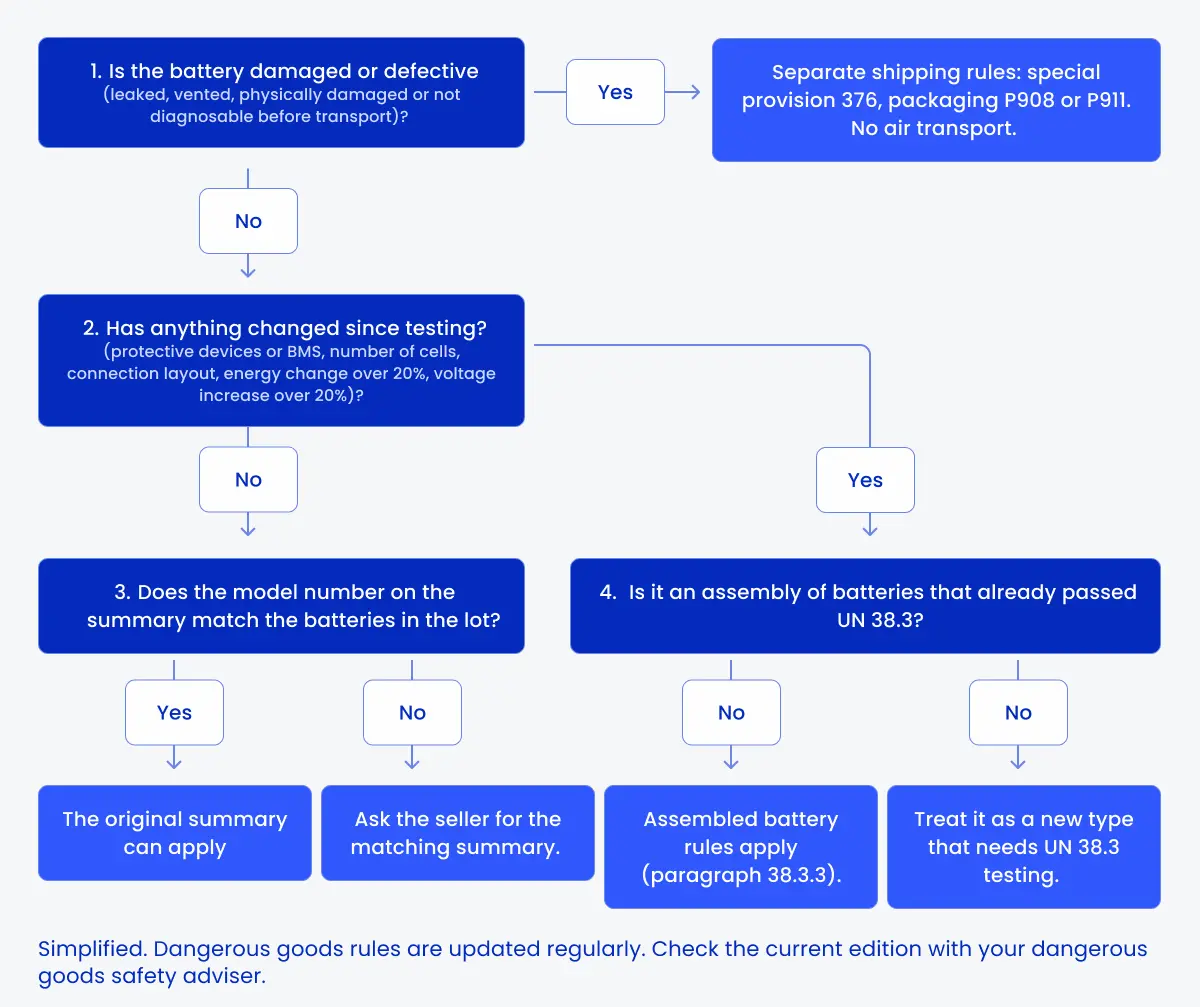
- A changed battery can count as a new type. New protective devices, a different number of cells or a new connection layout can mean the original UN 38.3 result no longer covers it.
- Damaged batteries ship under separate rules. On road and sea they need special packaging. By air they are not allowed at all.
- What to ask for: the UN 38.3 test summary and the IEC 62619 test report for the exact model and level (cell, module or pack) in the lot, before you negotiate price.
A surplus module lot with a cell-level certificate
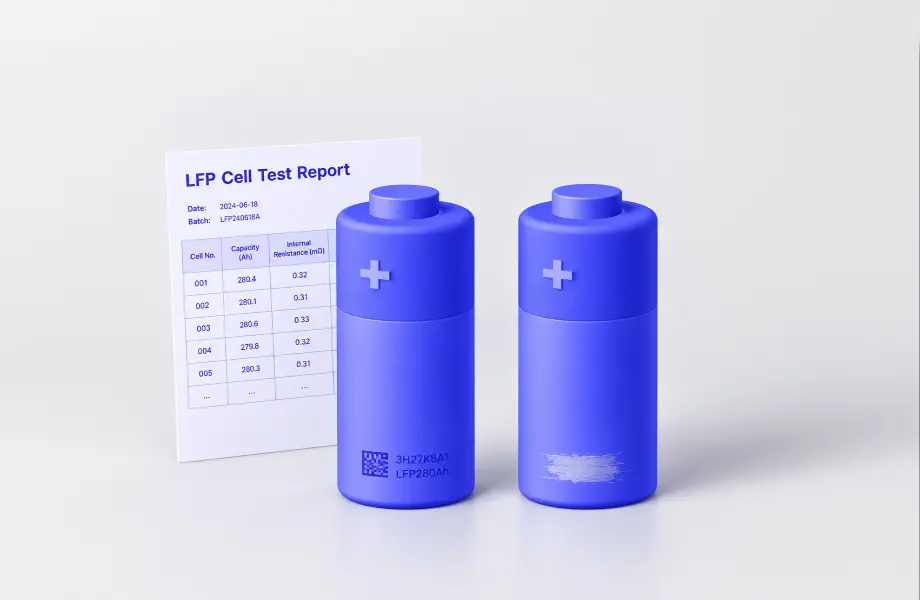
An integrator is sizing a 2 MWh storage project and finds a lot of lithium iron phosphate (LFP, LiFePO4) modules in a distributor's surplus stock. The datasheet fits. The seller sends a UN 38.3 test summary, but it covers the cell, not the module. The modules were assembled by a different company than the cell maker, and nobody in the conversation can say yet whether they were ever tested as a battery.
So the integrator has two open questions. Can this lot be shipped as it is? And is there any evidence that the modules are safe once they are installed and running?
UN 38.3 answers the first one. IEC 62619 helps with the second.
What is UN 38.3?
UN 38.3 (also written UN38.3) is the set of transport tests that every lithium cell and battery type must pass before it can be shipped as dangerous goods under the standard rules. It is Sub-section 38.3 of the United Nations Manual of Tests and Criteria, Part III. The road, rail, sea and air rules all refer back to it. For road transport in Europe, that is the European Agreement concerning the International Carriage of Dangerous Goods by Road (ADR), section 2.2.9.1.7.
Passing UN 38.3 is a condition for shipping lithium-ion batteries under UN 3480 (batteries on their own) or UN 3481 (batteries packed with or contained in equipment), the UN numbers you will see on shipping papers and labels.
The eight tests are:
- T.1 Altitude simulation
- T.2 Thermal test
- T.3 Vibration
- T.4 Shock
- T.5 External short circuit
- T.6 Impact or crush
- T.7 Overcharge
- T.8 Forced discharge
Cells go through T.1 to T.6 and T.8. Rechargeable batteries go through T.1 to T.5 and T.7. Under paragraph 38.3.2.1, a battery made of cells that already passed is still tested as a battery.
The tests apply to a type, not to each unit. For a buyer, the practical question is whether the batteries in the lot belong to the type that was tested.
Is there a UN 38.3 certificate?
Not as an official document. The UN Manual defines a test summary, not a certificate. When sellers talk about a "UN 38.3 certificate", they usually mean the test summary or the full test report from the lab. Ask for the test summary by name, because that is the document the rules require.
What should a UN 38.3 test summary include?
Since January 1, 2020, manufacturers and subsequent distributors of lithium cells and batteries have had to make a test summary available under the International Maritime Dangerous Goods (IMDG) Code and the International Civil Aviation Organization (ICAO) Technical Instructions. ADR includes the same requirement for road transport. The content is set by paragraph 38.3.5 of the Manual.
A complete UN 38.3 test summary includes:
- the name and contact details of the cell, battery or product manufacturer
- the name and contact details of the test lab
- a unique test report number and the date of the report
- a description of the cell or battery: lithium ion or lithium metal, mass, watt-hour (Wh) rating, physical description and model number
- the tests carried out and whether each was passed
- a reference to the assembled battery rules, where they apply
- the revision of the Manual used for testing
- the name and title of the person responsible for the information
When you get one, check it against the lot rather than just filing it:
- Does the model number match the labels on the cells or modules?
- Do mass and Wh rating match the datasheet?
- Was the test done at the level you are buying, meaning cell, module or pack?
If any of this does not line up, ask the seller for the full test report or contact the lab named on the summary.
What is IEC 62619, and how is it different from UN 38.3?
IEC 62619 is the safety standard for secondary lithium cells and batteries in industrial applications, published by the International Electrotechnical Commission (IEC). It sets requirements and tests for safe operation.
These include abuse tests such as external short circuit, impact, drop, thermal abuse, overcharge and forced discharge, a check against internal short circuit or thermal propagation, and requirements for the battery management system.
The scope names stationary uses such as telecom, uninterruptible power supplies (UPS) and electrical energy storage systems. It also covers motive uses such as forklifts, automated guided vehicles, railway and marine vehicles. Road vehicles are excluded.
Two points in the scope of the 2022 edition matter when you trade. It is written for first-life cells and batteries, so reuse, repurposing and second-life use fall outside it.
And it does not replace UN 38.3. UN 38.3 checks that a battery type survives transport. IEC 62619 checks that it can be operated safely once installed.
In the European Union (EU), Article 12 of the EU Batteries Regulation (EU) 2023/1542 requires a stationary BESS to be safe under normal operation and intended use. Its technical documentation must show successful testing against the safety parameters in Annex V, using state-of-the-art test methods. Article 12 does not name IEC 62619 or any other standard. When a battery is prepared for reuse, repurposing, or remanufacturing, that documentation has to be revised.

What about IEC 62133, UL 1973 and UL 9540A?
These come up in the same conversations, but they answer different questions.
- IEC 62133 covers portable sealed batteries, such as those in phones and tools. It is not the standard for stationary storage cells and modules.
- UL 1973 is a North American safety standard for batteries in stationary and motive applications, often requested for projects in the US and Canada.
- UL 9540A is a US test method for how thermal runaway and fire spread in a BESS. US fire codes and insurers often ask for it.
For a European BESS, UN 38.3 and IEC 62619 are the two documents to start with. Ask for the UL documents when the system is headed for North America.
Do surplus, second-life or dismantled modules keep their UN 38.3 certification?
Only if nothing that matters has changed since testing. It depends on what happened to the batteries after the test.
What counts as a new battery type under UN 38.3?
Under paragraph 38.3.2.2 of the Manual, a rechargeable battery counts as a different type, with its own tests, if its nominal energy changes by more than 20%, its nominal voltage rises by more than 20%, or anything changes that could make it fail one of the tests.
A note to that paragraph gives examples: different electrode, separator or electrolyte materials, changed protective devices (hardware and software), a different number of cells, or a different way of connecting them.
Four situations buyers run into
Four situations come up repeatedly when you trade these lots.
Surplus stock in its original form. New cells or modules sold on unchanged. The original test summary can apply if the model number matches and the batteries are undamaged. The distributor selling them also has to make the summary available.
Repacked or reconfigured batteries. Modules taken out of a pack and rebuilt or fitted with a new battery management system (BMS). Changes to protective devices, cell count and connection layout are all listed as examples of a new type, so expect new tests at the level you are buying.
Until the new tests are done, these batteries can only be shipped in two cases: they are prototypes being sent for testing, or they are part of a small production run of 100 units or fewer. They then ship under special provision 310 in the required packaging (P910, or LP905 for large batteries). Shipping by air also needs approval from the authority.
Assemblies of tested batteries. Paragraph 38.3.3 has lighter rules for systems built from batteries that already passed. Up to 6,200 Wh for lithium ion, one assembled battery is tested under T.3, T.4, T.5 and, if rechargeable, T.7. Above that, the tests can be replaced by verifying that the assembly prevents overcharge, short circuits and over-discharge between the batteries.
Damaged or defective batteries. Batteries that have leaked or vented, show physical damage or cannot be diagnosed before transport no longer conform to the tested type.
On road, rail and sea they ship under special provision 376, in packaging to packing instruction P908. If they could react dangerously or catch fire, P911 applies. The International Air Transport Association (IATA) rules do not allow them on aircraft.
Second-life and dismantled electric vehicle (EV) batteries can land in any of these groups. That is why the useful question for these lots is whether the certificate still describes what is in the box.
Which BESS certification documents should buyers request before making an offer?
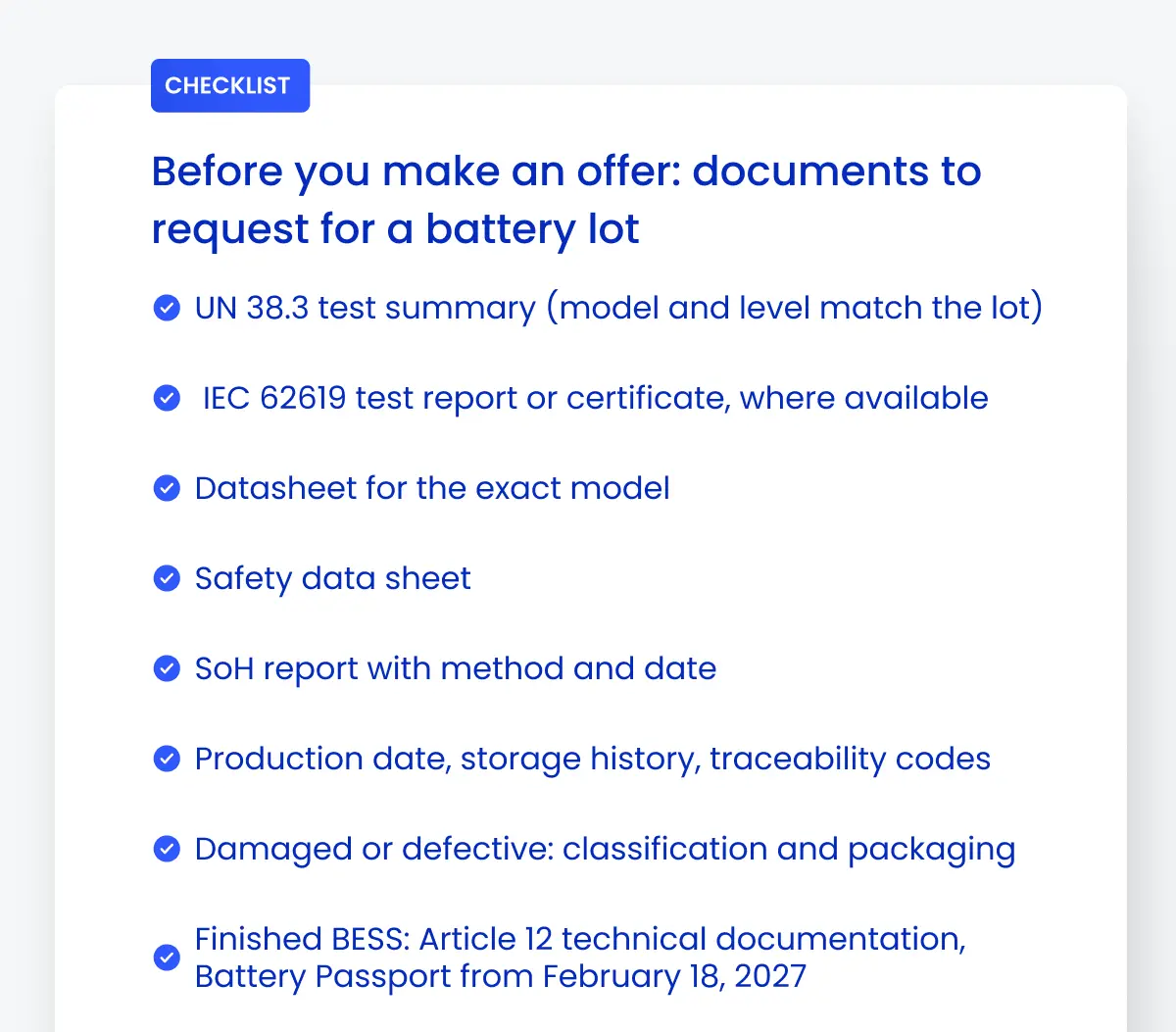
Ask for these before you negotiate price, not after. Each one is tied to the exact model and, where relevant, the exact lot.
- UN 38.3 test summary for the model and the level you are buying (cell, module or pack)
- IEC 62619 test report or certificate, where one exists, keeping in mind its first-life scope
- datasheet for the exact model
- safety data sheet (SDS)
- State of Health (SoH) report with the test method and date. Our guide to battery SoH explains what to look for
- per-lot data such as production date, storage history and traceability codes, as covered in the Grade A vs Grade B LiFePO4 checklist
- for damaged or defective batteries, the seller's classification and the packaging they plan to use
If you are buying a finished stationary system rather than cells or modules, add Article 12 technical documentation. From February 18, 2027, a Battery Passport is also required for industrial batteries over 2 kWh. The Battery Passport for BESS article explains who is responsible for it.
What happens if the documents are missing or do not match?
Shipping is affected first. Batteries that have not met UN 38.3 cannot travel under the standard rules, so the lot either needs testing or has to ship under a different classification with different packaging. Testing takes time and costs money, and buyer and seller need to agree who covers it before the deal is signed.
Missing IEC 62619 evidence is more of a project question. Whoever places a stationary system on the EU market has to document its safety under Article 12. Without test evidence for the cells and modules inside, that documentation is harder to put together. We looked at how gaps like this stall deals in Why Battery Deals Fail.
How do you check documents on the Circunomics marketplace?
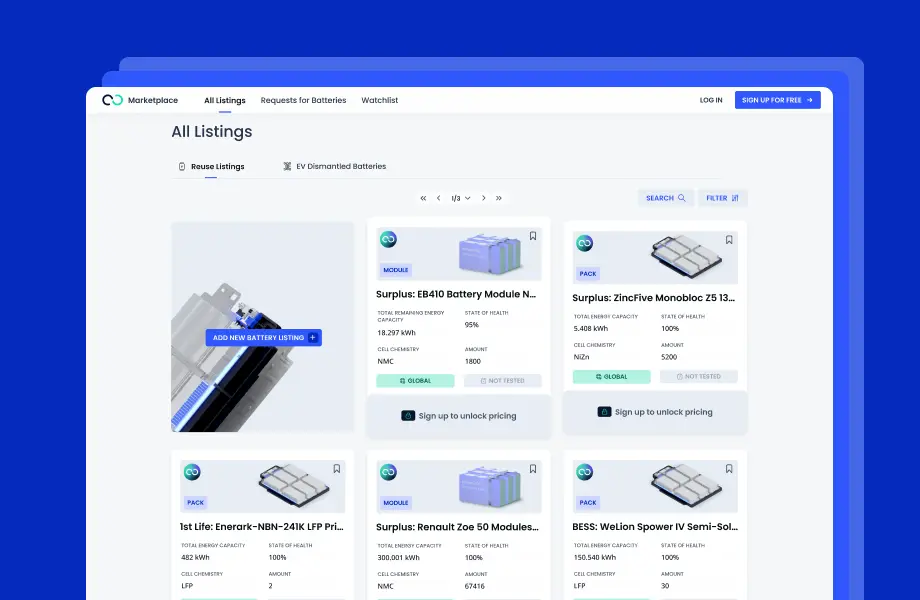
On the Circunomics B2B Battery Marketplace, public listings show technical specifications, SoH, inspection results and photos. You can filter by chemistry, capacity and location, and you do not need an account to browse. Pricing, seller identity and documents are visible to registered users.
That lets you shortlist first-life and second-life lots on condition and fit, then sign up and check whether the test summary and reports match the batteries before you make an offer. More on what changed in the marketplace launch post.
What to do now
For BESS integrators and developers. Ask for the UN 38.3 summary and IEC 62619 report in your first request to a seller. Check the model number and test level against the lot, not just against the datasheet.
For procurement teams. Add the checklist above to your request for quotation. Agree in writing who pays for new tests if the lot turns out to be a new type.
For sellers with surplus or second-life stock. Collect the test summaries for each model before you list. If you rebuilt or reconfigured modules, find out whether that makes them a new type. Our guide on making a surplus lot buyer-ready covers the other data buyers ask for.
For logistics teams. Confirm the classification before booking transport. Damaged or defective batteries need different packaging and cannot go by air.
FAQ: UN 38.3 and IEC 62619
What is UN 38.3 certification?
UN 38.3 certification usually means proof that a lithium cell or battery type passed the eight UN 38.3 transport tests. The official proof is the UN 38.3 test summary defined in paragraph 38.3.5 of the UN Manual of Tests and Criteria, backed by a full test report from the lab. There is no separate UN certificate.
Is UN 38.3 testing mandatory?
Yes, to ship lithium batteries under the standard dangerous goods rules (UN 3480 and UN 3481 for lithium ion). Batteries that have not passed can only travel under special rules, for example special provision 310 for prototypes and small production runs (100 units or fewer) sent for testing, or special provision 376 for damaged batteries.
Does a UN 38.3 test summary expire?
No. The summary describes a tested battery type and names the revision of the Manual used. It has no expiry date of its own. It stops covering a battery when that battery becomes a different type under paragraph 38.3.2.2, for example after a change to its protective devices or cell count.
Does a module need its own UN 38.3 test if its cells have already passed?
Yes. The Manual tests batteries as batteries, including those made from cells that already passed. Lighter rules apply only to assemblies built from batteries that passed, under paragraph 38.3.3. Ask for a summary that matches the level you are buying.
What counts as a new battery type under UN 38.3?
A rechargeable battery is a new type if its nominal energy changes by more than 20%, its nominal voltage rises by more than 20%, or a change could make it fail a test. Examples in the Manual include new protective devices or BMS, a different number of cells and a different connection layout.
Who has to provide the UN 38.3 test summary?
Manufacturers and subsequent distributors of lithium cells and batteries have to make it available. That includes a distributor selling surplus stock. Under the international sea and air rules, this has applied since January 1, 2020. ADR has the same requirement for road transport.
What is the difference between a UN 38.3 test summary and a test report?
The test summary is a short standard document defined in paragraph 38.3.5. It lists the tests, the results, the lab and a unique report number. The full test report holds the detailed test data. If anything on the summary looks off, ask for the report.
What is the difference between UN 38.3 and IEC 62619?
UN 38.3 checks that a battery type survives transport and is required to ship lithium batteries. IEC 62619 checks that cells and batteries can be operated safely in industrial and stationary use and is a voluntary standard. BESS buyers should ask for both.
Is IEC 62619 mandatory in the EU?
No, not by name. Article 12 of Regulation (EU) 2023/1542 requires a stationary BESS to be tested against the safety parameters in Annex V with state-of-the-art methods, but it does not name IEC 62619. The standard is voluntary, and its test report is one way to show cell and battery safety.
Does IEC 62619 cover second-life batteries?
No. The scope of the 2022 edition covers first-life cells and batteries for industrial applications and leaves reuse, repurposing and second-life use out. For repurposed batteries, buyers need other evidence, such as condition data and the revised technical documentation required under Article 12.
Can damaged lithium batteries be shipped?
Yes, by road, rail and sea, under special provision 376. Non-critical batteries use packing instruction P908. Batteries that could react dangerously or catch fire need P911 packaging. Damaged or defective lithium batteries are not allowed on aircraft under the IATA rules.
Where can I find battery lots with this information?
On the Circunomics B2B Battery Marketplace. Public listings show technical specifications, SoH, inspection results and photos without an account. Registered users can also see pricing, seller identity and documents, so they can check test summaries before making an offer.
Browse battery lots on the Circunomics marketplace
The Circunomics B2B Battery Marketplace is open to browse, no account needed. Check technical specifications, SoH and inspection results for first-life and second-life lots, and filter by chemistry, capacity and location. When a lot fits, sign up to see documents and use the checklist above before you make an offer.
Selling surplus or second-life modules? List your lot with the test documents ready, so buyers can check them sooner.
This article summarizes transport and safety rules from a buyer's point of view. It is not legal or dangerous goods advice. Dangerous goods rules are updated regularly, so check the current ADR, IMDG Code or IATA edition with your dangerous goods safety adviser.