When you compare Grade A vs Grade B lithium iron phosphate (LFP, also written LiFePO4) cells, the test data behind each offer tells you more than the label on it. Sellers usually describe “Grade A” as brand-new cells that meet the full specification, and “Grade B” as cells that fall outside it in one or more ways.
We found no public standard that defines either grade, and seller guides confirm that each vendor sets its own thresholds. So the label tells you less than the test data, traceability and documents behind it.
This guide is for battery energy storage system (BESS) integrators and pack builders who source LFP battery cells, including through a B2B battery marketplace. It explains what the grades usually mean, why they matter more in a string of hundreds of cells than in a single cell, and what to check before you buy.
TL;DR
- No standard defines Grade A or Grade B. The labels describe how a seller sorted the cells, and every seller sorts a little differently.
- In a BESS, the spread between cells matters more than the average. In a series string, the weakest cell empties first and holds back the rest.
- Ask for measured data per lot: capacity, internal resistance, voltage spread, production date and storage history, plus a traceability code you can check against the manufacturer’s records.
- UN 38.3 and IEC 62619 apply whatever the grade. They show the cell model is safe to ship and integrate, not how well your cells match.
- Grade B can work when you know which parameter is off, your design can absorb it, and the price covers testing and sorting.
Grade A label vs test data: a typical sourcing case
A pack builder in Germany needs 2,000 prismatic LiFePO4 cells for a commercial storage project. Two offers come in. Both list the same cell model. One says “Grade A, brand new,” the other says “Grade B, tested OK,” at a noticeably lower price.
The first offer has no test report and no production date. The second comes with a capacity and internal resistance table for every cell, a production date from last year, and a short note from the seller on how they stored the cells.
The “Grade A” label makes the first offer look safer. On the evidence, the second one carries less risk, at least until the first seller can show data. With cells, what you can verify is the data, so that is what you are paying for.
What do Grade A and Grade B mean for LFP cells?
Grade A usually means new, in-spec cells with traceable origin.
Grade B usually means cells the seller sorted out because at least one parameter, or their appearance, falls outside the top grade. Seller guides grade cells on a handful of measured properties: capacity deviation, internal resistance, voltage spread within a batch, self-discharge and cosmetic condition (EVLithium grade guide). The labels in trade are used roughly like this:

Source for the descriptions: EVLithium grade guide. Other sellers draw the lines elsewhere. A UK reseller of EVE cells writes that there are no obvious visual differences between grades and that the reliable way to tell them apart is the manufacturer’s own database, reached through the cell’s traceability code (Fogstar). So, two “Grade B” offers can describe very different products.
Is there a standard for battery cell grades?
No. No public standard defines Grade A or Grade B. Seller guides say so themselves: the EVLithium guide notes that the industry still lacks a mandatory standard for these tiers, so grade labels depend on each vendor’s claims. What does exist are safety and transport rules that apply whatever the grade:
- UN 38.3 covers the transport tests for lithium cells and batteries. Each manufacturer and subsequent distributor of lithium cells must make a UN 38.3 test summary available, under air and sea transport rules since January 1, 2020 (PHMSA test summary guide).
- IEC 62619 (International Electrotechnical Commission) specifies requirements and tests for the safe operation of secondary lithium cells and batteries used in industrial applications, including stationary ones (IEC webstore).
- EU Battery Regulation: In the European Union (EU), Regulation (EU) 2023/1542, Article 12, requires stationary battery energy storage systems to be safe in normal operation and use. Their technical documentation must show successful testing against the safety parameters in Annex V. This applies to the finished system, not to loose cells, so it pays to collect the cells’ safety documents early.
None of these tells you whether a cell is “Grade A.” They tell you whether the cell model is safe to ship and integrate. Grade is a commercial label on top.
Why does cell grade matter more in a BESS than in a single cell?
Because cells don’t work alone. In a BESS rack or a pack, you connect cells in series and in parallel, and the system behaves according to the spread between them. That is why cell matching matters more than the grade label.
- In a series string, the weaker cell holds less capacity and empties faster than the others. Battery University calls capacity matching important for industrial batteries and puts the capacity tolerance between cells at +/- 2.5 percent (BU-803a).
- A cell with higher internal resistance generates more heat, and since temperature strongly affects how fast cells age, that cell is likely to age faster (Battery Design). Uneven heating also adds work for the thermal design and the battery management system (BMS).
- Cells that drift apart in charge need balancing by the BMS, and there is a strong link between cell balance and battery life (BU-803a).
- Lithium-ion cells, LFP included, also lose capacity in storage. Elevated temperature speeds up permanent capacity loss, and storing cells fully charged costs more than storing them at a partial State of Charge (SoC) (BU-702). Two lots of the same model can behave differently if one sat in a warm warehouse for two years.
A single Grade B cell in a hobby project is a small risk. A few hundred cells with a wide spread in a commercial system become a design problem, and in the worst case a safety one.
What should you check before buying LFP cells?
Ask for evidence per lot, not per cell model. A datasheet describes the model. Only test data describes the cells you are buying.
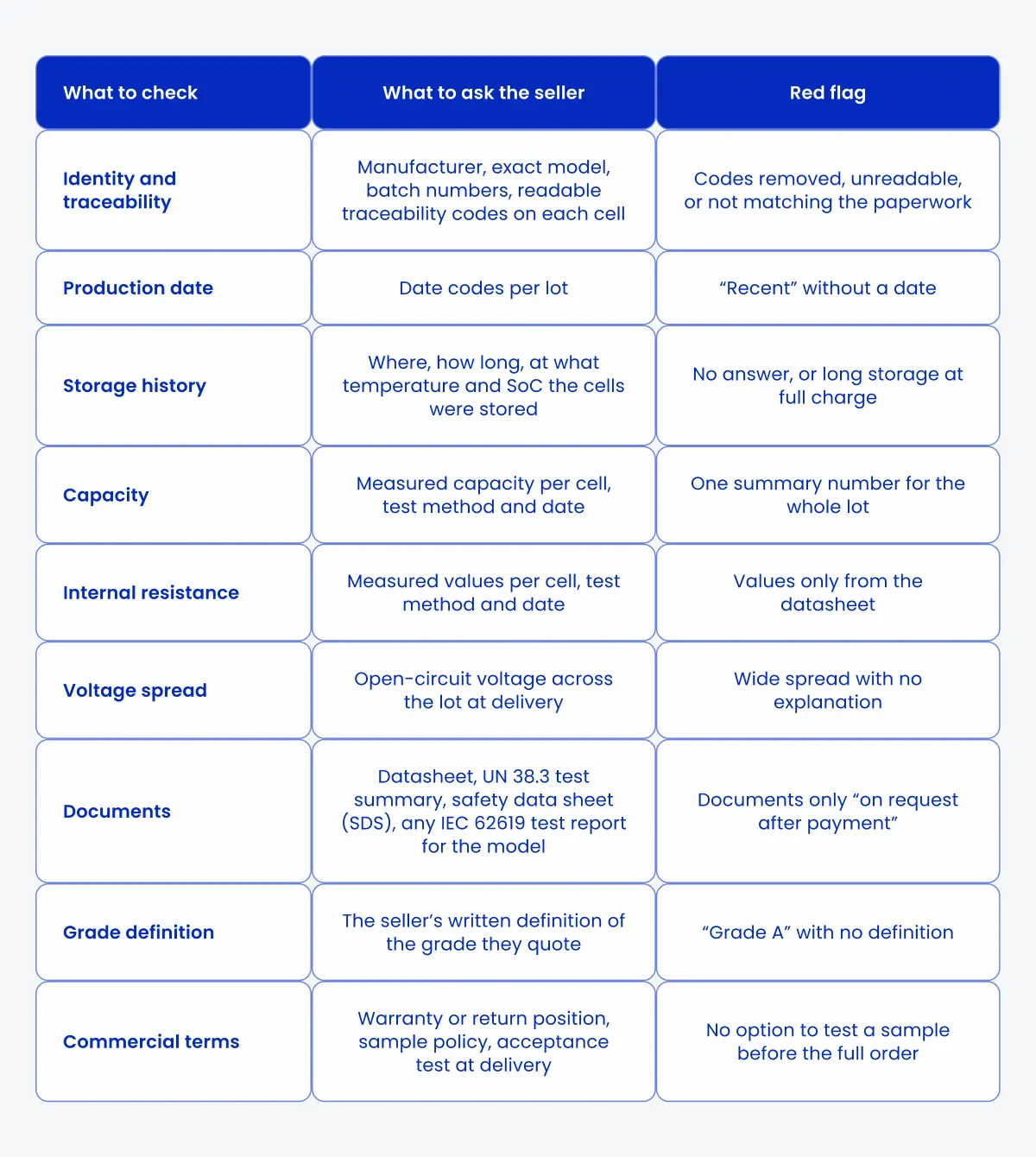
Two practical steps help a lot:
- Test a sample before you commit. Agree with the seller how many cells you will test, which parameters, and what result counts as a pass.
- Write the acceptance criteria into the contract. If capacity or internal resistance spread is outside the agreed range, you need a clear return or price adjustment path.
What internal resistance is “good” for a LiFePO4 cell? Compare the measured values with the datasheet value for that exact model, and look at the spread inside the lot. A few cells far above the rest are a sorting job, even if the average looks fine. Use the same meter and method for every cell, because values from different instruments are hard to compare.
If you check State of Health (SoH) for used or stored cells, ask the seller how and when they measured it.
An SoH figure without a method and date is hard to compare. With LFP, the flat curve of open-circuit voltage against state of charge makes estimating the state of charge particularly hard (Shi et al., UC Berkeley, 2025), so a quick voltage reading says little. Our guide to battery State of Health explains the main test methods.
Are surplus or second-life cells the same as Grade B? Are surplus or second-life cells the same as Grade B?
No. Grade, surplus and second life describe different things, even though offers often mix them up.
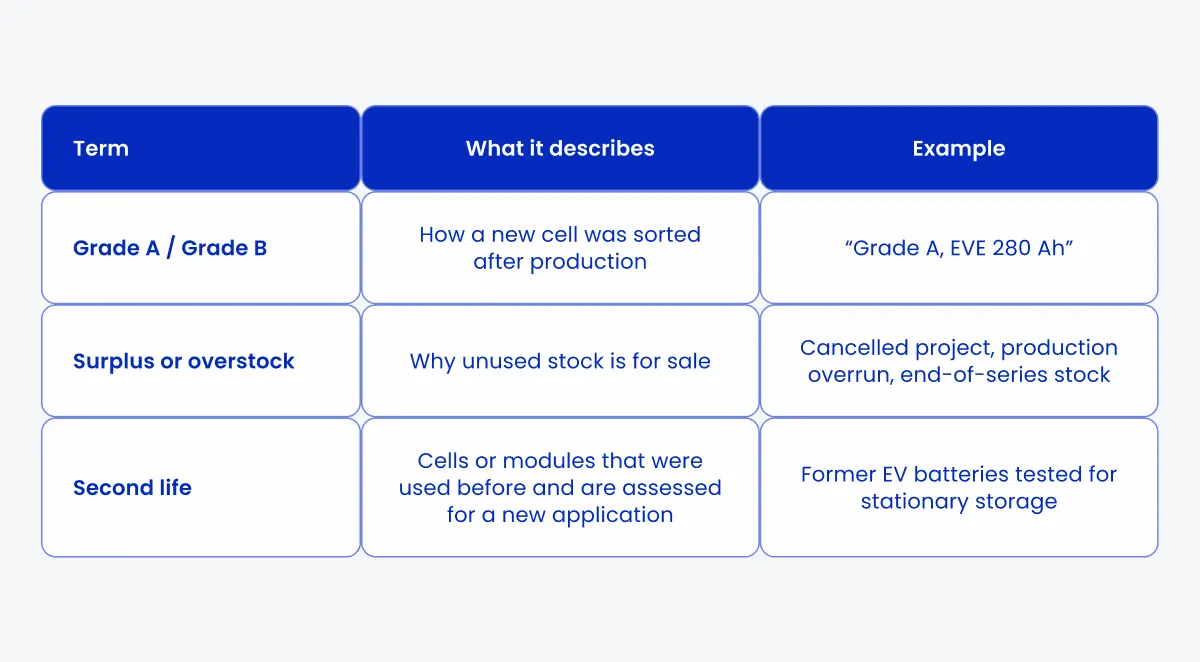
Surplus describes the inventory situation, not the condition. A surplus lot can be fully in-spec Grade A, or it can include cells that sat in storage too long. That is why the same checks apply.
If you are weighing surplus against new or second-life batteries, our BESS battery comparison walks through the trade-offs, and 5 reasons first-life inventory becomes surplus explains where this stock comes from.
When do Grade B LFP cells make sense for a BESS?
Grade B is not automatically a bad buy. It can fit when three things are true:
- You know which parameter is off. A cosmetic flaw on the casing is different from high internal resistance.
- Your system can tolerate it. Check the measured deviation against your own design margins for current, temperature and cycling, not against the label.
- You can test and sort on arrival. Matching cells by capacity and resistance before building modules takes equipment and time, and should be part of the price.
If an offer doesn’t meet those conditions, sorting effort, rejected cells, weaker warranty terms or delays can eat up the lower price. Compare offers on the total cost to deploy, not on the price per kWh alone.
Where can you buy LFP cells with data you can compare?
Most of the checks above come down to one thing: getting comparable data before the deal, not after delivery.
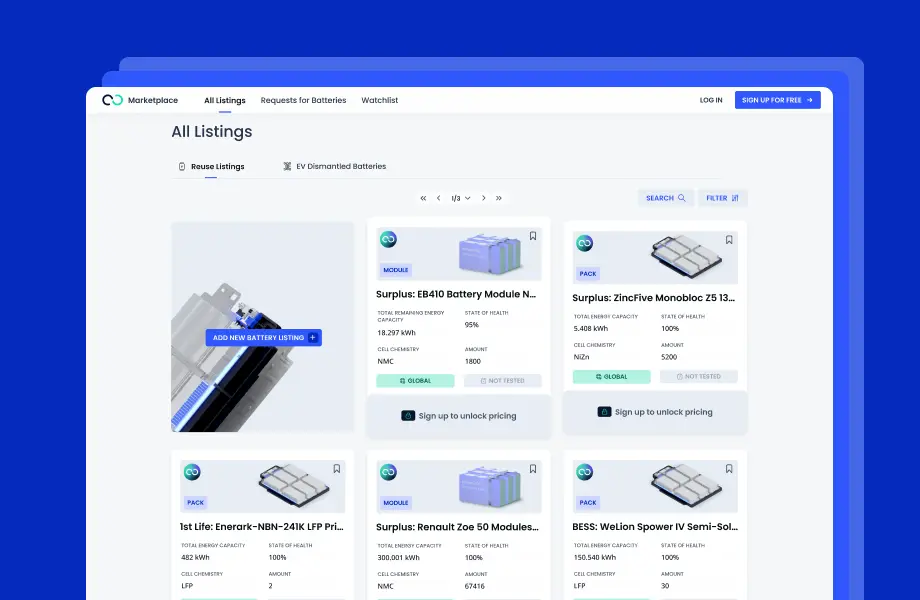
On the Circunomics B2B Battery Marketplace, anyone can browse listings and buyer requests without registering. Public listings show technical specifications, SoH, inspection results and photos, and you can filter by chemistry, capacity and location. Pricing, seller identity and documents are visible to registered users.
Behind the listings, Battery Lifecycle Analytics adds condition assessment and valuation where a lot needs it. Buyers can also post a request for batteries describing the cells they need, so sellers with matching stock can respond.
When a seller shows measured data with a method and a date, buyers can check fit before the first call and price the cells on their condition. Sellers with well-documented stock get fewer back-and-forth questions and a stronger case for their price. Why battery origin matters in EU BESS procurement covers the origin side of the same question.
What to do now
For BESS integrators
- Set your own written acceptance criteria for capacity, internal resistance and voltage spread before you request offers.
- Ask every seller for their definition of the grade they quote.
- Plan a sample test and include it in the timeline.
- Collect the cell documents (UN 38.3 test summary, SDS, IEC 62619 report where available) early for your system documentation.
For pack builders
- Ask for per-cell test data, not lot averages.
- Check production dates and storage history, especially for surplus lots.
- Budget for incoming inspection and cell matching if you buy Grade B.
For procurement teams
- Compare offers on total cost to deploy: price, testing, rejects, warranty and lead time.
- Write acceptance tests and return terms into the purchase contract.
For sellers with surplus LFP cells
- List with measured data, test method and date. Clear data shortens the buyer’s checks and supports your price.
- Keep traceability codes intact and documents ready to share.
FAQ: Grade A vs Grade B LFP cells
What is the difference between Grade A and Grade B LFP cells?
Sellers usually describe Grade A as brand-new cells that meet the full specification for capacity, internal resistance, voltage spread and appearance. Grade B usually means cells left after the seller sorts out the top grades, often aged or disassembled stock. Definitions vary by seller, so ask for the written definition and the measured data behind the label.
Are LFP and LiFePO4 cells the same thing?
Yes. LFP and LiFePO4 both stand for lithium iron phosphate, the cathode chemistry of the cell. Sellers and datasheets use both names, and the grading questions in this guide apply to both.
Is there an official standard for battery cell grades?
No public standard defines Grade A or Grade B, and sellers set their own thresholds. UN 38.3 (transport) and IEC 62619 (safety of lithium cells in industrial applications) apply to the cell model regardless of grade, but neither sorts cells into grades.
How can I tell if LiFePO4 cells are really Grade A?
You can’t tell by looking at them. Check readable traceability codes against the paperwork and, where possible, the manufacturer’s records. Ask for per-cell capacity and internal resistance data with test method and date, the production date and storage history. Then test a sample before you commit to the full order.
Are Grade A LiFePO4 cells safer than Grade B?
Not by label alone. Safety starts with the cell model’s UN 38.3 and IEC 62619 testing, which applies to every grade. What the grade can affect is how evenly cells age and heat in a pack. Damaged, swollen or poorly stored cells are a risk whatever the label says.
Can you use Grade B LFP cells in a BESS?
Yes, if you know which parameter is out of spec, your system’s design margins can absorb it, and you can test and match cells on arrival. Factor sorting effort, rejected cells and warranty terms into the total cost, and compare that with a Grade A offer on the same basis.
Why does cell matching matter in a battery pack?
In a series string, the weaker cell holds less capacity and empties first, which limits the string. Cells with higher internal resistance generate more heat and tend to age faster. A wide spread means more balancing work for the BMS and less usable capacity overall.
How do you match LFP cells before building a pack?
Measure capacity and internal resistance for every cell with the same method, then group cells with the closest values into the same module. Check open-circuit voltage before assembly. Battery University gives +/- 2.5 percent as the capacity tolerance between cells in industrial batteries.
Are surplus LFP cells the same as Grade B?
No. Surplus describes why unused stock is for sale, such as a cancelled project or a production overrun. A surplus lot can be Grade A. It can also include cells stored for a long time. Check production dates, storage conditions and test data for every lot.
Does storage time affect LiFePO4 cells?
Yes. LFP cells lose capacity in storage, faster at high temperature and when stored fully charged. Two lots of the same model can perform differently because of where and how the seller stored them. Ask for the production date and storage conditions for each lot.
What documents should come with LFP cells?
At minimum, the datasheet for the exact model, a UN 38.3 test summary and a safety data sheet. Manufacturers and distributors of lithium cells must make the test summary available. For stationary storage, ask whether an IEC 62619 test report exists for the model, plus test data, date codes and storage history for the lot.
Does a lower price per kWh make Grade B cells cheaper?
Not always. Incoming testing, sorting, rejected cells, weaker warranty terms and project delays add cost. Compare offers on the total cost to deploy the cells in your system, not on the price per kWh alone.
Where can I buy LFP cells for a BESS with test data?
On a B2B battery marketplace such as Circunomics, public listings show specifications, SoH and inspection results without registration. You can filter by chemistry, capacity and location, or post a request so sellers with matching stock contact you.
Looking for LFP cells with data you can check?
Browse live listings on the Circunomics B2B Battery Marketplace and filter by chemistry, capacity and location. Public listings show specifications, SoH and inspection results, no registration needed. If you can’t find what you need, post a request and let sellers with matching stock come to you.
Search the marketplace or post a request for batteries.