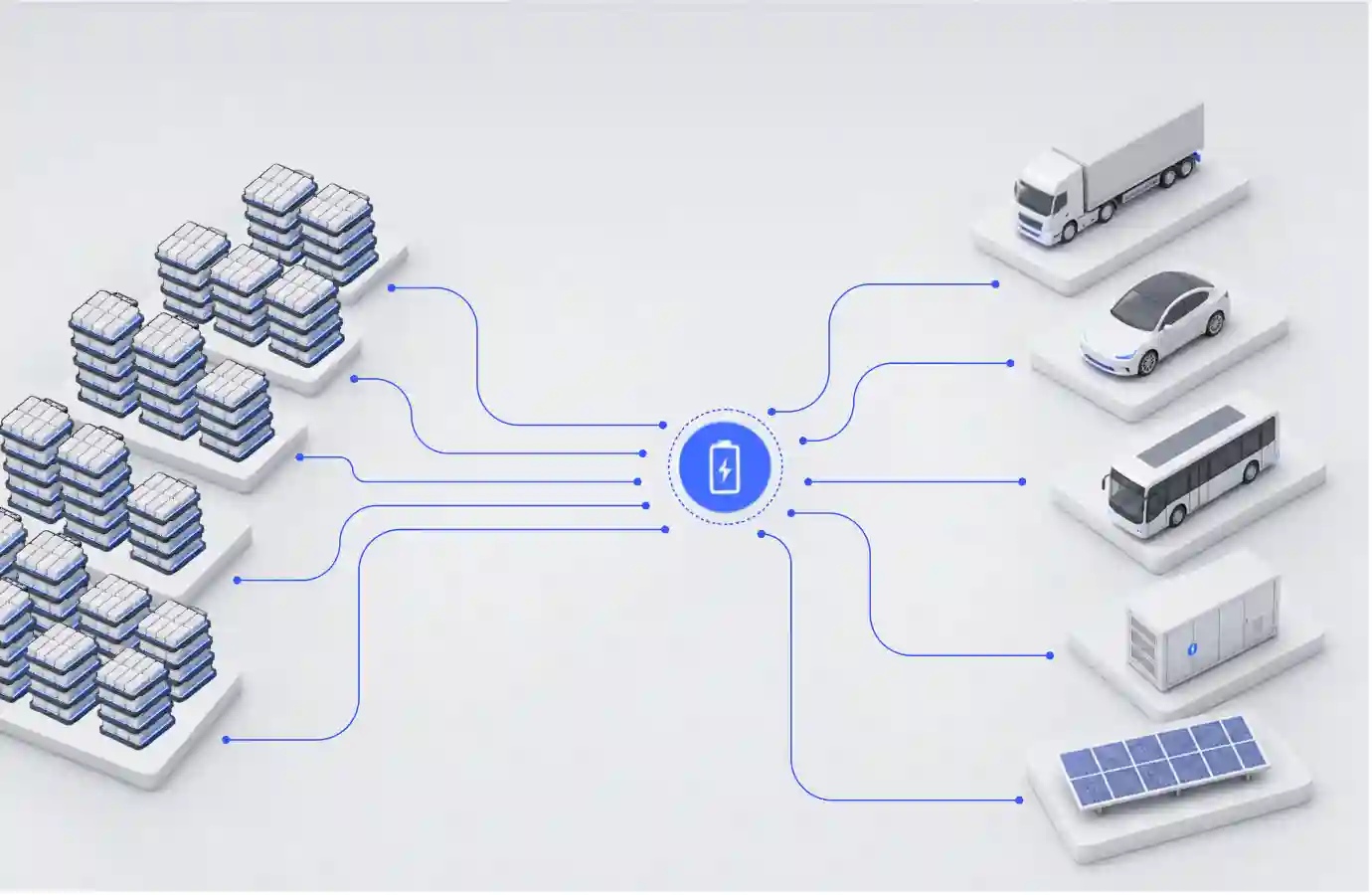
When a battery becomes available, someone must decide what happens next.
A battery becomes available for all kinds of reasons. It comes out of an electric vehicle at around 75% State of Health (SoH).
A company cancels a project and leaves new stock sitting in a warehouse. A production run ends up as overstock. In every case, the same question follows: what do you do with it now?
TL;DR – Quick Summary
The routing decision determines whether you trade, repurpose, or recycle a used or surplus battery.
You may also repurpose it for second-life uses or recycle it to recover materials.
This decision depends on State of Health (SoH) and usage history. It also depends on the chemistry data. It must comply with the EU Battery Regulation (EU 2023/1542). It must also meet the Digital Battery Passport rules.
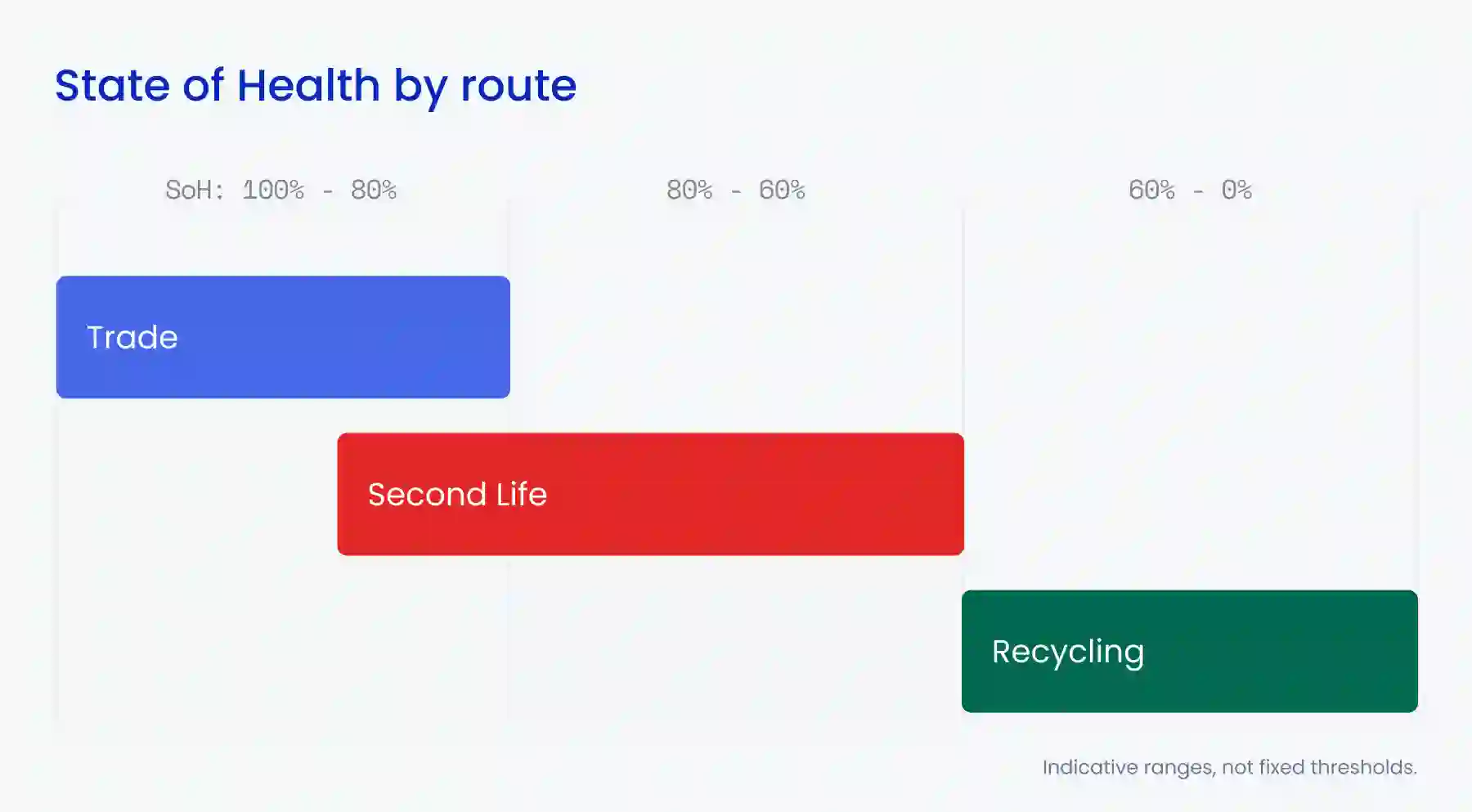
Batteries with high SoH (80%+) are best for trading. Batteries between 60% and 80% SoH suit second-life reuse. This follows EN 18061:2025 standards. You should recycle batteries below 60% SoH or with safety issues.
Making evidence-based routing decisions maximizes battery value, reduces waste, and ensures regulatory compliance with Extended Producer Responsibility (EPR) obligations.
That question is the battery routing decision. Trade the battery for continued use. Repurpose it for a second-life battery application. Or send it to battery recycling for material recovery.
The right answer depends on the battery's condition and where it came from, not on a fixed rule.
Most of it comes down to one thing: what do you really know about the battery? Without State of Health (SoH), usage history, and chemistry data, buyers and operators are guessing. And buyers price guessing as risk.
👉 Join Circunomics to access verified battery listings with complete SoH records and technical details.
The Rules Already Picked a Side: Evidence
Europe's battery rules are already in motion. Under the EU Battery Regulation (EU 2023/1542), Extended Producer Responsibility (EPR) duties apply. Producers must manage legacy and new battery portfolios separately from 18 August 2025.
The Digital Battery Passport (DBP) becomes mandatory for relevant batteries in February 2027. EN 18061:2025 sets out the framework for second-life battery qualification.
These rules point in the same direction: you need evidence. Producers must show what they collected. Recyclers have to document recovery. Anyone putting a battery into a second life must show it is safe and fit for the job.
The battery routing decision is where you use that evidence. It is the point where battery lifecycle data stops being a compliance file and starts driving a commercial call.
Three Routes: Trade, Repurpose, Recycle
1. Trade: The Battery Keeps Doing Its Job
Battery trading means the battery moves to a new owner and stays in a similar use. No teardown, no rebuild. It changes hands as it is.
Two kinds of batteries fit this route. The first is surplus batteries: unused overstock from overproduction, cancelled orders, or excess inventory. These never went into service, so they are close to new, with little or no usage history to work through.
The second is lightly using batteries that operators retire early for reasons unrelated to wear, like a lease ending. Or a project changing direction.
What SoH do you need for battery trading? Surplus is the cleanest trade case. High SoH (typically 80% or above), a known chemistry, and a clean record make it straightforward to match with a buyer.
This is also battery sourcing matters most. Finding stock and matching it to demand is the core of trading. It happens before any second-life or recycling questions come up.
For used batteries, the bar is the same, but the evidence is heavier. A buyer wants charge and discharge history.
They also want a verified State of Health (SoH) and State of Charge (SoC). They want chain-of-custody records and chemistry data.
A fleet battery retired early because a lease ended, not because it degraded, can serve another operator for years. But only if the record proves it.
Without that record, buyers discount hard for the unknown. With it, the battery trades closer to what it is actually worth.
A battery marketplace helps here. When sellers list a battery with its data, buyers work from the same facts. They do not negotiate around unknowns.
We built Circunomics for this: we source batteries. We connect sellers and buyers. We make trading more structured and transparent.
2. Repurpose: A Second Life in a Lighter Application
Battery repurposing moves a battery into an use with lower demands than its first one. An EV battery that no longer suits a car can often run in stationary energy storage for years.
At what SoH should you repurpose a battery? SoH is the starting signal. As a rough guide, operators often retire EV batteries near 80% SoH. Stationary storage systems can run lower, sometimes into the 60–70% range.
Exact figures vary by chemistry, use, and manufacturer. Inside those ranges, second-life batteries are worth assessing. Remaining Usable Life (RUL) matters just as much, since it tells you how long the battery is likely to keep working.
Second-life battery economics depends on getting the health read right. Overestimate capacity and the system will underperform. Underestimate it and you scrap a battery that still has years left. The difference between those outcomes is battery data quality.
Second-life qualification also must meet EN 18061:2025, and safety history matters. A battery with a record of thermal stress carries more risk than one with the same SoH and a clean log.
3. Recycle: Recover the Materials
Battery recycling breaks the battery down to recover materials such as lithium, cobalt, nickel, and graphite. It is the last step in the loop, not the default first moves.
When should you recycle the battery? It is the right call when SoH is too low for further use, often below 60%. It is also right when there are safety concerns, like swelling or damage. It is right when refurbishment does not make economic sense.
Even here, data earns its keep. Knowing the exact battery chemistry helps recyclers tune their process and improve yield. And battery traceability is what lets producers meet their EPR reporting duties.
Worth noting: the EU framework favors higher-value use before recycling. But recycling quotas and value-retention goals can conflict.
Routing straight to recycling without checking for reuse potential can mean leaving value on the table.
How the Battery Routing Decision Gets Made
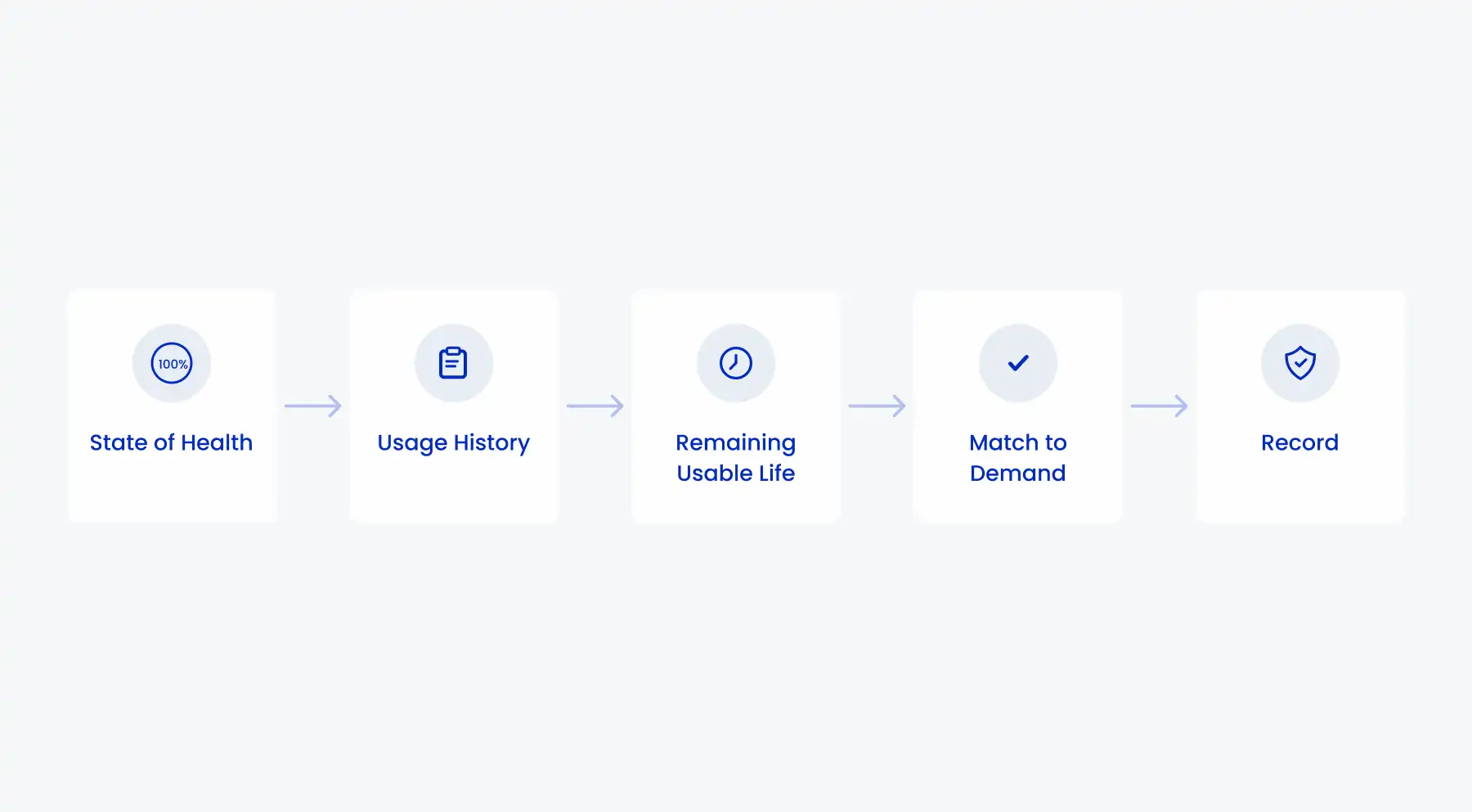
Routing is a sequence, not a single test.
- Check SoH: Measure current capacity against the original rating. Higher SoH points toward trade or continued use. Lower SoH moves the case toward recycling. The middle is where you assess second life.
- Read the usage history: Look for thermal events, deep discharges, heavy fast-charging, and temperature extremes. Two batteries at the same SoH are not equal if one has a stressed history.
- Estimate RUL: SoH tells you where the battery is now. Remaining Usable Life (RUL), based on how it has degraded, tells you where it is heading.
- Match to demand: The best route also depends on the market. Strong demand for stationary storage lifts second-life value. Tight supply of recycled battery materials lifts recycling returns.
- Record the decision: EPR schemes need proof of collection and treatment. The Battery Passport will require battery lifecycle data. The routing decision is not finished until you document it.
What This Means for Different Players
For OEMs
Routing affects warranty reserves, residual value, and EPR cost planning. Tracking SoH and usage from the start gives you more options later. It also avoids relying on a cold assessment at the end of life.
For Recyclers
Knowing which batteries are heading your way, and when, helps with capacity planning and chemistry-specific processing. Clean battery traceability also lowers contamination and compliance risk.
For Second-Life Operators
Verified SoH data lets you price acquisitions properly and cut down on testing overhead. Undocumented batteries mean more failures and slower qualification.
A Few Practical Recommendations
- Track SoH from day one. The decision you make at the end of life depends on data captured during use
- Use EN 18061:2025 as your baseline for second-life safety and documentation
- Build routing into EPR planning. Different routes carry different costs. Model them
- Prepare for the Battery Passport. Aligning your data now makes 2027 less of a scramble
- Test before you route. Age and mileage alone do not tell you enough. A clean older battery can beat a stressed younger one
Where This Is Heading
Battery routing is becoming a real point of difference. Teams that decide based on verified data tend to capture more value and carry less risk than those working from assumptions.
As the Battery Passport takes effect and second-life battery markets grow, routing should become faster and more consistent. Machine-readable health records and shared traceability help people make decisions with less manual work. They also reduce blind spots.
The practical question for most organizations is this. When a battery becomes available, do you have enough data? Can you make the call with confidence? If the answer is yes, trade, repurpose, and recycle stop being guessed and start being decisions.
Circunomics sources batteries and lets sellers and buyers trade them with their data attached. This helps routing decisions to rely on evidence, not assumptions.
👉 Registration is free and takes only a few minutes. Create your account and start listing or sourcing batteries today.
The next piece in this series looks at the data layer behind it all: the Battery Passport. It also explores how it is taking shape across Asia and Europe.
Frequently Asked Questions (FAQ)
What is the battery routing decision?
The battery routing decision determines what to do with a used or surplus battery. It may be:
- traded for continued use
- repurposed for a second-life application, such as stationary energy storage
- recycled for material recovery
This decision is based on State of Health (SoH), usage history, battery chemistry, safety records, and market demand
At what State of Health (SoH) should you trade, repurpose, or recycle a battery?
- Trade: Batteries with high SoH (typically 80% or above) and clean usage records are ideal for trading
- Repurpose: You can often repurpose batteries with SoH between 60–80% for second-life applications like stationary storage
- Recycle: You should recycle batteries with SoH below 60%, safety concerns, or no viable second-life use
What is a second-life battery?
A second-life battery is a used battery, often from an electric vehicle. Operators reuse it for a less demanding task, like stationary energy storage. Second-life batteries extend the useful life of the battery before operators eventually recycle it
What is the EU Battery Regulation (EU 2023/1542)?
A second-life battery is a used battery, often from an electric vehicle. Operators reuse it for a less demanding job, such as stationary energy storage. It aims to improve battery sustainability, traceability, and circular economy practices across Europe.
What is the Digital Battery Passport?
The Digital Battery Passport (DBP) is a mandatory digital record that will track battery lifecycle data, including chemistry, SoH, usage history, and recycling information. It became mandatory for relevant batteries in February 2027 under the EU Battery Regulation.
What is EN 18061:2025?
EN 18061:2025 is the European standard that sets out the framework for qualifying batteries for second-life use. It includes safety, performance, and documentation requirements to ensure repurposed batteries are fit for their new application.
What is Extended Producer Responsibility (EPR) for batteries?
Extended Producer Responsibility (EPR) is a rule that makes battery producers responsible for a battery’s full life. This includes collection, treatment, and recycling. Under the EU Battery Regulation, producers must manage legacy and new battery portfolios separately and report on collection and recycling performance.
How do I know if a battery is safe for second-life use?
A battery is safe for second-life use if it meets EN 18061:2025 requirements. It must have a verified SoH in an acceptable range, usually 60–80%. It must have no history of thermal events or damage. It must have documented usage and safety records.
What is Remaining Usable Life (RUL)?
Remaining Usable Life (RUL) estimates how long a battery can keep working before it reaches end of life. Operators calculate RUL based on degradation patterns, usage history, and current State of Health.
Why is battery traceability important?
Battery traceability ensures that producers document the full lifecycle of a battery, from production to end of life. This is essential for compliance with EPR obligations, the Digital Battery Passport, and making informed routing decisions. Traceability also improves safety, recycling efficiency, and circular economy outcomes.
Can I trade a used battery?
Yes, you can trade a used battery if it has a high SoH, verified usage history, and clean safety records. Platforms like Circunomics make it easier to list and trade batteries. Clear data helps buyers and sellers make informed decisions.