First-life batteries are not automatically surplus. In this article, we focus on batteries that are still new, unused or suitable for their original application, but are no longer needed for the project or product they were originally ordered for.
This can happen for several reasons. Companies often order battery cells, modules and packs months or even years before they are needed. By the time they are ready for deployment, a project may be delayed, scaled back or cancelled. Product designs can change, specifications can be updated, demand can shift or a company may simply have ordered more batteries than it needs.
The batteries themselves may still be fully functional and suitable for their intended use. They have simply become surplus to the original buyer’s needs and may be useful to someone else.
That is what we mean by surplus first-life battery inventory: battery stock that is new, unused, unallocated or still suitable for its original application, but is now available to another buyer.
Because the terms used in the market can vary, every transaction should clearly state the battery’s status. Is it new and unused? Has it been lightly used? Has it been removed from its original application? This information is essential for assessing the battery’s condition, suitability and next possible use.
This article focuses on surplus first-life inventory, not used or end-of-life batteries. Some batteries may later enter a second-life market, but that is a separate status and requires its own technical assessment.
TL;DR
Surplus first-life battery inventory usually becomes available for five common reasons:
- Project changes or is delayed
- Specifications no longer match
- Buyers order more than they need
- Long lead times push people to buy early
- A product is discontinued
These batteries are different from end-of-life batteries and are not automatically second-life material. The commercial challenge is matching the right chemistry, format, condition, documentation, location, and timing with a qualified buyer.
Better inventory data and a specialist battery marketplace can turn surplus stock into a tradable asset.
Battery supply is growing, but inventory does not move in a straight line
The battery market is expanding quickly. Production capacity, project pipelines, and demand are all increasing, but they do not grow at the same speed or in the same place.
In an August 2026 market update, Benchmark Mineral Intelligence said finished-cell and electric-vehicle inventory was rising. BESS cell production was also running ahead of installations.
This is a timing and allocation issue. Companies can sell some batteries while they find new uses for others.
The same pattern appears downstream. Rho Motion reported more than 400 GWh of projects in the 2025 grid-storage pipeline. A project that is announced, planned, or supplied is not the same as a project that has been commissioned.
Delays and cancellations can release battery inventory that was already ordered for the original project.
There is also a secondary-market signal. Circular Energy Storage tracked 123 GWh of available used batteries in 2026. It expects global used battery supply in 2030 to be almost three times 2025 levels.
These figures describe different parts of the market, so they should not be added together. They point to the same fact: batteries do not always move from the production line to the use named in the order.
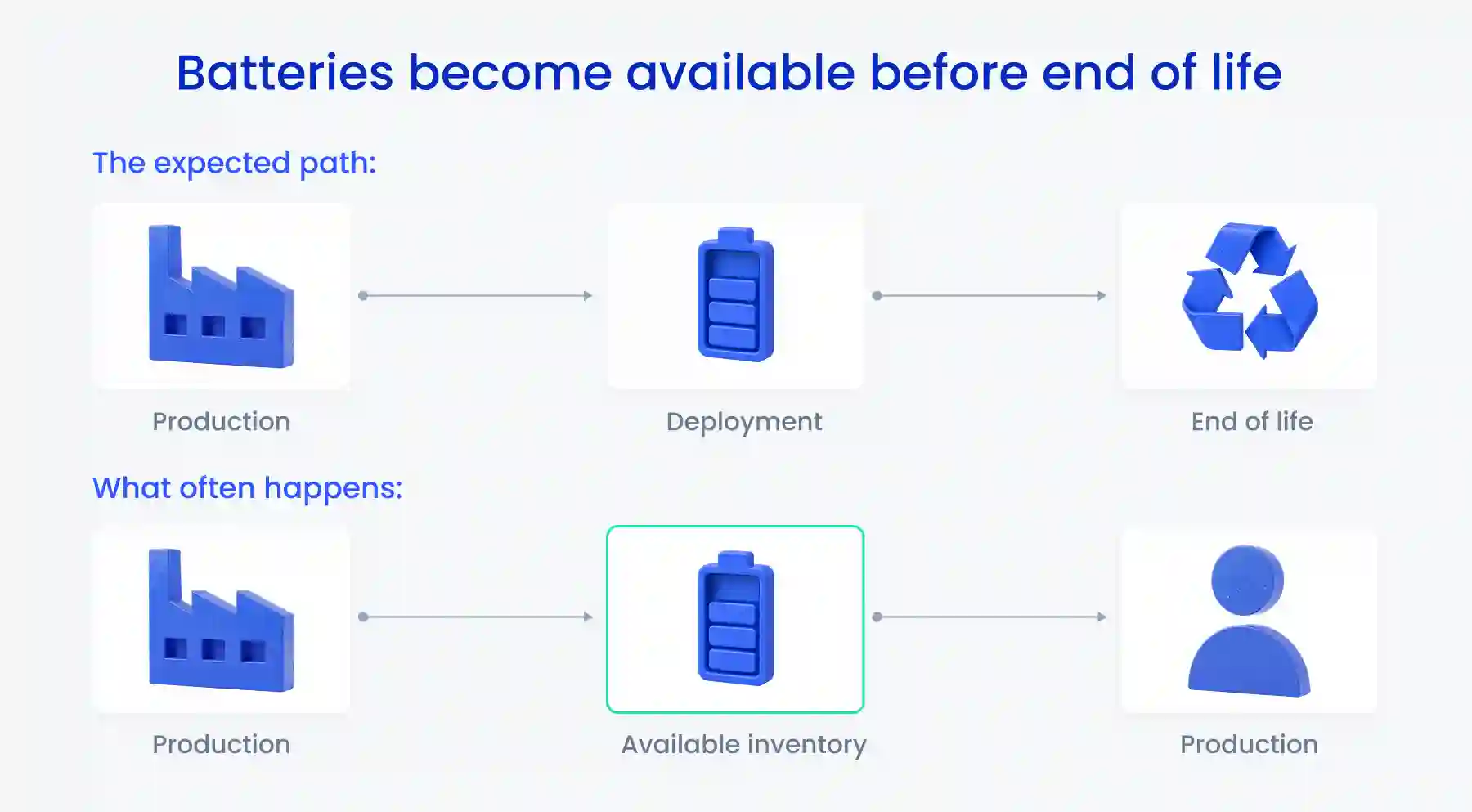
Some cells remain in stock longer than planned. A project may be postponed, a product plan may change, or a battery may no longer fit the required specification before it is deployed. These are examples of surplus first-life inventory.
Used batteries are a separate part of the market. Once a battery has been used in its original application, it may be assessed for reuse, repurposing or a second-life application. In other cases, batteries enter a reuse or secondary market because of changing market conditions, component shortages, vehicle-model priorities, or demand forecasts.
This does not mean battery demand is weak. The International Energy Agency has reported that battery storage remains one of the fastest-growing power technologies. Benchmark also said global battery demand passed 1 TWh in the first seven months of 2026. This followed energy-sector battery demand reaching 1 TWh in 2024.
Rho Motion reported that global BESS deployments reached 205 GWh in 2024, up 53% year on year. The market has demand. The gap is what happens between production and deployment. A battery may be in the wrong country. It may be in the wrong quantity. Its chemistry or form factor may not fit the next project.
The original project may have changed direction. A buyer may need capacity now while suitable stock is already somewhere else in the supply chain.
That creates a practical question for both sides of the market:
- For inventory holders: how do you find a buyer who can use the stock safely and commercially?
- For battery buyers: how do you find suitable available inventory before placing another factory order?
Manufacturing is only one part of battery supply. The other part is knowing what exists, where it is, what condition it is in, and which application can use it next.
Why does battery supply run ahead of deployment?
Available battery inventory is partly a result of how the market has developed. Manufacturing is often in one region. Lead times can be long. Minimum order quantities can be high. Battery specifications can change fast.
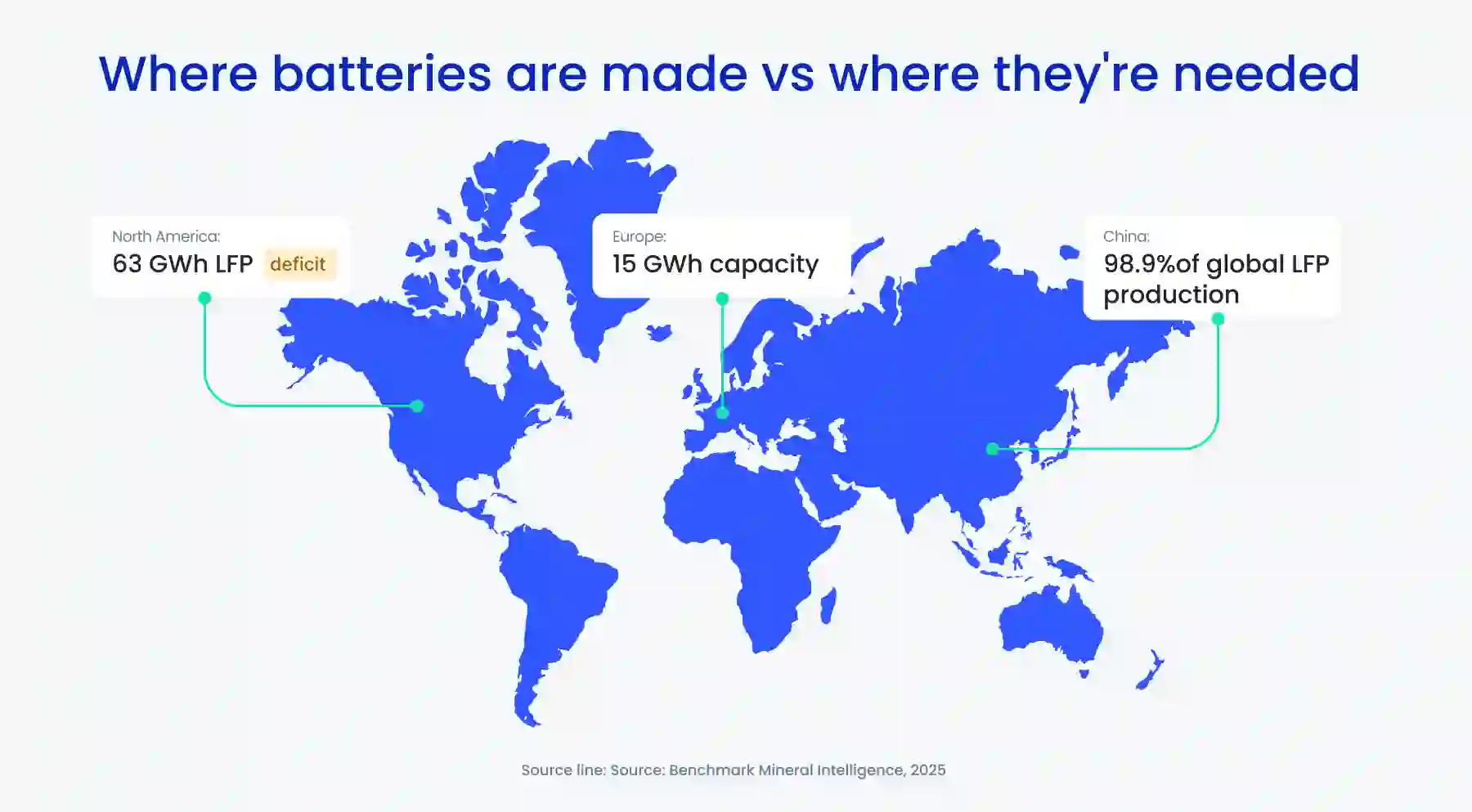
China made 84% of the world’s battery supply in 2025. But it used 56% of global demand. These figures come from Benchmark Mineral Intelligence.
They were cited in the original analysis. That geographic mismatch affects both delivery times and resale options. Benchmark has also reported oversupply in several parts of the battery value chain. This includes raw lithium, finished cells, and cathode materials.
The commercial effect is straightforward. Benchmark has also reported oversupply in several parts of the battery value chain. It ranges from raw lithium to finished cells and cathode materials.
The batteries may still be technically sound. The business case has moved.
What are the five reasons first-life batteries become available?
1. Project scope or timelines change
Battery orders often come before final deployment. During the gap, fleet plans change, storage projects are resized, customer contracts move, or a product is cancelled.
When the project changes, the batteries may already have been manufactured, paid for, or delivered. They remain first-life inventory because they are still new, unused, or fit for the original application. They no longer fit the buyer's updated plan.
This is one reason project pipelines should be read carefully. Rho Motion’s 2025 pipeline data shows how large the planned BESS deployment is. But planned capacity does not guarantee every project will be built on time.
- What this means for buyers: Delayed or resized projects may offer access to batteries already made. These batteries could be available sooner than a new order
- What this means for sellers: explaining the original use case and the reason the stock was released helps buyers assess fit and risk
2. Specifications no longer match the application
Battery specifications are an eligibility filter, not a general product label. Chemistry, voltage, capacity, and form factor can determine if a battery fits an application.
Connector type, thermal design, and the battery-management system also matter. Software compatibility, safety documents, and certification can affect whether it will work.
A cell or module that worked well for one project can become unsuitable after a product update. It can also become unsuitable after a regulatory change or a late technical decision.
The inventory is correct for the original brief but wrong for the current one. The mismatch can also be regional. Benchmark estimates in the original draft say China made 98.9% of global LFP cells in 2025.
North America had a 63 GWh LFP deficit. Europe’s LFP manufacturing capacity was about 15 GWh. When production is in one region, a buyer elsewhere may have few local options for an exact replacement.
- What this means for buyers: define the technical brief before searching for stock. A close match is not necessarily a usable match
- What this means for sellers: list technical details at cell, module, pack, or system level. A broad description such as “lithium-ion battery” is not enough for a serious transaction
3. Excess procurement and risk hedging create surplus
Large deployments often procure more capacity than the immediate minimum. The additional stock protects against manufacturing delays, quality variation, logistics problems, or demand that arrives earlier than forecast.
That strategy is reasonable when lead times are uncertain. If the risk does not materialize, the buffer becomes available inventory. It was ordered for a valid reason, but the buyer no longer needs all of it.
Falling prices make the decision more difficult. When battery prices fall fast, a company with older stock must compare using it versus trading it. Inventory becomes a commercial and balance-sheet decision rather than only a supply-chain decision.
- What this means for buyers: surplus procurement can help you get the exact quantity you need. It also avoids committing to a full factory minimum order
- What this means for sellers: price and describe the stock based on its current market value. Consider its documentation, condition, and delivery options, not just its original purchase price
4. Concentrated supply and long lead times encourage early ordering
For buyers outside major manufacturing hubs, long lead times and minimum order volumes are common. Companies often order larger batches than they need right away. They do this because later orders could delay a project.
By the time the batteries arrive, market conditions may have changed. Prices may be lower. Another chemistry may offer better economics. A local supplier may have opened capacity. The original use case may have shifted.
The batteries may still meet the specification against which they were ordered. They simply may no longer be the best commercial choice for the buyer that purchased them.
- What this means for buyers: available stock may cut lead time, but the transaction still needs checks. Check storage history, condition, compliance, warranty, and logistics
- What this means for sellers: location is part of the value proposition. A battery lot with clear records that is ready to ship may be more useful. A cheaper lot may be less useful if its availability is unclear
5. Discontinued or replaced products release buffer stock
Product cycles in electric vehicles and energy storage are becoming shorter. A vehicle model is updated. A storage system is replaced. A module design is superseded by a more cost-effective version.
OEMs, integrators, fleet operators, and service organisations may keep buffer stock. They may use it for warranty replacements, maintenance, future production, or spare parts.
If the product is discontinued, that stock may no longer have an internal purpose. The inventory could still help another buyer. They might use the same vehicle. They might support a legacy system. Or they might make a compatible product.
Pre-production units and unused obsolete inventory can enter the market before they reach the end of their useful life. Test-vehicle batteries, returned products and warranty replacements may also become available, but their status needs to be assessed separately.
They can enter earlier than end-of-life EV batteries.
- What this means for buyers: discontinued stock can be valuable when compatibility is proven and replacement needs are predictable
- What this means for sellers: include product history, compatibility details, lot quantity, and any warranty or support limits
Does available battery inventory mean demand is weak?
No. Strong demand and available inventory can exist at the same time.
The battery market is large enough for production, project pipelines, and deployment to move at different speeds. A battery can be available because its project was delayed while another buyer is waiting for capacity.
It can be surplus in one geography while buyers face long lead times in another. It can be technically sound but incompatible with the specification that the original buyer now needs.
The issue is less about whether batteries exist. It is more about whether the market can find them. It must also qualify, price, and move them to the right use.
What information should buyers request before purchasing battery inventory?
Before buying first-life or surplus batteries, ask for enough details to check fit, value, safety, and compliance:
- Chemistry, cell type, module or pack format, and manufacturer
- Quantity, lot structure, production date, and lot or serial numbers
- Nominal voltage, capacity, energy, dimensions, weight, and connectors
- Original intended application and compatibility requirements
- State of Health data where the battery has been used
- Cycle count, usage history, storage conditions, and temperature history where available
- Battery-management-system and software requirements
- Quality-control documentation and test results
- Safety documentation, transport classification, and applicable certifications
- Warranty status, chain of custody, ownership, and location
- Current availability, minimum order quantity, delivery timing, and logistics constraints
For unused battery cells, State of Health may not be the most useful metric. Buyers should ask for production records. They should ask for quality control results. They should ask for the storage history. They should also ask for proof that the lot stayed within the manufacturer’s required conditions.
How should companies manage available first-life battery inventory?
For companies holding surplus battery inventory
- Map the stock precisely. Record chemistry, format, quantity, condition, location, production date, technical specifications, and documentation. A battery cannot be matched efficiently if the listing only says “surplus lithium-ion cells”
- Treat the stock as a commercial asset. The value of first-life inventory depends on fit, timing, condition, documentation, and delivery. Compare the cost of holding it with the value of releasing it to a qualified buyer
- Explain why it became available. Buyers need to know why the stock is available. Clear context supports better decisions
- Use a specialist marketplace. General procurement platforms rarely capture the technical, safety, regulatory, and logistics details required for battery transactions
- Update listings as the stock moves. Quantity, location, availability date, and reservation status should stay current. Out-of-date inventory creates unnecessary work for both sides
For companies sourcing batteries
- Search beyond direct factory orders. Available inventory can reduce lead times and provide access to capacity already in the supply chain. It may also reduce the need to buy a full factory minimum order
- Define the requirement clearly. State chemistry, format, quantity, energy or power requirements, compatibility, timing, geography, and documentation needs. Specific requirements make matching faster
- Request traceability and evidence. First-life does not mean automatically verified. Ask for production records, test data, storage history, ownership, and transport information
- Compare total landed cost. The right comparison includes price, logistics, inspection, compliance, integration work, warranty position, and delivery time
- Consider future routing. If you can’t keep using the stock for its original purpose, choose what to do next. Decide whether to repair it, repurpose it, use it for a second life, or recycle it
How Circunomics helps connect available supply with demand
The battery market will continue to grow. Project pipelines through 2030 are measured in terawatt-hours. Manufacturing is scaling up. More companies are entering mobility, energy storage, reuse, and recycling markets.
Long lead times, regional concentration, evolving specifications, volatile pricing, project delays, and changing product strategies will keep creating battery inventory.
The practical need is clear:
- We need better visibility into what is available
- We need to know where it is
- We need to know its condition
- We need to know who can use it
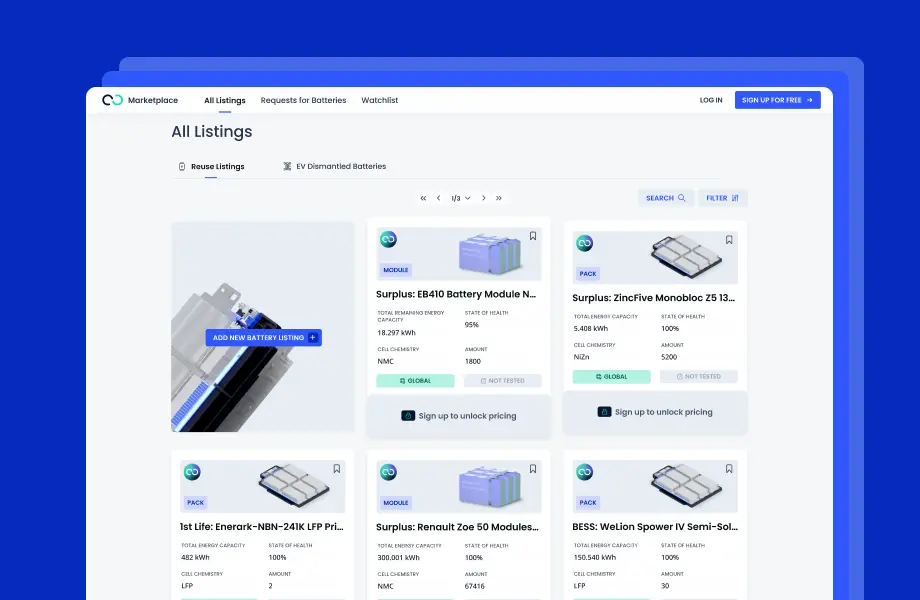
Buyers and sellers also need data-based matching that covers specifications, condition, compliance, ownership, and suitability. That is the gap Circunomics is building around. The Circunomics Battery Marketplace connects companies with available batteries to companies looking for specific supply.
The platform supports the sourcing and trading of surplus first-life inventory, as well as the evaluation of used batteries for potential second-life applications. It uses structured battery data and direct routes to potential buyers or sellers.
Circular Energy Storage projects in Europe will handle more decommissioned EV, ESS, and industrial batteries. This will grow from 5.8 GWh in 2025 to 106 GWh by 2035. That is an approximately 18-fold increase.
The analysis estimates that more than half of EV batteries stay in their original application for over 17 years. This means the largest wave of battery returns is still ahead.
First-life batteries becoming available is a market dynamic to manage. Companies can buy available batteries, sell what they do not need, and reduce waste.
Start sourcing or trading batteries
- Have batteries to trade? Explore the Circunomics Battery Marketplace
- Looking for a specific lot? Browse the available supply
- Need help with a battery transaction? Contact the Circunomics team
FAQ
What are first-life batteries?
First-life batteries are new, unused or still suitable for their original application. When this inventory is no longer needed by the original buyer, it can become surplus and be offered to another buyer.
Why do first-life batteries become available?
First-life batteries often become available because projects change, companies order too much, or products are replaced. These reasons can create surplus stock even when overall battery demand is strong.
Are first-life batteries the same as second-life batteries?
No. First-life batteries are generally still suitable for their original application. Second-life batteries have been removed from their original application and assessed for a different use. Buyers should confirm whether the batteries are new, used, repaired, or repurposed.
Are surplus first-life batteries safe to buy?
Safety depends on the battery's chemistry, condition, storage history, documentation, transport requirements, and intended application. First-life status does not replace technical checks. Buyers should review test results, quality records, storage conditions, ownership, safety documentation, and compatibility before purchasing.
What data should buyers request before purchasing battery inventory?
Before buying, request the battery’s specifications, condition, test results, safety documents, warranty, and location.
Can surplus first-life batteries be cheaper or faster to source than a new factory order?
They can help buyers get batteries faster without ordering more than necessary. The commercial result depends on the battery's technical fit, condition, documentation, location, logistics, inspection needs, warranty position, and current market price.
Can unused EV or BESS batteries be used in another application?
Potentially, but the battery must be assessed against the requirements of the new application. Compatibility, safety, battery-management systems, thermal management, certifications, transport, warranty, and applicable regulation all need to be reviewed. A battery that is suitable for its original application is not automatically suitable for a different one.
How can a company sell surplus battery inventory?
To sell battery inventory, companies need accurate records, clear terms, and access to qualified buyers. Accurate technical data and current availability make it easier to match the lot with a suitable application.
Does available battery inventory mean battery demand is weak?
High demand and available inventory can exist at the same time. The market challenge is often matching existing supply with the right buyer and application.