Most Battery Lots Get Priced by Gut Feel
Pricing a used battery pack is rarely straightforward.
Some sellers anchor to scrap value. Others work backwards from new-pack pricing. Some refer to recent comparable deals.
Others wait for the market to set the number or run their own model. Each approach gives a different result, and none of them is wrong on its own.
That variation is one reason second-life and surplus pricing still feels uncertain. This is true even when the lot is well understood.
That's not a failure of expertise. The market is still building a shared pricing language.
Second-life and surplus batteries don't have the liquidity of new modules or the clear pricing of pure scrap. They sit in a wide grey zone between the two. Knowing where your lot fits in that zone, and being able to argue for it, is a useful skill. Buyers and sellers can build this skill now.
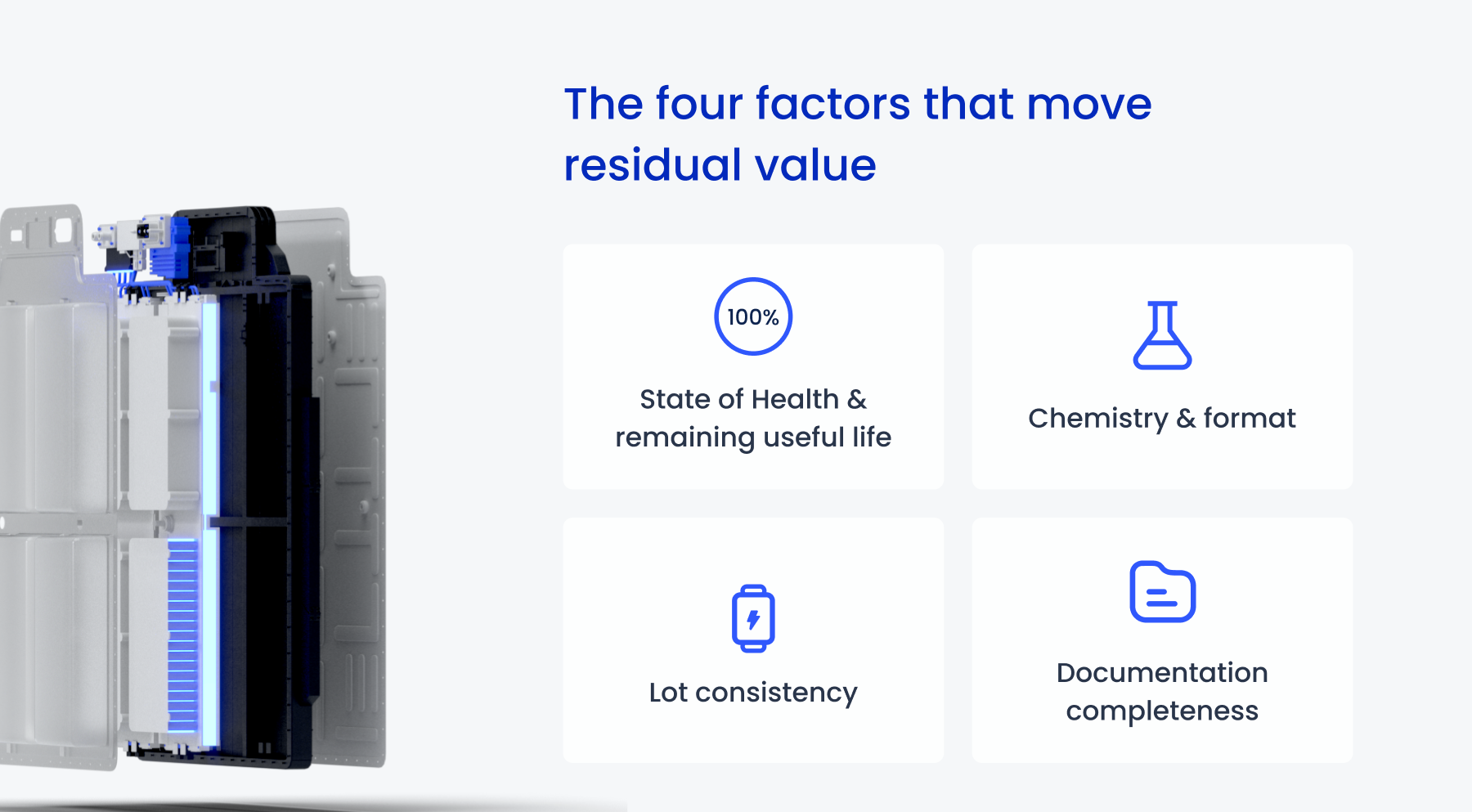
Here's a practical look at the four factors that actually move residual value, and how to use them.
A Quick Definition
Residual value is what a battery is worth after its first life, before recycling becomes the only option left.
For sellers, it's what the lot can realistically fetch. For buyers, it's what the lot is reasonably worth paying. The challenge is that there's no single number, and no fixed formula. The value depends on the lot, the use case, and what evidence travels with it.
The Two Reference Points
Every used battery lot sits between two numbers. Knowing both makes pricing easier to discuss.
The floor: what a recycler would pay
This is the material value of the batteries, minus the cost of processing them. For most chemistries today, it's the lowest realistic price. It's also the easiest number to get – a recycler can usually quote it quickly. Think of it as the battery scrap value benchmark:the "do nothing else with this lot" number.
The ceiling: what a comparable new module would cost
This is what a buyer would pay for new batteries that deliver the same usable capacity. Lithium-ion battery pack prices fell to USD 108/kWh in 2025, according to BloombergNEF's annual battery price survey. That number keeps moving, and the ceiling for second-life pricing moves with it. A second-life lot only makes commercial sense when it's clearly cheaper than buying new for the same use case.
Everything in between is where second-life pricing actually happens. Where your specific lot lands inside that range depends on four things.
Factor 1: State of Health (SoH) and Remaining Useful Life (RUL)
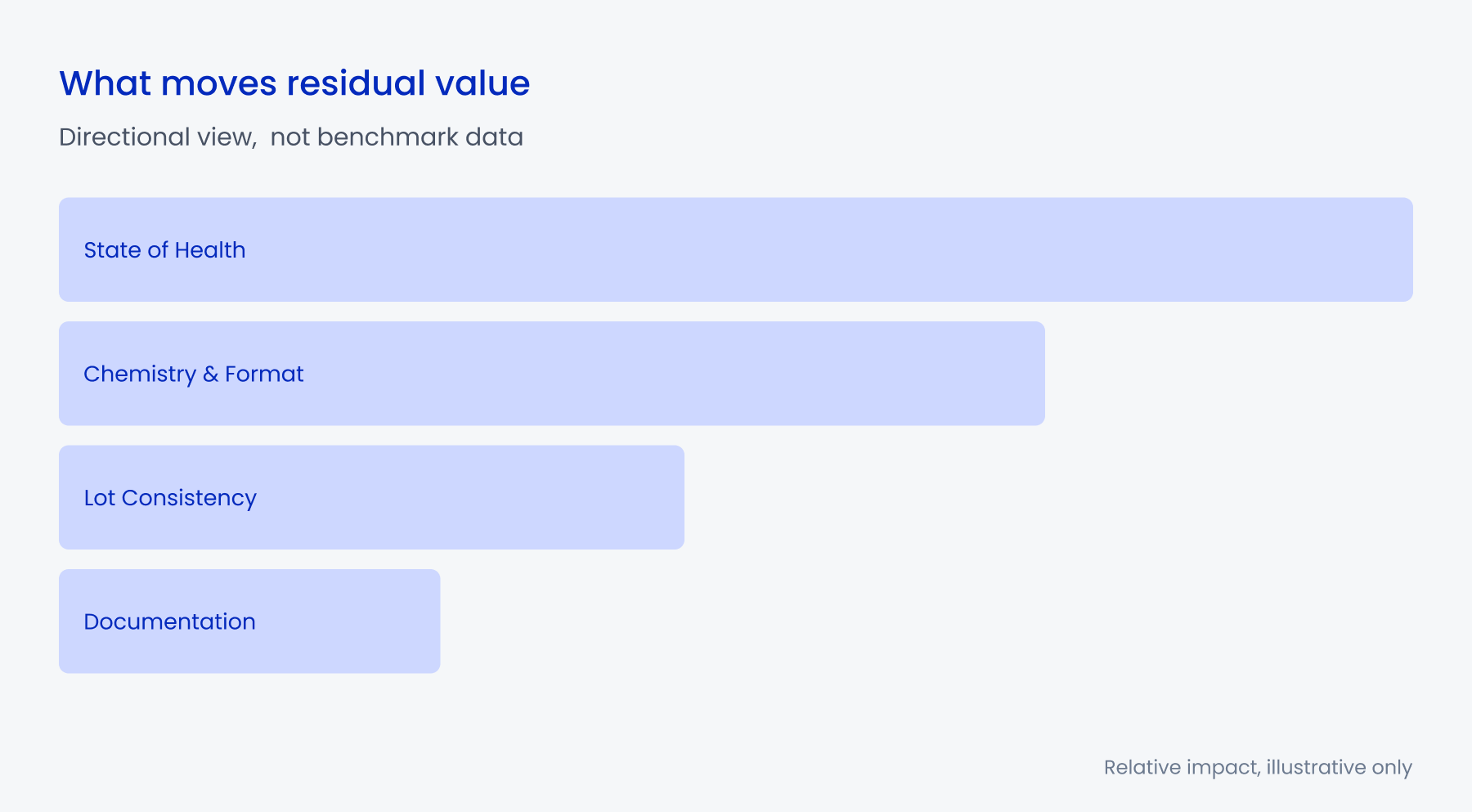
The single biggest driver of battery residual value. But "SoH 85%" on its own doesn't price a lot.
What matters to a buyer:
- How SoH was measured: Full discharge cycle? Pulse test? Manufacturer estimate? Method changes the confidence interval
- When it was measured: SoH from 18 months ago, with the pack sitting since, is not the same as a fresh test
- Module-level data matters more than pack-level averages. Second-life integrators repackage batteries at the module level, so that's the data they actually use.
- What use case it implies: A pack at 80% SoH may be excellent for stationary storage and useless for high-rate applications
A defensible SoH number includes the method, the date, the measurement level, and ana usable conclusion. A vague SoH number costs you money. Buyers will assume the worst and price accordingly.
Factor 2: Chemistry and Format
Not all chemistries hold their value the same way.
Lithium Iron Phosphate (LFP) batteries
Tend to hold their resale value well in stationary storage. If your lot is LFP, that works in your favour. LFP is the preferred second-life chemistry for Battery Energy Storage Systems (BESS). Long cycle life, thermal stability, and predictable degradation drive consistent demand and a more stable resale value.
Lithium Nickel Manganese Cobalt Oxide (NMC)
Lots are more sensitive to use cases. NMC's higher energy density and predictable SoC are selling points, but not for everyone. Degradation patterns and thermal management requirements reduce the buyer pool. A smaller pool puts more pressure on second-life pricing.
Format matters as much as chemistry. Buyers pay more for formats they already know how to work with. Modules from established commercial vehicle or EV platforms are easier to integrate. That ease of integration shows up directly in the price.
Same SoH doesn't mean the same price. LFP modules from a known platform always price better than mixed-chemistry packs from a fragmented source.
Factor 3: Lot Consistency
Buyers don't buy single modules. Buyers deploy modules together, so the whole lot has to work as one.
A lot of 200 modules with SoH ranging from 78% to 92% is harder to use than a lot of 200 modules sitting between 84% and 88%. Integrators have to either screen further (cost) or design around the worst case (lost capacity). Both outcomes reduce what they're willing to pay.
What buyers look at:
- SoH distribution across the lot: narrow is worth more than wide
- Source uniformity: same fleet, same usage pattern, same age = lower risk and higher residual value
- Thermal event history: any module that's been outside spec drags the entire lot's price down
A "clean" lot with a tight distribution can price meaningfully above a "noisy" lot of the same average SoH. This is where many sellers leave money on the table they list by average, not by distribution.
Factor 4: Documentation Completeness
The least technical factor and often the most decisive in used battery lot pricing.
Two lots with identical specs and SoH can price 20–30% apart based on what evidence travels with them. A buyer who must assume risk because data is missing will price that assumption in.
The documentation that moves price:
- Original manufacturer specifications
- Usage history (mileage, charging patterns, environment)
- Test reports with method and date
- Thermal incident log (or confirmed absence)
- Chain of custody since end of first life
- Compliance documents for transport and, where relevant, waste classification (increasingly important under the EU Battery Regulation)
Buyers treat lots with a complete data pack as known quantities. That confidence shows up directly in the price. Tell a buyer "we'll send the documents later" and they'll price your lot as a risk. Because that's exactly what it is.
How to Defend a Price (Seller View)
If you're listing a lot, build the price around evidence, not hope. Here's how to argue for strong battery residual value:
- Establish the floor: Get a recycling quote for the same lot. That's your battery scrap value the "do nothing else" number
- Anchor the ceiling: Identify the new-equivalent price per kWh for the use case your lot fits. Stationary storage (BESS) is most common
- Position your lot within the corridor: Your position in the spread isn't a guess, it's an argument. Build it around SoH, chemistry and format, lot consistency, and documentation completeness
- Make the argument visible in the listing: The buyer's first read of your listing should answer "why this price"
A price without proof gets pushed down. A price with proof holds up.
How to Challenge a Price (Buyer View)
If you're sourcing, the same four factors give you a structured way to push back.
- Ask for the SoH method and date, not just the number
- Ask for the SoH distribution across the lot, not the average
- Ask what's in the documentation pack before you make an offer
- Benchmark against the new-equivalent price per kWh for your specific use case
A seller who can't answer these questions is usually pricing on hope. A seller who can is usually pricing fairly, and you save time arguing.
Where the Second-Life Battery Market Is Heading
Battery residual value pricing is getting sharper. Three forces are driving it:
- New-pack prices are compressing the ceiling: That forces second-life pricing to be tighter and more defensible
- A complete data pack used to set a lot apart. Under the EU Battery Regulation and Battery Passport, it's quickly becoming the minimum buyers expect. Lots without documentation will increasingly struggle to find buyers at fair prices.
- Marketplaces with standardized listings are making lots comparable: Comparability is the precondition for transparent used battery lot pricing. The grey zone between scrap value and new-pack cost is shrinking. Consistent data across more listings is what's making it easier for both buyers and sellers to find fair ground.
The gut-feel era isn't over. But the lots priced by evidence and the people who can argue with that evidence are the ones closing deals.
See What Lots Are Worth on the Open Marketplace
See what's listed, browse battery lots, and get a real feel for second-life battery pricing in the market today.
Explore the Circunomics Marketplace →
FAQ
What is residual value in the context of used batteries?
Residual value is what a battery is worth after its first life. It's the value that remains before recycling becomes the only option left. For sellers, it's the realistic price a lot can fetch on the market. For buyers, it's the maximum they should reasonably pay, based on the lot's condition, chemistry, and documentation.
What is the floor price for a used battery lot?
The floor price is what a recycler would pay for the lot. It is the material value of the batteries minus processing costs. It's the "do nothing else with this lot" benchmark and the lowest realistic price a seller should accept. Getting a recycler quote before listing a lot gives sellers a useful pricing anchor.
What documents should travel with a battery lot to maximize its value?
These are the documents that most directly move price:
- Original manufacturer specifications
- Usage history: mileage, charging patterns, operating environment
- Test reports with method and date
- Thermal incident log, or confirmed absence of incidents
- Chain of custody since end of first life
- Transport and waste classification compliance documents
How is second-life battery pricing changing with the EU Battery Regulation?
The EU Battery Regulation and the Battery Passport are making documentation a baseline expectation rather than a differentiator. As standardized listings on battery marketplaces make lots more comparable, pricing is becoming more transparent and evidence-based. Sellers who can back their price with data are increasingly closing deals faster and at better prices.
Does battery chemistry affect resale value?
Chemistry and format are two of the clearest value signals in a used battery lot. LFP (Lithium Iron Phosphate) holds up well in stationary storage, long cycle life and predictable degradation give buyers confidence. NMC (Lithium Nickel Manganese Cobalt Oxide) is more sensitive to use case, which narrows the buyer pool. Standardized modules from known platforms consistently price higher than bespoke or mixed-format lots.