You have batteries. Perhaps you canceled a project, transitioned a fleet, or changed a model. The packs are still good. You know they have value, and you want to move them into BESS.
So, you reach out. You get into conversations. And then things start to drag. Procurement asks questions you did not expect.
A deal that feels close goes quiet for weeks and then falls apart. Another one closes, but at a worse price than you thought, and you are not entirely sure why.
Most of the time it is not the batteries that killed the deal. It is the information that didn’t travel with them.
Buyers building storage systems expect you to show where these packs came from, how your team used them, and what they can still deliver. When that picture is incomplete, the conversation gets difficult. Sometimes it just ends.
Why Data Makes the Difference in selling surplus Batteries to BESS
Selling surplus batteries into BESS is not the same as selling a commodity. BESS buyers do not treat batteries the way commodity traders treat steel or copper. They cannot.
A battery is not a static asset. Its performance reflects how your team used it. It also reflects how you stored it. It also reflects how you managed it before it reached the buyer.
A lot with 75% State of Health (SoH) from one source may differ. It may differ a lot with 75% SoH from another source.
They match only if both include the same second-life battery sales documents, test transparency, and thermal history.
Without that context, buyers protect themselves. They lower the offer, add a risk buffer, or step back entirely. And the ones who do stay often spend weeks piecing together information the seller could have handed over on day one.
The surplus battery procurement process moves faster for lots that arrive buyer ready. Those are the ones with complete data packs, clear testing records, and no documentation gaps.
Sellers who understand what buyers need before the first email close deals faster and at better terms. This article explains what makes a battery lot buyer ready. It also shows how sellers can prepare surplus batteries for sale.
The Buyer Ready Checklist: What BESS Buyers Need Before They Evaluate Your Lot
When a BESS procurement team looks at a surplus battery lot, they are running a qualification process. That process has defined inputs. If you provide them upfront, you move to the front of the line. If you do not, you are asking the buyer to do extra work, and extra work translates into longer timelines and lower offers.
1. Chemistry and Cell Format
This is the first filter. Buyers route lots differently based on chemistry.
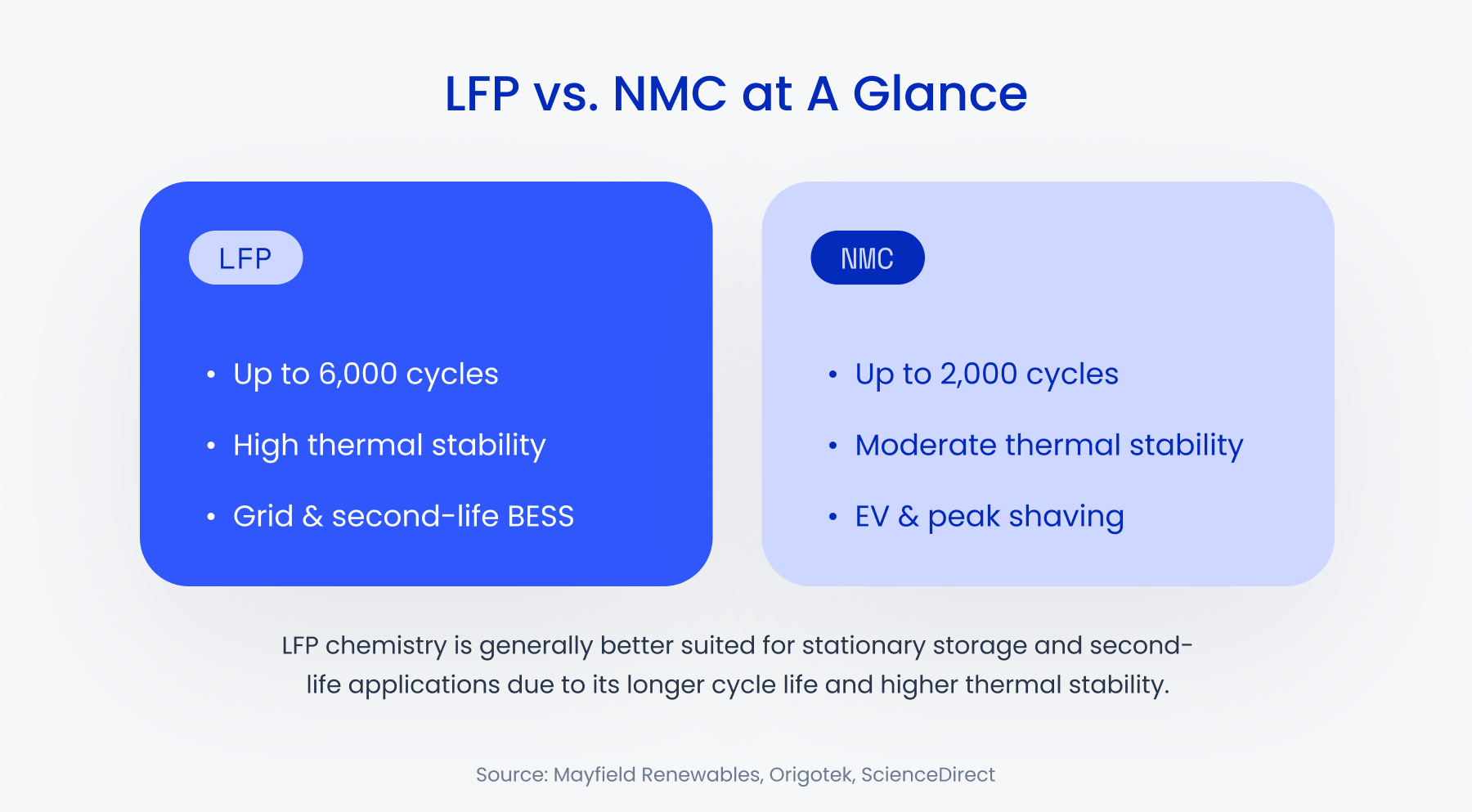
LFP vs NMC for second-life BESS is not just technical. It drives how procurement teams evaluate, price, and deploy each lot. Lithium Iron Phosphate (LFP) batteries are thermally stable.
They handle deeper discharge cycles well.BESS integrators frequently use them for stationary storage. This is where long life matters more than energy density.
Nickel Manganese Cobalt (NMC) batteries offer higher energy density but require tighter thermal management and degrade faster under stress.
If you cannot confirm whether your lot is LFP or NMC, the buyer can’t evaluate it. It is that simple.
What to provide:
- Chemistry (LFP, NMC, NCA, etc.)
- Cell format (prismatic, cylindrical, pouch)
- Rated capacity at manufacture
- Original equipment manufacturer and model if available
2. State of Health with Method Transparency
SoH is the central performance metric. But a number without a method is not usable.
Two sellers can report 73% SoH on similar lots. One measured it at 25 degrees using a full discharge cycle. The other estimated it from Battery Management System (BMS) logs at variable temperatures. Those are not comparable figures, and experienced buyers know it.
Proper battery State of Health documentation must include the value, the method, and the context, not just the percentage.
What to provide:
- SoH value (percentage)
- Testing method and protocol
- Testing date
- Baseline capacity used for calculation
- Name of testing entity (internal team or third party)
According to the European Commission Joint Research Centre, incomplete battery data limits confident performance assessments, especially for reused materials and operational history. That uncertainty travels directly into pricing conversations.
3. Lot Consistency and Spread
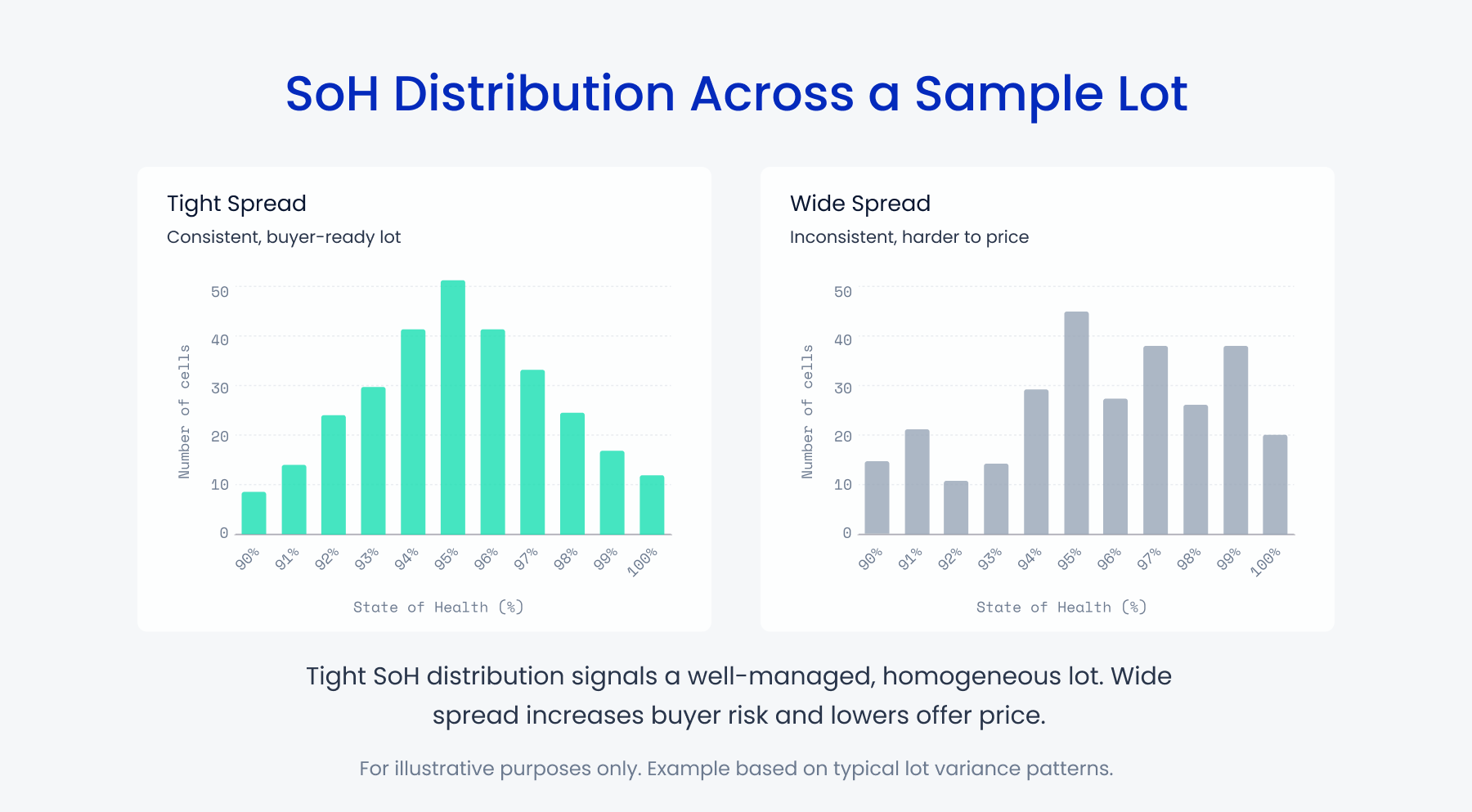
Average SoH tells part of the story. Battery lot consistency and SoH spread tell the rest.
A lot where individual modules range from 68% to 82% SoH is not a 75% lot. It is a heterogeneous lot. That creates integration complexity, uneven degradation curves, and maintenance issues that compound over time. BESS integrators need the distribution, not just the mean.
What to provide:
- SoH range across the lot (e.g., min, max and standard deviation)
- Number of modules or cells tested
- Sampling method if full testing was not performed
- Any outliers removed and the reason why
4. Cycle History and Usage Profile
Batteries degrade based on how they were used, not just how long they were in service. Battery cycle history records are one of the most valuable details a seller can provide.
They are also one of the most often missing.
A battery from an urban delivery fleet with shallow discharge cycles and moderate temperatures acts very differently.
This differs from a battery that spent years in a fast-charging taxi fleet. Both might show similar SoH. The remaining usable life of the battery lot and reliability profile are not the same.
If you can provide usage data, do. If you can’t, say it clearly. Buyers trust transparency more than estimates.
What to provide:
- Total cycle count if available
- Typical depth of discharge during operational life
- Operating temperature range
- Fast charging exposure (yes or no, and frequency if known)
- Application type (urban fleet, long haul transport, stationary backup, etc.)
5. Thermal Event History
Thermal event history in surplus batteries is a major hidden risk in surplus battery sales.
It is also the issue that kills the most deals when found late.
A battery that experienced thermal stress, even once, may show normal capacity but carry elevated risk under load. Buyers screen for this aggressively because thermal events are leading indicators of safety problems.
If your lot has a clean thermal history, document it. If there were incidents, disclose them. Non-disclosure creates liability and destroys deals when it surfaces during due diligence.
What to provide:
- Written confirmation of no thermal events if applicable
- Documentation of any over temperature events, thermal runaway, or fire incidents
- BMS logs showing temperature excursions if available
- Any safety inspections or certifications completed after an incident
The International Energy Agency has consistently noted that while battery costs are declining, deployment depends on system reliability, integration quality, and risk transparency. Thermal history is a core part of that transparency.
6. Storage Conditions Since Decommissioning
Batteries degrade in storage. The rate depends on temperature, humidity, and state of charge during storage.
A lot stored at 40 to 60% SoC in a climate-controlled facility degrades much slower.
It degrades slower than one stored at full charge in an outdoor warehouse.
Wide temperature swings in the warehouse make degradation worse. Buyers want to know what happened between decommissioning and the current offer.
What to provide:
- Decommissioning date
- Storage location type (climate controlled, outdoor, warehouse)
- Storage temperature range
- Storage state of charge level
- Any maintenance or testing performed during storage
7. ADR Transport Documentation for Lithium Batteries
If your batteries can’t legally move across borders or regions, the deal is over before it starts.
ADR transport documentation for lithium batteries is a non-negotiable requirement for BESS buyers. Procurement teams expect you to confirm transport classification compliance and identify any damaged, swollen, or disqualified units upfront.
What to provide:
- ADR transport classification per UN/ECE ADR regulations
- UN number for the battery type
- Confirmation that no units are physically damaged, swollen, or leaking
- Any prior transport documentation or safety certifications
8. Traceability and Chain of Custody
The EU Battery Regulation and surplus batteries are increasingly linked. The regulation, which entered into force in August 2023, is tightening traceability requirements. Understanding Digital Battery Passport seller requirements is no longer optional. From 18 February 2027, the Digital Battery Passport will be mandatory for batteries entering the market.
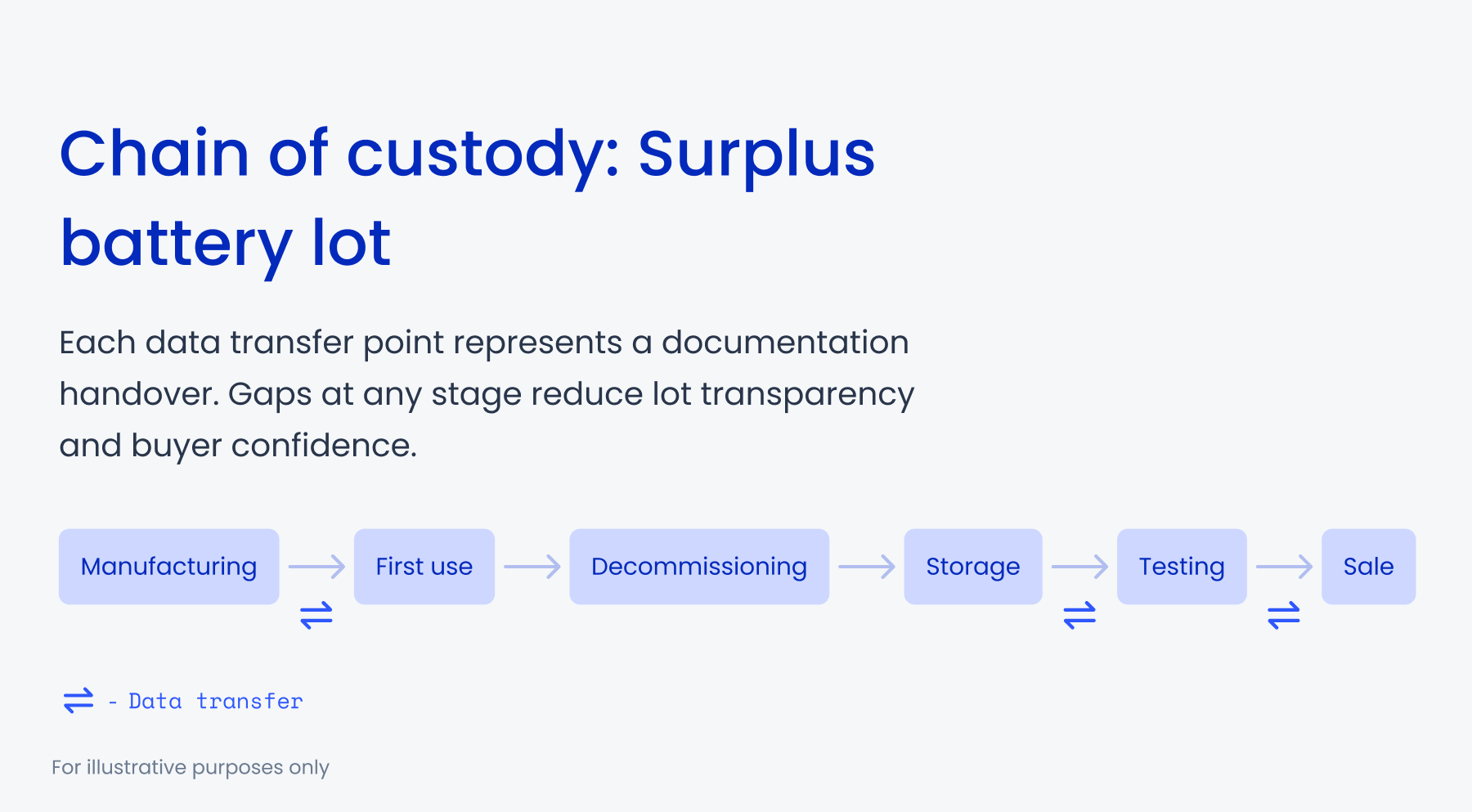
Battery traceability and chain of custody are already becoming a procurement prerequisite. A lot with a clear chain of custody, from manufacturing through decommissioning, is worth more than one without.
What to provide:
- Original manufacturer and production batch
- First application and operational timeline
- Ownership history (fleet operator, leasing company, OEM, etc.)
- Any prior testing, refurbishment, or requalification records
- Unique identifiers such as serial numbers, BMS IDs, or other persistent IDs
Why Surplus Battery Deals Fall Apart — from the Seller’s Side
Understanding why surplus battery deals fall apart is the first step to preventing it. Most deals slow down or collapse in the same places — and it is rarely a pricing disagreement. It is an information gap.
The information usually exists. Nobody gathered it, documented it, or passed it along.
SoH reported without a method. You tell the buyer 75% SoH. Buyers immediately ask how you measured it. You do not have a clear answer. The conversation stalls.
Thermal history is unclear. The buyer asks about over-temperature events. You are not sure, or you did not track it. They assume the worst and price accordingly.
Storage conditions are unknown. After decommissioning, the batteries went to a warehouse — but nobody tracked temperature or state of charge. The buyer has no way to estimate what happened to them since.
Transport documentation is incomplete. You reach commercial terms, then discover the ADR paperwork is not in order. The deal pauses while you chase certifications.
Nobody tested lot consistency. You report average SoH but cannot tell the buyer the spread. They assume high variance and adjust their offer or walk away.
What Changes When a Lot Is Buyer Ready
When a surplus battery lot arrives with full documentation, the buyer can act faster. The test records are clear. No information is missing.
Procurement teams do not spend weeks reconstructing asset histories. Engineers do not request the same documents three times. Legal teams do not discover compliance gaps at the contract stage.
Here is what changes in practice:
- Qualification happens in days, not weeks. Buyers evaluate the lot against their requirements immediately instead of waiting for missing data
- Pricing reflects actual risk, not assumed risk. When buyers have full transparency, they do not build in margins for unknowns
- Contracts close faster. Clear documentation means fewer renegotiations and fewer last-minute surprises
- Your lot competes on merit, not on effort. Buyers choose the cleanest, best documented option when performance is comparable
The market is moving toward standardized listings and structured platforms where data travels with the asset. Sellers who prepare lots to that standard now will be ready when volumes scale and competition tightens.
How to Build a Buyer Ready Data Pack Before You Start Outreach
Treat documentation as part of the product, not an afterthought. Knowing how to sell surplus battery lots starts here. Here is a practical sequence:
- Gather manufacturing and usage records. Pull original specs, production batch details, and operational history from your asset management system or OEM records
- Conduct or commission SoH testing. If you have not tested the lot recently, do it now. Use a consistent protocol and document the method, temperature, and baseline capacity
- Check lot consistency. Test a representative sample to confirm SoH spread.High variance? Split or grade the lot before you start outreach
- Document storage and handling. Log where the batteries have been since decommissioning, at what conditions, and for how long
- Confirm transport readiness.Verify ADR classification. Flag any physically compromised units before outreach
- Compile a single data pack. Organize all of the above into a structured document or listing that travels with the lot. Do not make buyers ask for it
This process aligns with EN 18061:2025, the European standard for second life battery qualification. Using it as your framework gives your output a clear, defensible structure and a shared language with the buyers across the table.
The Market Is Shifting Toward Structured Listings
Selling surplus batteries the old way uses messy emails, scattered offers, and uneven data. This creates friction that slows deals and reduces value for both sides.
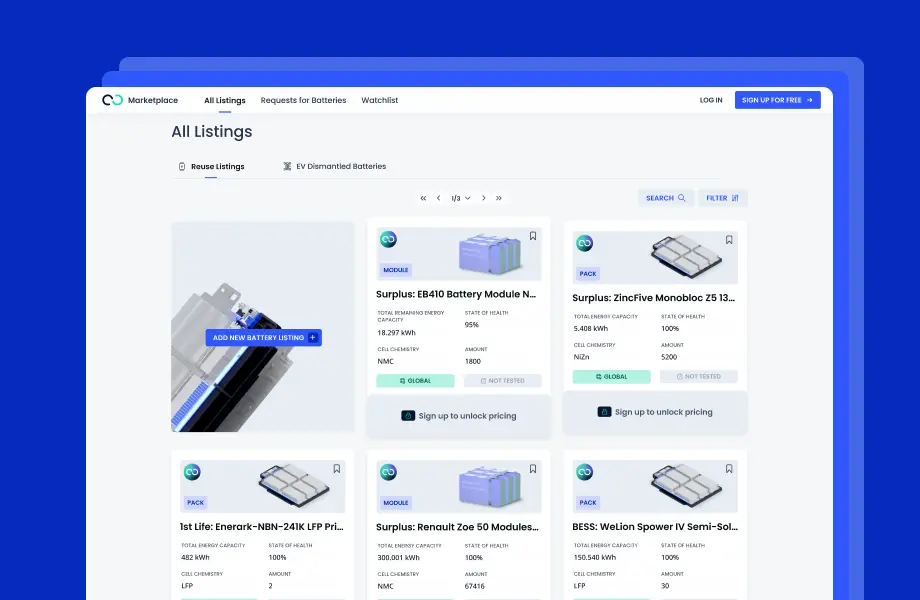
B2B battery marketplaces for surplus lots, like the Circunomics B2B Battery Marketplace, are changing that. Platforms like Circunomics standardize how buyers and sellers list and evaluate battery lots.
Chemistry, SoH, usage history, and traceability data are standard fields in every listing. The data stays with the asset. You do not need to chase it after the fact.
For sellers, this means a faster time to market, more buyer interest, less repeat paperwork, and clearer pricing.
Data is the foundation of circularity. Without it, surplus supply stays potential. It does not become deployed capacity.
Six Actions to Take Now
- Audit what data you already have. Most sellers have more information than they realize. It lives across systems, teams, and filing cabinets — rarely in one place. Consolidate it
- Fill the gaps before outreach. If your team never tested SoH, test it now. Never tracked thermal history? Confirm it with the fleet operator or OEM. Do not leave unknowns for the buyer to discover
- Standardize how you present lot information. Build a template data pack you can reuse across lots. Make it a repeatable process, not a one time exercise
- Disclose what you do not know. If cycle count is unavailable, say so clearly. Buyers trust transparency more than estimates
- Treat traceability as a value driver, not a compliance checkbox. Lots with clear battery traceability, a strong chain of custody, and persistent IDs will sell for more.
This will happen as Digital Battery Passport rules take effect in February 2027
- Use platforms that make documentation a requirement from the start. Structured marketplaces eliminate the need to chase data after initial outreach. Your lot competes on quality, not on how much work the buyer must do
From Inventory to Revenue
Surplus batteries are entering the market at scale. Fleet transitions, model changes, and production overcapacity are creating supply faster than the BESS sector has historically absorbed it.
But supply alone does not create liquidity. Buyer ready lots do.
The difference between a battery lot that moves quickly and one that sits in storage for months is not always performance. It is documentation. It is transparency. It is the work sellers do before the first conversation with a buyer.
BESS procurement teams want assets they can evaluate, finance, and deploy. They don’t want to spend weeks rebuilding histories or finding gaps during contract review.
Sellers who share clear details early can sell their inventory faster.
They can also close deals with better terms. This helps them build a strong reputation in a market that rewards structure.
The question is not whether your batteries have value. The question is whether buyers can verify that value without doing your work for them.
List your surplus battery lot on the Circunomics B2B Battery Marketplace. It includes structured data, standardized listings, and built-in regulatory readiness.
Related Readings
- Surplus Battery Qualification for BESS: A Proven Workflow Read the buyer side process →
- Cheap Battery Modules Won’t Make Your BESS Bankable Why documentation matters →
- Battery Compliance Timeline 2025–2027 What to build now →
- SoH Insights: The Key to Better Batteries Educational deep dive →
FAQ
What do BESS buyers need from surplus battery sellers before they evaluate a lot?
BESS buyers need a complete data pack before they can evaluate a surplus battery lot. This includes chemistry and cell format. It also includes State of Health (SoH) with a documented test method.
Provide lot consistency data that shows SoH spread across modules. Include cycle history and the usage profile. Include thermal event history. Provide storage conditions since decommissioning. Include ADR transport documentation.
Sellers who provide this upfront move faster through procurement and close deals at better terms. Incomplete documentation is the most common reason surplus battery deals stall or fall apart
Why does SoH need a testing method — is the number not enough?
SoH without a testing method is not a usable figure for BESS procurement. Two sellers can report 75% SoH on similar lots using different methods. One measured it at 25°C with a full discharge cycle. Another estimated it from BMS logs at changing temperatures.
Those figures are not comparable and are not contractable. BESS buyers need the SoH value, the testing protocol, the test date, the baseline capacity used, and the tester’s name. Without method transparency, buyers build a risk buffer into their offer — or walk away entirely.
How does thermal event history affect surplus battery pricing and deal outcomes?
Thermal event history is the most underestimated risk factor in surplus battery sales. A battery that experienced thermal stress — even once — may show normal capacity but carry elevated risk under load. BESS buyers screen for this aggressively because thermal events are leading indicators of safety problems.
A lot with a clean, documented thermal history earns a higher price than one with unknown history. Non-disclosure creates liability and destroys deals when it surfaces during due diligence. If your lot has a clean record, document it. If there were incidents, disclose them early.
What is a buyer ready battery lot and why does it matter for sellers?
A buyer-ready battery lot arrives with complete documents and clear test records, with no missing information.
This lets BESS procurement teams review it at once without chasing missing data. In practice, this means full SoH documents with clear methods. It includes lot consistency data and cycle history.
It also covers thermal event records and storage conditions. It must meet ADR transport rules.
Buyer ready lots move faster through qualification, attract more competitive offers, and close at better terms. Lots without this documentation sit longer. They attract lower bids. They often lose out to better documented options, regardless of battery quality.
How does the Digital Battery Passport affect sellers of surplus battery lots?
The Digital Battery Passport (DBP) will be mandatory from 18 February 2027 under the EU Battery Regulation. It will require batteries entering the market to have persistent identifiers.
It will also require standard data records on performance, traceability, and lifecycle history. For surplus battery sellers, this means lots with a clear chain of custody are easier to sell.
Lots with documented SoH and traceable operating history will also sell faster. As DBP requirements take effect, these lots will command higher prices.
For surplus battery sellers, this means lots with a clear chain of custody will be easier to sell. Lots with documented SoH and a traceable operating history will also sell faster.
As DBP rules take effect, these lots will likely command higher prices. Sellers who add traceability and documentation to their process now will be better prepared. They will be ready when the regulation takes effect. They will also meet changing buyer expectations.