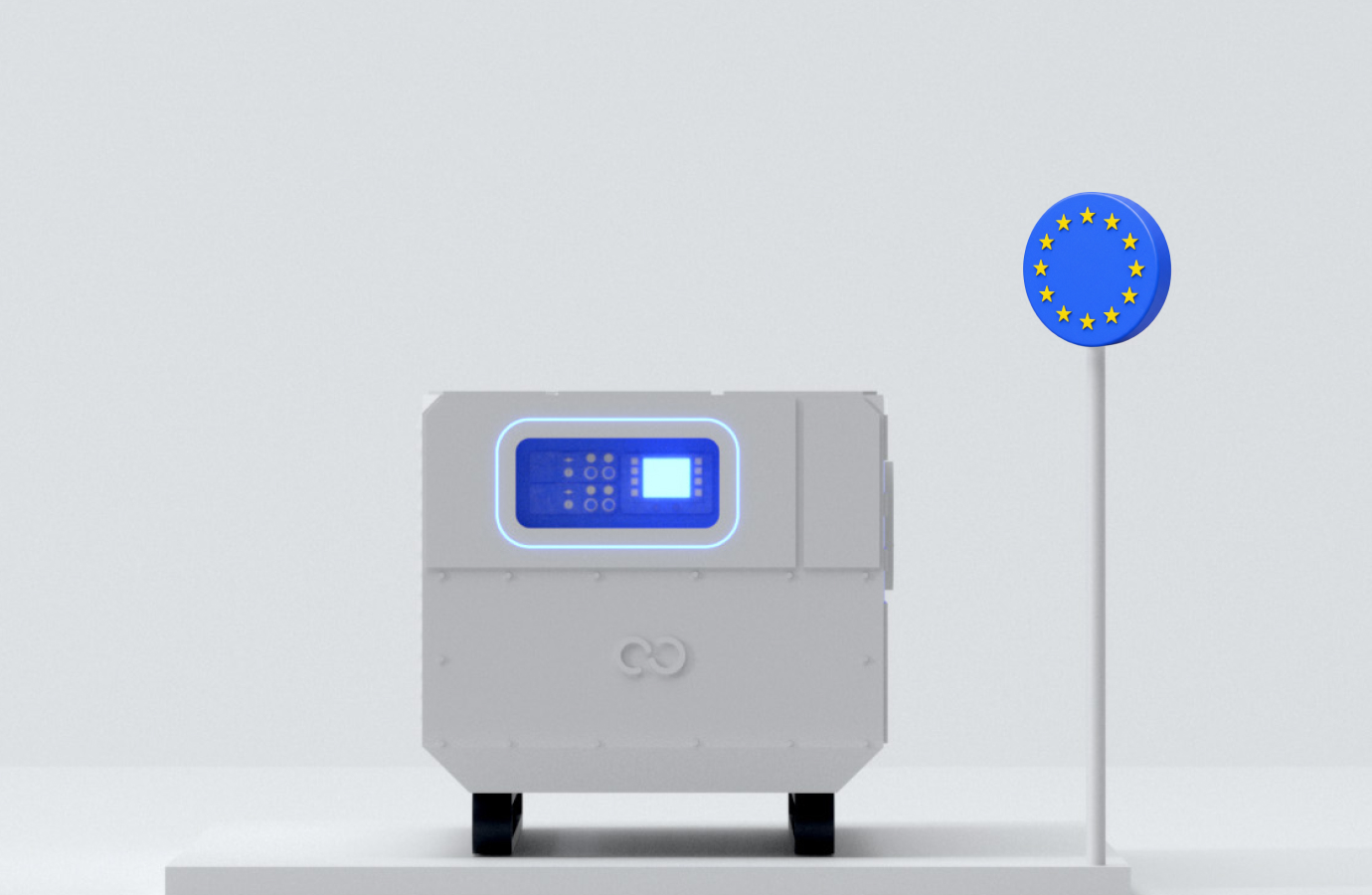
Prices are falling. Supply is expanding. Yet bankable storage projects are not being deployed as fast as either trend suggests.
Walk into any conversation about energy storage right now, and someone will mention how cheap batteries have become. That part is true. What gets left out is battery data transparency. Whether the batteries can be validated, documented, and financed by investors who cannot afford to guess.
That gap between availability and deployment is where most projects quietly stall. Understanding it is the first step to closing it.
What Battery Oversupply Actually Looks Like
The current oversupply did not emerge from a single cause. Manufacturers scaled up production quickly. EV demand grew more slowly than earlier projections suggested.
Several large storage projects were delayed or reconfigured. The result is a battery market with more supply than demand, and falling prices to match.
A second supply stream is also growing, and it changes the picture further.

As Felix Paul Wagner, CEO of Circunomics, has noted
"A large share of batteries leaves automotive use with 70–80% remaining capacity. That is not waste. It is new supply."
Electric vehicle batteries, primarily LFP and NMC battery packs, still hold meaningful capacity after first life and can serve stationary storage for years.
LFP cells are particularly well suited to this transition. Their thermal stability and long cycle life make them a practical fit for grid applications.
NMC battery packs offer higher energy density, but their state of health battery (SoH) degrades faster under temperature stress and deep discharge cycles making second-life planning more complex. Chemistry awareness shapes the routing decision before anything else does.
This supply expansion is structural. On the surface, the market looks full of opportunity. But dig deeper and the quality and documentation behind each asset tells a different story.
What Does Battery Qualification Mean for BESS Projects?
Battery qualification is the process of confirming that a specific asset is technically suitable, commercially viable, and operationally safe for a defined application. In BESS projects, that process goes well beyond a visual inspection or a single data point.
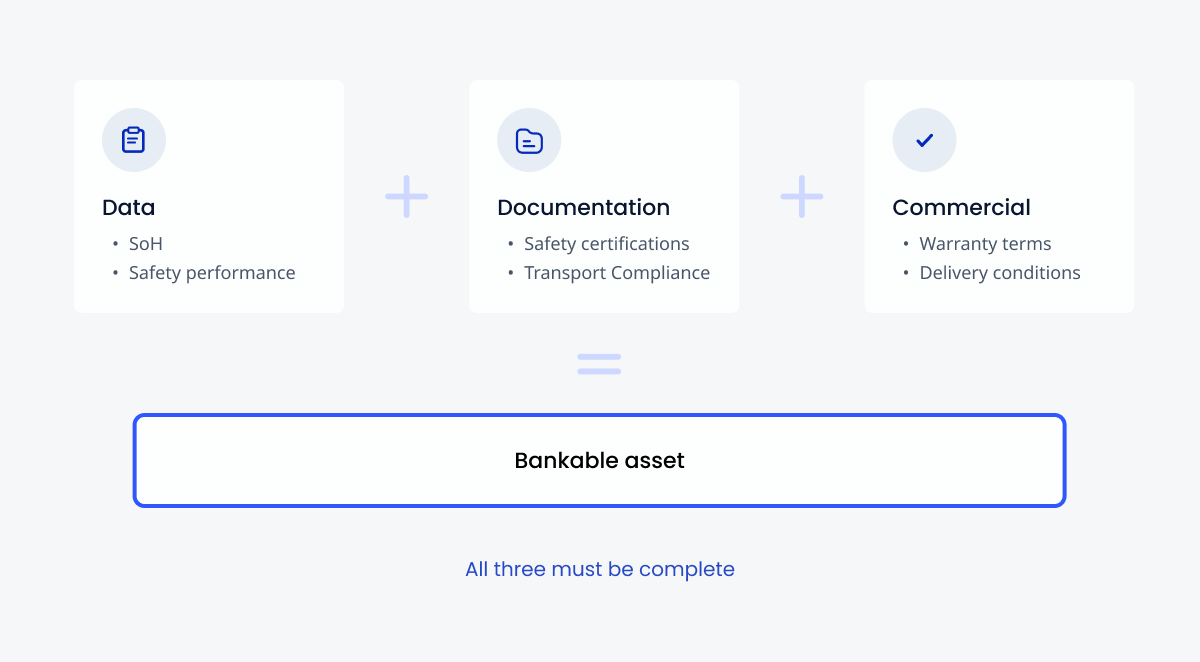
Three elements need to be in place simultaneously:
- Technical validation: performance data, SoH, test methodology, and chemistry-specific behavior under real operating conditions
- Documentation completeness: safety certifications, transport compliance, storage history, and chain of custody
- Commercial clarity: warranty terms, liability allocation, and delivery conditions defined before negotiation begins
When any one of these is missing or unclear, the others cannot compensate. A battery with excellent SoH data and no safety certification is not deployable. A battery with full documentation and ambiguous warranty terms creates financing risk. All three have to hold.
A Low Price Attracts Attention. It Does Not Answer the Questions That Matter.
Think about how people approach a used vehicle purchase. The price gets them in the door. But before signing anything, a serious buyer wants answers:
- What is the service history?
- What condition is the engine in?
- How was the vehicle used?
A steep discount on a car with no records is not a deal, but a different kind of risk.
Battery energy storage systems work the same way, scaled up considerably. These are long-term infrastructure investments that engineers, insurers, and lenders all review before a project moves forward. Each of those parties is asking something specific:
- Will this perform reliably over the project lifetime?
- Is it safe to operate under real conditions?
- Can the risks be quantified well enough to finance?
A low module price does not answer any of those questions. The data does. The documentation does. The commercial terms do.
The International Energy Agency (IEA) has consistently noted is clear: while battery costs are declining, deployment depends on system reliability, integration quality, and risk transparency.
Not All Battery Oversupply Is the Same
Treating oversupply as a uniform category is where buyers run into trouble.
Today's battery market includes unused modules from canceled or delayed projects:
- Surplus inventory from battery manufacturing overstock
- Batteries displaced by changing technical specifications
- Second-life electric vehicle batteries with documented operational histories
Each of these categories carries a different level of data availability, documentation quality, and traceability.
That variation is where complexity begins and where project timelines shift.
As Felix Wagner has observed:
"We are not just seeing more batteries. We are seeing a wider range of asset types entering the market, each with very different levels of transparency."
A surplus module from a canceled project may arrive with full factory documentation. A second-life battery from an automotive fleet may have partial service records.
A battery sourced through an unstructured resale channel may have almost none. The origin of an asset shapes how long qualification takes and whether it is possible at all.
Where Projects Actually Stall
The price discussion is rarely what holds a project back. Delays usually begin when the details need to be checked.
An engineer questions how SoH was measured and under which conditions. A legal team finds that warranty coverage is unclear or absent. Compliance documentation turns out to be incomplete.
Transport classification does not match the asset. Each of these is a resolvable problem on its own. Together, they create friction that compounds across weeks.
Longer validation cycles. Repeated back-and-forth between parties. Delayed decisions. And a project timeline that becomes harder to defend to lenders.
The European Commission Joint Research Centre (JRC) has found that incomplete battery data transparency. Particularly around battery recycling and reused materials, limits how confidently performance and environmental impact can be assessed. That uncertainty does not stay in the sustainability section of a project report. It travels into financing conversations.
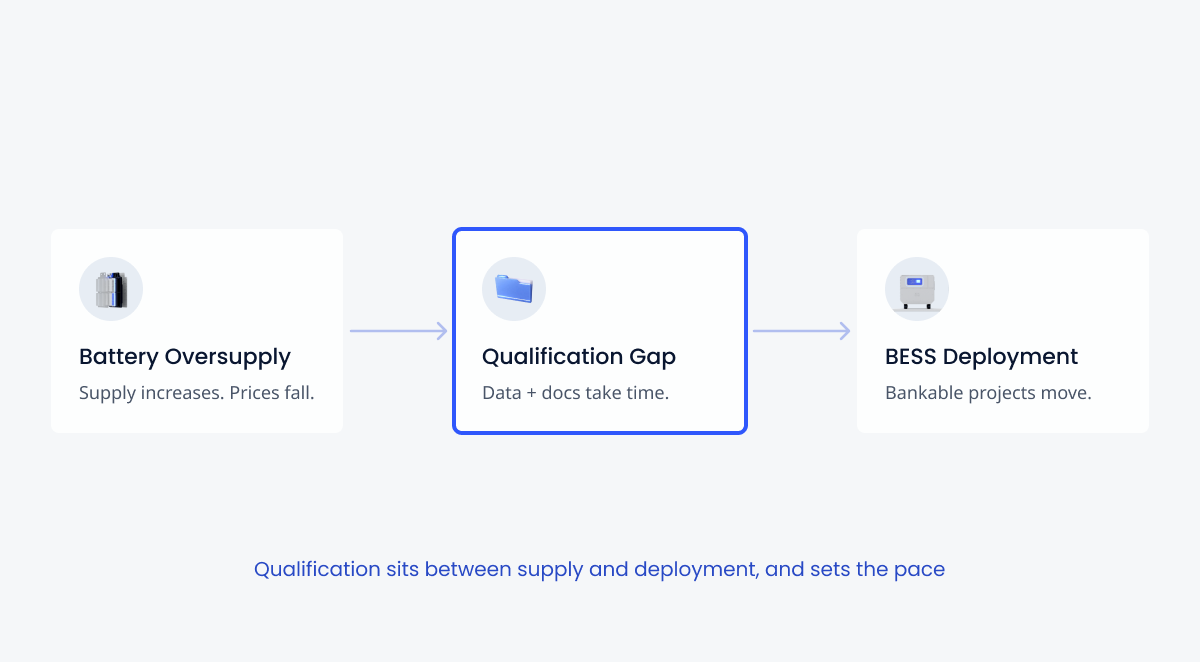
What Bankability Actually Requires
A bankable BESS project is one where risks are measurable, transparent, and clearly allocated. Getting there from a pool of oversupplied batteries requires three things to be true at the same time.
Data has to be comparable
SoH is the most critical metric in battery evaluation and also the most frequently misunderstood. Two suppliers can report identical SoH values using entirely different testing conditions, different temperatures, charge rates, discharge depths, measurement methodologies. Without transparency on how a number was produced, it cannot be meaningfully compared to anything else.

As Jan Born, CTO of Circunomics, explains:
"A single SoH number is not enough. What matters is how it was measured and how that translates into performance in a specific application."
He adds:
"Scaling battery reuse is not just about having supply. It is about creating the infrastructure that makes assets comparable and usable."
Documentation must be complete before commercial negotiation starts
Safety certifications, transport classification, and storage history cannot be open questions at the term sheet stage. Discovering gaps there adds weeks to timelines and erodes lender confidence in ways that are difficult to recover from.
Commercial terms defined upfront
Responsibilities, warranties, and delivery conditions need to be on the table before a project team commits. Ambiguity at this stage is not a negotiation position but a deployment blocker.
The Missing Layer: Structure in Battery Markets
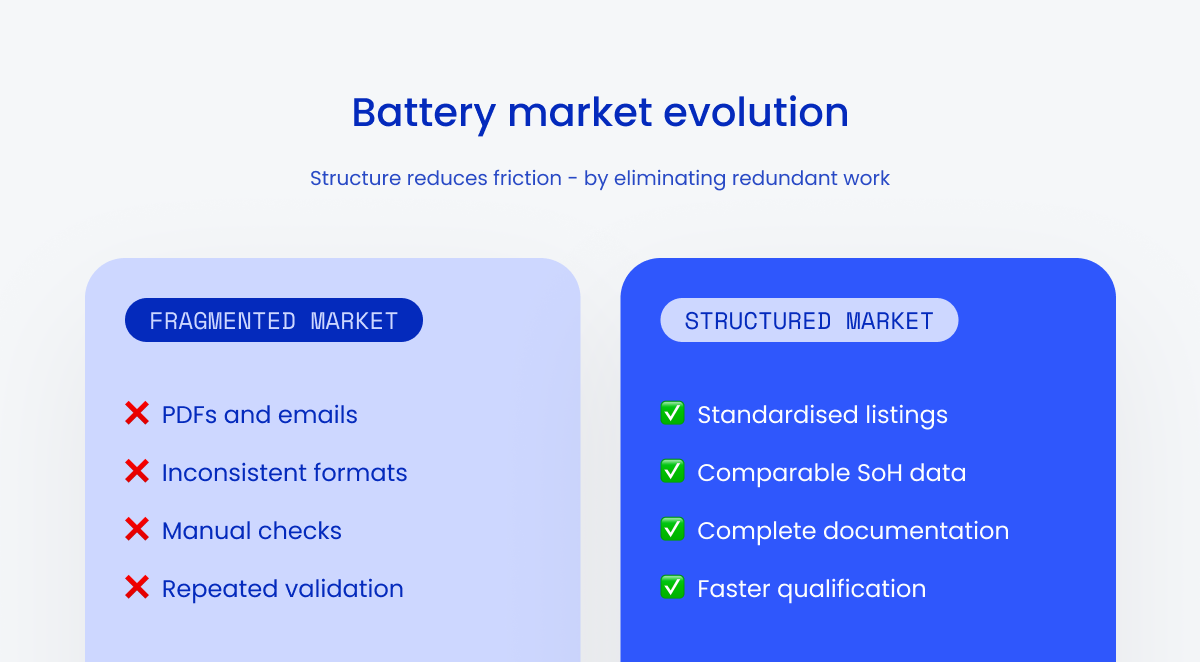
More supply creates more options. It also creates more work — unless the market has the infrastructure to make assets comparable from the start.
The reality is that much of the battery market still runs on fragmented channels. Unstructured offers. Inconsistent data. Long email threads that repeat the same information every single time a deal is made.
A buyer evaluating ten different suppliers is effectively running ten separate qualification processes, even if the underlying assets are similar.
That is changing. Standardized listings, comparable SoH data, and complete documentation that travels with the asset, not chased down after the fact. Changes how quickly a project team can move from interest to deployment.
Data is the foundation of circularity. Without it, oversupply stays potential. It does not become capacity.
Steps to Move from Oversupply to Deployment
Require methodology disclosure alongside SoH
A SoH figure without context is not a usable data point. Ask for the test conditions like temperature, charge rate, discharge depth, cycle count at time of measurement. This is the baseline for any meaningful comparison across assets.
Resolve documentation before commercial negotiation begins
Safety certifications, transport classification, and storage history should be confirmed before price discussions start. Finding gaps after a term sheet is signed adds time and introduces doubt at exactly the wrong moment.
Match chemistry to application requirements before anything else
LFP and NMC batteries behave differently in stationary storage. LFP offers thermal stability and long cycle life. NMC delivers higher energy density but requires tighter thermal management.
Selecting the wrong chemistry for a BESS application creates performance risk that no documentation can resolve after the fact.
Use structured platforms to reduce repeated validation work
When batteries are listed with standardized data fields and verified documentation, project teams spend less time reconstructing asset histories. That time goes toward evaluating fit instead — which is where the real decisions happen.
From Surplus to Infrastructure
Battery oversupply is real, and it is reshaping the economics of energy storage. The supply will keep growing. Second-life batteries from automotive fleets are entering the market at scale. Prices will stay under pressure.
Access to low-cost modules is only part of the picture. Projects move forward when batteries are properly qualified — backed by clear data, complete documentation, and workable commercial terms.
The Digital Battery Passport (DBP), mandatory across the EU from 18 February 2027, will formalize this requirement. Traceability, chemistry data, and performance history will become compliance infrastructure. Projects that build those habits now will move faster when the regulation lands.
For anyone working in energy storage today, the question is straightforward: how much of the available battery supply can you qualify for BESS deployment? Because that answer determines exactly how much of it becomes deployable capacity — and how much stays on the shelf.