If you produce, import, or sell batteries in the EU, the second half of 2025 wasn't just regulatory noise. Several obligations went from "coming soon" to enforceable.
New reporting requirements kicked in. Collection targets became measurable. And the timeline that seemed comfortable six months ago is now tight.
This isn't another regulation explainer. It's a timeline of what's mandatory now, what hits in the next six months, and what those deadlines mean for the systems you need to build.

18 August 2025: EPR Went Live Across the EU
Not proposed. Not optional. From 18 August 2025, the stricter EU Batteries Regulation’s EPR rules apply.
If you place batteries on the EU market, you're now legally responsible for financing their collection, treatment, and recycling. You're also on the hook for meeting collection rate targets and reporting what you sold versus what came back.
Here's what that looks like in practice:
Registration requirements
Every EU member state runs its own EPR scheme. Germany has one system.
France has another. Poland has a third. If you operate in all three, you register with all three.
Reporting obligations
Each scheme wants data on the batteries you put on the market: how many units, what chemistries, total weight. They want it in their format, on their schedule. Quarterly in some countries. Annually, in others.
The friction point
You're probably tracking sales data for revenue. You might be tracking it for a warranty. But EPR reporting needs product-level detail like chemistry type, weight, or battery category broken down by market.
If that data lives in different systems or doesn't exist at the granularity required, you've got a gap.
What Else Became Mandatory in August 2025
Batteries need a separate collection symbol. Chemical symbols for hazardous substances. Capacity information. And a QR code or data matrix that links to technical documentation.
It seems easy to coordinate packaging updates for many products. You also need to manage supplier labeling rules. Plus, you must ensure the digital side, the data behind the QR code, is correct and easy to access.
These aren't "nice to have" updates you can phase in slowly. When a battery goes to market now, it needs compliant labeling.
That means packaging, product documentation, and digital systems had to be ready before the deadline hits.
What's Happening Right Now (January 2026)
Producers who registered under EPR schemes in late 2025 are now in their first reporting cycles. Depending on the country, deadlines are hitting in Q1 or Q2 2026.
The data you need:
- Number of batteries placed on market by category and chemistry
- Total weight
- Collection and recycling data (where available)
- Proof of EPR financing contributions
If you work in many markets, you handle different formats, deadlines, and systems that do not connect. One centralized spreadsheet doesn't cut it.
EN 18061:2025 Is the Second-Life Standard
Published in 2025, EN 18061 sets the technical requirements for repurposing and remanufacturing batteries for second-life use. It's not legally required, but it's become the industry's baseline.
If you run a second-life operation, you must check the health, remaining capacity, cycle history, and safety standards. If you're a battery producer planning to recover value through second life, this matters to you too.
Why it matters now
You can only assess a battery's second-life potential if you know its history. How many cycles? What operating conditions? What is the current state of health?
If that data doesn't exist or isn't accessible, the battery enters a lower-trust, lower-value market. Or it doesn't enter the second-life market at all.
What Hits in the Next Six Months
First Full EPR Reporting Deadlines (Q1/Q2 2026)
Producers who registered in late 2025 are facing their first complete reporting cycles now.
If your data systems can't make the reports you need, you might be working manually. You could also use incomplete data. Both create risks.
Digital Battery Passport Build-Out
The DBP became mandatory on 18 February 2027. That's 13 months away. It requires disclosure of:
- Battery composition and chemistry
- Carbon footprint
- Sourcing and supply chain information
- Performance and durability data
- Dismantling and recycling instructions
Here's the backward math:
- Q4 2026: Final testing and pilot deployment
- Q3 2026: System integration and data validation
- Q2 2026: Data architecture finalized, supplier onboarding complete
- Q1 2026: Requirements mapped, system design locked
Starting DBP development in late 2026 doesn't leave enough time to build, test, and integrate the infrastructure. The window is now.
Supply Chain Due Diligence Reporting (Mid-2026)
- Battery makers will soon have to check their supply chain. They need to report on cobalt, lithium, nickel, and natural graphite.
- That means verifying sourcing, assessing environmental and social risks, and proving you've got mitigation strategies in place.
The gap:
- This requires visibility into upstream supply chains. You need documentation from raw material suppliers, smelters, and refiners. If you're not already requesting that information, the timeline to collect it is compressing.
What February 2027 Means for What You Build in 2026
To meet the DBP deadline in 13 months, the system's work has to start now.
The DBP isn't a data export feature you bolt onto existing systems. It's a lifecycle data architecture.
To learn more about DBP-ready data architecture, check out our white paper on EPR and system design here.
Information needs to flow from raw material sourcing through production, usage, and end-of-life. It needs to be structured, accessible, and verifiable.
If you're starting from scratch
You're looking at 12–18 months to design, integrate, and validate. That timeline starts now, not next year.
If you've got partial systems in place :You still need to map gaps, onboard suppliers, and test data flows. Waiting until Q3 2026 to finalize this creates compressed deadlines and higher risk of incomplete compliance.

What This Means for Different Players Battery
Producers and OEMs
EPR, DBP, and due diligence all need the same thing: structured data from production and supply chain. Chemistry specs, sourcing docs, production parameters, and end-of-life tracking.
The key difference is how you manage your time. If you create integrated data systems now, you will do better. If you rush to meet deadlines, you will have to fix reporting tools later.
Recyclers
With stricter EPR requirements, battery return volumes become more predictable, improving planning and process optimization. However, these benefits materialize only when incoming batteries are accompanied by reliable data. Without sufficient transparency, higher volumes increase operational complexity rather than efficiency.
A battery arriving with documented chemistry, contamination status, and hazardous content gets processed faster and safely. A battery arriving as a black box slows everything down and reduces material recovery value.
Second-Life Operators
EN 18061 gives you a qualification framework. But you can't qualify for a battery without its history.
Cycle count, depth of discharge, thermal exposure, state of health – all this needs to be documented during first life. When it is, second-life markets can scale. When it's not, you're stuck with lower trust and lower prices.
Compliance Teams
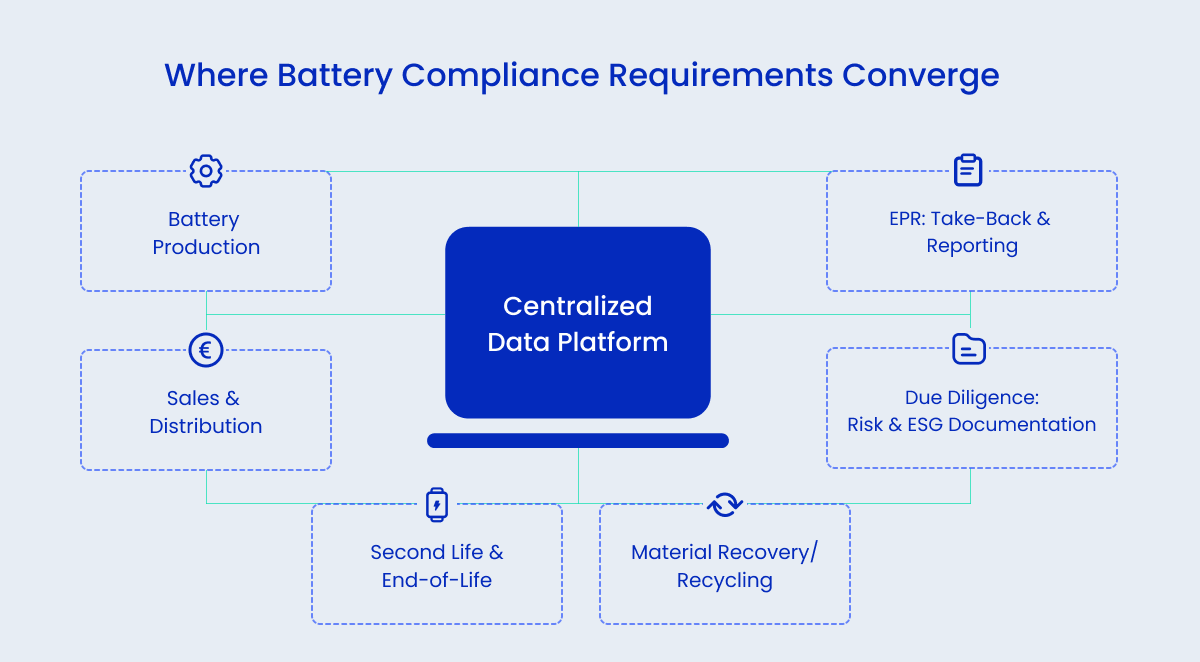
You're managing EPR reporting, DBP readiness, and due diligence prep simultaneously. All three pull from the same data sources: production systems, suppliers, logistics, end-of-life partners.
Building three separate reporting processes is inefficient. Better approach: design data capture once, use it across all compliance functions.
What to Do Now
Map your EPR obligations by market
Which schemes are you registered with? What are the reporting deadlines? What formats do they require? If you operate in multiple countries, can your systems generate compliant reports for each one?
Assess DBP readiness today, not in 2027
Which DBP data points do you capture in production? Which can you get from suppliers? Which is missing? The gap between what's required and what you have defines the scope of work for 2026.
Check if your production data supports second-life qualifications
If you're planning to recover value through second-life markets, confirm that usage data is being tracked. Without cycle count, operating conditions, and state of health, batteries can't be qualified under EN 18061.
Integrate compliance data across functions
EPR, DBP, and due diligence aren't separate projects. They all need data from the same sources. Design your capture systems once and apply them across multiple requirements.
Start supplier engagement for due diligence now
Supply chain due diligence needs documentation from upstream partners. Requesting sourcing certificates and risk assessments in mid-2026 creates bottlenecks. Start earlier.
The Timeline Is Tight
Battery regulation in the EU moved from framework to enforcement. August 2025 activated obligations that will expand through 2027 and beyond.
The companies that adapt well are building data systems now. They are adding compliance to their production processes. They treat regulatory deadlines like product timelines, not just last-minute legal tasks.
February 2027 isn't far away. It's the finish line for systems work that needs to be underway today.