If you have read our piece on why cheap battery modules won't make your BESS bankable, you already know the argument. Low module cost does not satisfy lenders, insurers, or grid operators.
What they need is proof of a documented State of Health (SoH). They also need a traceable history and a qualification record. It must hold up under scrutiny.
This article is the operational follow-up. Not the argument for why qualification matters. The workflow for how to run it.
Surplus battery due diligence starts earlier than most buyers expect. EV fleet transitions, model changes, cancelled programs a lot of inventory is moving.
Some of it is genuinely usable for BESS. Some of it is not. Most buyers cannot tell the difference fast enough to act on the good lots before they move.
What follows is a five-gate surplus battery procurement process. From first contact with a lot to a go/no-go decision, with the documentation to back it up.
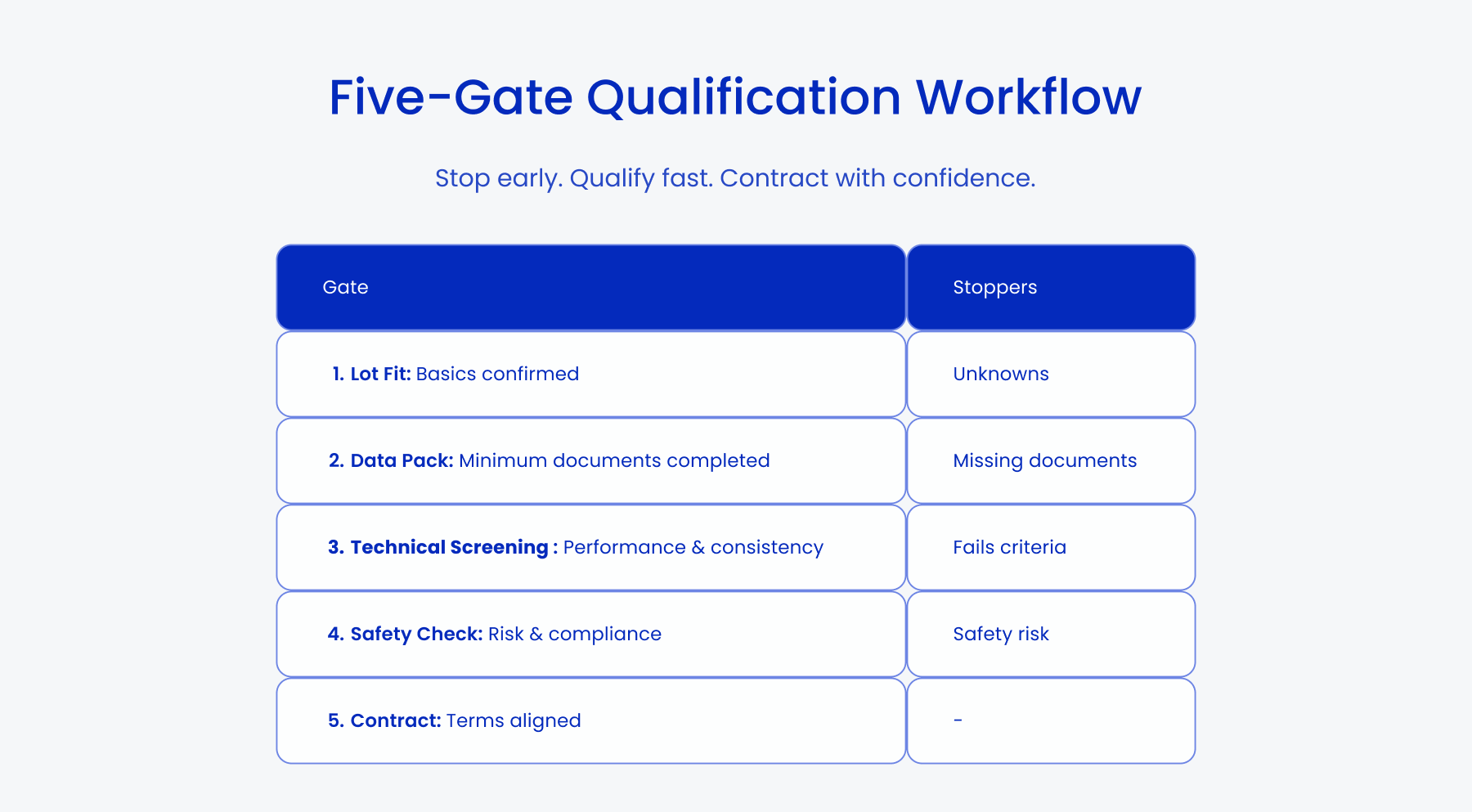
Gate 1: Lot Fit Before You Spend Engineering Time
You can complete the first filter in under an hour as an initial desk review, if the seller shares basic lot data upfront. It helps rule out many items that are not ready for BESS evaluation. This happens before engineering time goes into deeper testing.
Before evaluating a lot in more detail, buyers need a small set of basic inputs for an initial screening. These are not the complete qualification package. However, they are usually enough to decide whether a lot needs a deeper technical review.
In an unstructured market, you often must collect this information by hand from the seller. It often arrives incomplete or in inconsistent formats:
- Chemistry and cell format: LFP, NMC, prismatic, cylindrical, pouch
- Original application: EV, stationary, industrial, telecom backup
- Manufacturing date and production batch: not the decommissioning date
- Cycle count or estimated usage history: even a rough figure matters
- BMS data availability: yes/no, and in what format
- Storage conditions since decommissioning: temperature, humidity, duration
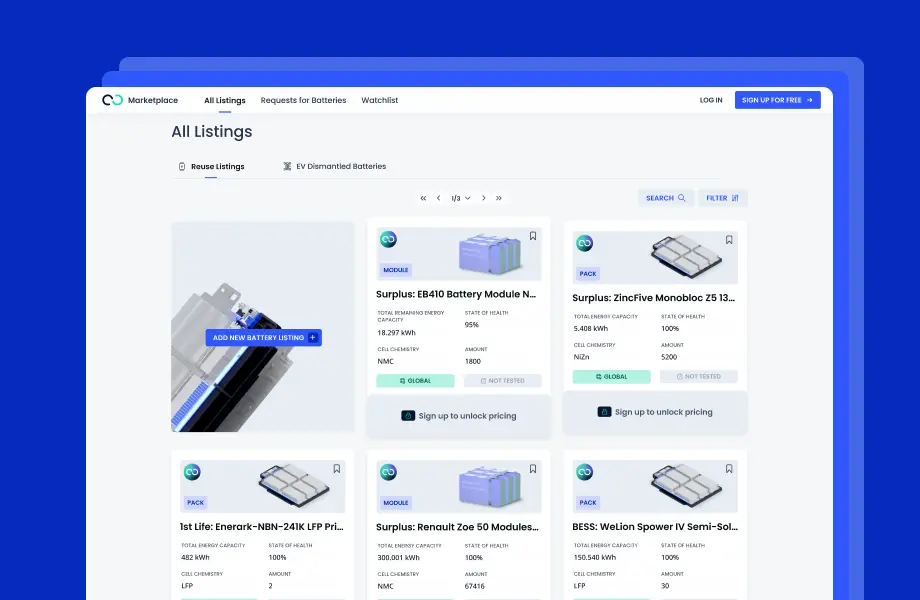
On the Circunomics Marketplace, these fields are standard in every listing.This includes chemistry, SoH, usage history, and battery traceability data. The data stays with the asset.
You do not need to chase it after the fact. That change show fast you can move from first contact to go/no-go.
Chemistry matters most at this stage. LFP lots are generally more stable under storage and more tolerant of partial SoH degradation for BESS use. NMC lots need tighter SoH thresholds for BESS and more careful thermal history review. The routing decision starts with chemistry, not with a price sheet.
Decision rule: If chemistry is unconfirmed, manufacturing date is missing, and storage conditions are unknown — stop here.
The lot is not ready for serious BESS evaluation.
Gate 2: The Minimum Data Pack
If the lot passes the first filter, the next step is assembling a battery minimum data pack. This is a defined document, not a checklist you improvise per deal. Without it, you are testing blind.
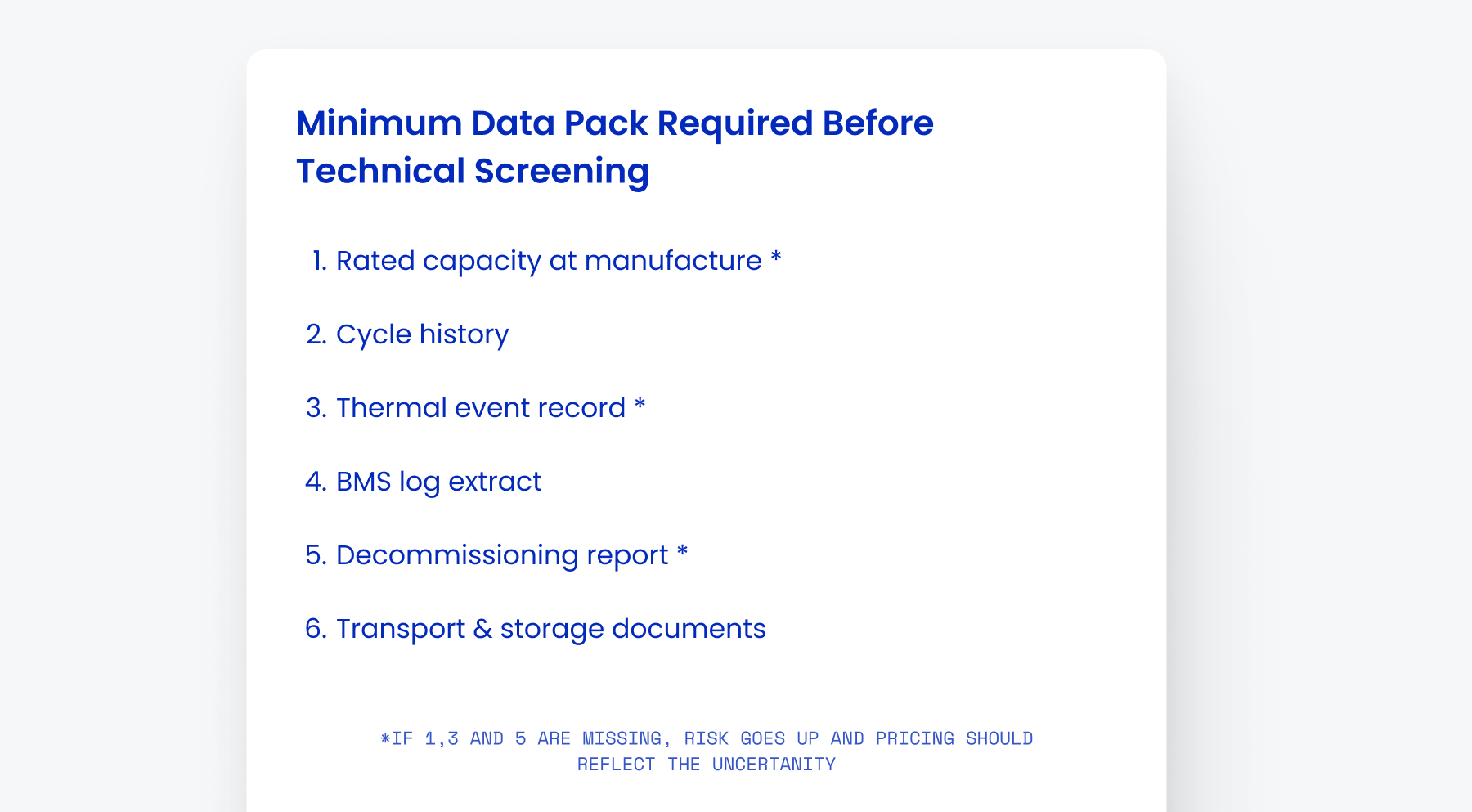
A minimum data pack for surplus battery qualification includes:
- Rated capacity at manufacture: the baseline for SoH calculation
- Cycle history: total cycles completed, or estimated from application profile
- Thermal event record: any documented over temperature, thermal runaway, or fire
- BMS log extract: voltage, current, temperature data from the operational period
- Decommissioning report: why the battery was retired, and when
- Transport and storage documentation: conditions from decommissioning to current location
If the seller cannot provide items 1, 3, and 5, you are missing the three most critical inputs for risk assessment. You can proceed, but your testing protocol must cover the gaps. Your pricing should reflect the added uncertainty.
Most surplus transactions happen without a complete data pack. Buyers accept verbal assurances or partial test reports. That creates downstream liability and makes it harder to finance, insure, or resell the system later.
This is especially true for reused materials and operational history.
As the European Commission Joint Research Centre (JRC) has noted, missing battery data limits confident assessments.
This is especially true for reused materials and operational history. That uncertainty does not stay in the sustainability section of a project report. It travels into financing conversations.
When sellers list batteries with standardized data fields and verified documentation, project teams spend less time reconstructing asset histories. That time goes toward evaluating fit, which is where the real decisions happen.
Gate 3: Technical Screening — SoH, Lot Consistency, and Remaining Usable Life
Battery State of Health is the central metric for surplus battery qualification for BESS. It measures how much usable capacity remains relative to the original rated capacity:

The JRC recognizes EV batteries as viable candidates for second-life applications. They often still have about 70–80% of their original capacity.
In practice, whether a battery lot suits BESS depends on more than its range alone.
It also depends on the target use, battery condition, and the project’s technical and economic needs.
Lots tested above 80% SoH may be strong candidates for higher-value reuse paths. However, SoH alone does not confirm that buyers must validate further before drawing conclusions.
But SoH is one number. Three additional metrics determine whether a lot is usable:
- Remaining Usable Life (RUL): the expected number of cycles or time left before the battery reaches end of life. A lot at 68% SoH with 800 remaining cycles is a different asset from a lot at 68% SoH with 2,000 remaining cycles. RUL determines whether the economics of integration work over the project lifetime, not just at commissioning
- Capacity spread across the lot: where individual modules range from 62% to 84% SoH is not a "73% SoH lot." It is a heterogeneous lot. Poor battery lot consistency creates integration complexity, uneven degradation curves, and maintenance problems that compound over time. The spread matters as much as the average, sometimes more
- Internal resistance: rising resistance indicates accelerated degradation and potential thermal risk in addition to power usage limitations. It catches degradation faster than capacity fade, and buyers should measure it alongside SoH, not treat it as optional
To assess battery State of Health credibly, buyers need a defined baseline and a transparent method.
That may rely on original manufacturer capacity data, controlled discharge testing, or representative sampling for larger lots.
This approach estimates the average SoH and the range across the lot.
For BESS contracting, what matters is that the SoH value comes from an agreed method. It must also link to clear battery lot acceptance criteria.
On EN 18061:2025: This is the European standard for second-life battery qualification, published by CEN/CENELEC. It defines testing protocols, data requirements, and classification criteria for batteries entering second-life applications.
Insurers, grid operators, and project financiers treat it as a reference standard even where no formal mandate yet exists. Using it as your qualification framework gives your output a clear, defensible structure.
It also gives you a shared language with the other side of the table.
Gate 4: Second-Life Battery Safety Assessment
SoH tells you about capacity. It does not tell you about safety.
Thermal history is the most underestimated risk factor in surplus battery qualification. A battery that experienced thermal stress, even once, may show normal SoH.
But it may have a higher risk under load. Without battery traceability from production to decommissioning, you cannot price that risk accurately.
Screen for:
- Thermal event history: any record of over temperature, thermal runaway, or fire in the original application
- Physical inspection: swelling, deformation, electrolyte leakage, connector corrosion
- Impedance spectroscopy: detects internal degradation not visible in capacity tests
- Self-discharge rate: elevated self-discharge indicates internal short-circuit risk
- ADR transport documentation: lithium battery transport classification and condition on arrival, according to ADR regulations
For large lots, representative sampling can be an efficient first step. Define the sampling protocol before testing begins, and do not adjust it afterwards.
As UL Solutions notes on battery repurposing, the process should follow sorting, grading, and suitability checks. Avoid ad hoc checks.
In practice, the sampling method should match the lot’s structure, including the production batch, configuration, and storage history.
A lot with full thermal history and clean transport records commands a different price than a lot without them. That difference should be explicit in negotiation, not absorbed silently into your margin.
Gate 5: Contract Readiness
Our bankability article covers why commercial terms need to be defined upfront. Here is what those terms actually look like in a surplus battery contract.
Integration costs, testing, refurbishment, transport, commissioning do not fall just because battery quality is lower. They often rise. A qualification package gives both sides a shared factual basis for pricing. Without one, the buyer absorbs risk the seller has not disclosed.
Key contract elements for surplus battery procurement:
- SoH floor: the minimum acceptable SoH at delivery. The contract must define and agree to the testing protocol. Do not only reference it
- Lot acceptance criteria: pass rate required across sampled units before the buyer accepts delivery
- Thermal event disclosure: seller representation on known thermal history, with explicit liability for non-disclosure
- Data transfer: what documentation transfers with the lot, in what format, and who is responsible for gaps
- Remediation terms: what happens if delivered units fall below agreed thresholds:replacement, price adjustment, or rejection
- Traceability record: confirmation that the qualification package will serve as the battery’s forward-facing data record. It also includes preparation for Digital BatteryPassport (DBP) requirements, starting 18 February 2027
Most contracts get this wrong; they separate the SoH floor from the testing protocol, or leave the protocol out altogether.
If your testing defines SoH by a specific method, your contract needs to reference that method. Otherwise the floor is unenforceable and disputes start exactly there.
Where Deals Actually Stall
Most surplus battery deals slow down in the same five parts of the process:
- SoH is reported without method: a seller says "75% SoH." But which protocol? Measured at what temperature? Against what baseline capacity? Without method transparency, SoH figures from different suppliers are not comparable, and not contractable. The IEA has consistently noted that deployment depends on system reliability and risk transparency, not just cost reduction
- Lot consistency is unclear: the average SoH looks acceptable. The battery lot consistency spread does not. Nobody checked until testing was already underway
- Safety and transport documents are incomplete: the batteries are technically sound. But the seller lacks ADR paperwork. Or the seller has not documented the thermal event history. The insurer will not cover the project. The deal stalls
- Usage history is partial: the seller knows the batteries came from an EV fleet. They do not know the cycle profile or the operating temperature range. They also do not know if any units faced fast-charging stress. Buyers translate that uncertainty into a lower offer. The gap between bid and ask widens
- Contract terms do not match project risk: the buyer wants SoH guarantees. The seller offers "as-is." Neither side has a framework for bridging that gap.The deal dies on terms, not on battery quality
A repeatable second-life battery screening workflow eliminates most of these before they become deal-killers. Sourcing from a platform where data travels with every listing removes the need to chase it down deal by deal.
Six Things Worth Doing Now
- Set your SoH threshold before you start screening. Know your minimum acceptable SoH threshold for BESS before evaluating any lot. It prevents post-hoc rationalisation of marginal assets
- Build a standard battery minimum data pack request. Make it a document you send with every Request for Quotation (RFQ) outside a structured platform. Sellers who cannot complete it are flagging a documentation gap price accordingly
- Require thermal event disclosure in every RFQ. Make it a standard field, not optional. Non-disclosure should carry explicit liability in the contract
- Separate lot screening from lot acceptance. Screening is fast and low-cost. Run it first to eliminate non-starters before committing to full qualification
- Structure your qualification output as a transferable record. The data you generate helps with financing and insurance. It also supports future resale. It prepares DigitalBattery Passports for assets operating in 2027 and beyond
- Align your contract template to your qualification protocol. If your testing defines SoH by a specific method, your contract should reference that method. Most do not. That inconsistency is where disputes start
A Note on Where the Market Is Heading
The EU Battery Regulation, which entered into force in August 2023, sets the regulatory direction. From 18 February 2027, the Digital Battery Passport will be mandatory.
It will change battery data rules for products entering the market after that date. Persistent identifiers and standardized records will make surplus battery qualification faster and more reliable.
Until then, the qualification burden sits with the buyer. Teams that build this capability now will be better prepared.
They should make it a repeatable process, not a one time exercise. They will be ready when volumes rise and competition for top lots grows tighter. The market has batteries. The question is whether your team has the workflow and the data infrastructure to deploy them.
Explore how the Circunomics Marketplace adds standard data to every battery listing. So your surplus battery due diligence takes minutes, not weeks.
Frequently Asked Questions
What is surplus battery qualification for BESS?
It is a structured screening process. It checks if used or surplus battery lots meet technical requirements. It also checks safety and documentation needs for use in Battery Energy Storage Systems (BESS). It covers State of Health, thermal history, lot consistency, and contract readiness.
What SoH threshold is acceptable for second-life BESS?
According to the JRC, second-life EV batteries typically retain 70–80% of their initial capacity. Whether a specific lot qualifies depends on the target application, remaining usable life, and lot consistency not SoH alone.
What documents does your team need to qualify used batteries for BESS??
A minimum data pack should include the rated capacity at manufacture:
- The cycle history
- Thermal event records
- BMS log extracts
- Decommissioning reports
- Transport and storage documents
What is EN 18061:2025?
It is the European standard for second-life battery qualification, published by CEN/CENELEC. It defines test protocols, data needs, and battery rating rules for second-life use. Insurers, grid operators, and project financiers refer to it more and more.