Price, performance, warranty, availability and bankability. These are the usual questions when sourcing a battery energy storage system.
Europe is now considering adding another one. Where was it made?
The European Commission's proposed Industrial Accelerator Act would introduce origin requirements for BESS used in certain public procurement procedures, auctions and public support schemes.
TL;DR
The EU is proposing a new rule. For battery storage systems used in public projects must be made in the EU or approved regions. The rules roll out in two stages. Year one: BESS must be EU-made. Year three: battery cells, the BMS, and one more key component must also be EU-made.
Europe's battery storage market is growing fast. 36 GWh in 2025, over 50 GWh expected in 2026. The new origin rules mean buyers and suppliers must track where every component comes from. That's crucial in a €28 billion market.
The proposal is still being negotiated and the final rules could change. For BESS buyers and suppliers, this means one thing: where a battery was made now matters.
And this comes at a time when Europe's battery storage market is growing quickly. Europe installed 36 GWh of new battery energy storage in 2025, taking the operational fleet above 100 GWh.
In 2026, installations are expected to reach over 50 GWh. Large battery projects will represent nearly two-thirds.
See SolarPower Europe's European Battery Market Outlook 2026–2030. So, this is not a small market question.
What is on the table?
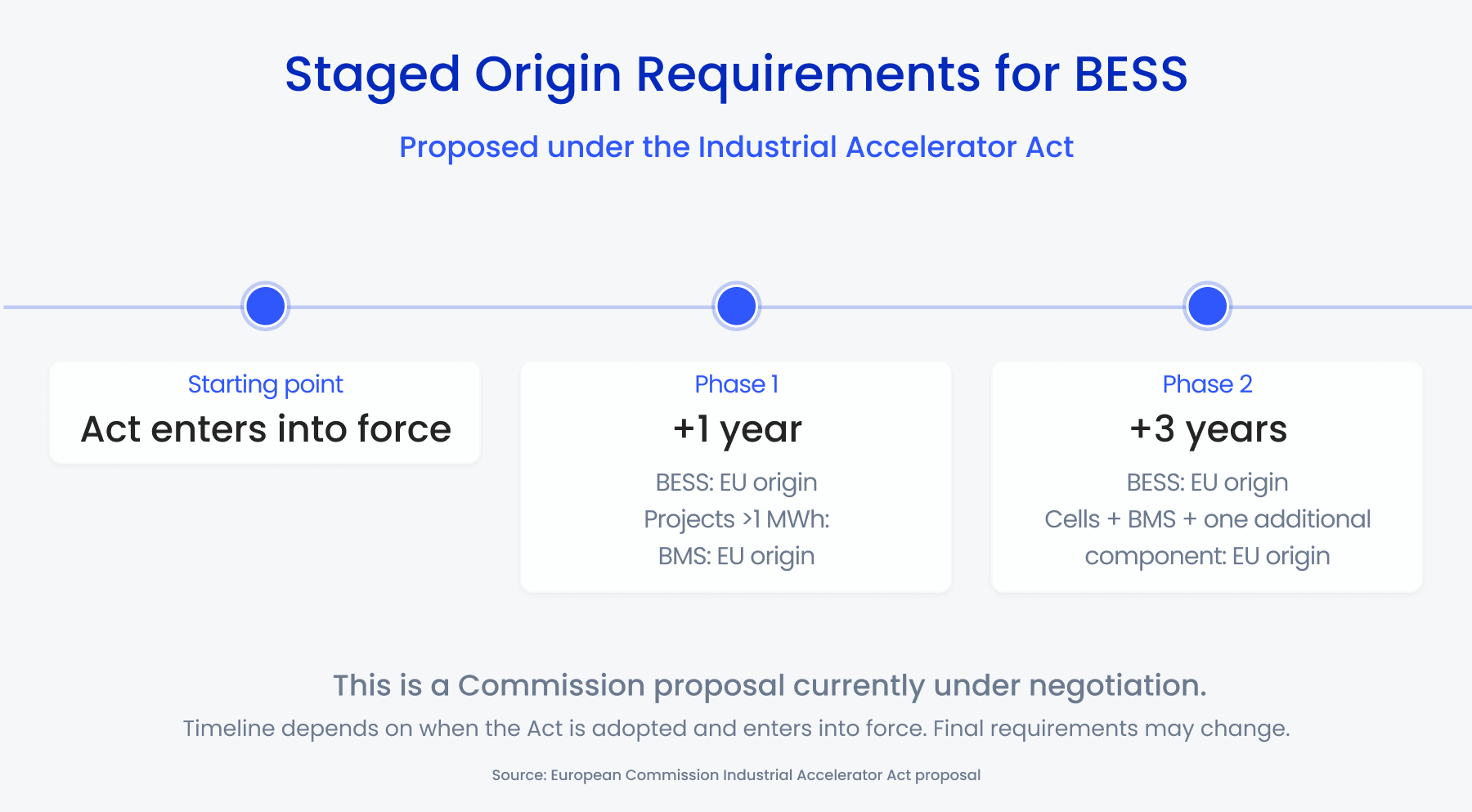
Under the Commission proposal, the BESS origin requirements would be introduced in stages.
Year one: covered battery systems must be EU-made. For larger projects (over 1 MWh), the battery management system (BMS) must also be EU-made. After three years, the requirements get stricter. The BESS must still be EU-made. Plus, the battery cells, BMS, and at least one other major component must also come from the EU.
The file is currently going through the EU legislative process. The European Parliament still lists it as awaiting committee decision, while the Council is actively working on compromise texts.
The second draft came out September 2. More Council meetings are happening all month. So, nobody should be treating these as final procurement rules yet. But the direction is worth paying attention to.
Why is Europe looking at battery origin requirements now?
The bigger picture is Europe's dependence on imported batteries and battery supply chain resilience.
In 2024, the EU imported €28 billion in batteries. China supplied €22 billion of that total. The Commission also puts China's share of global battery production capacity at roughly 83% in 2024.
Those figures cover batteries more broadly, not BESS alone. But they help explain the policy push.
The Commission wants to use European demand to support more battery manufacturing in Europe. In the Battery Booster Strategy, it explicitly talks about creating stronger markets for
EU-made batteries, components and materials, including through the Industrial Accelerator Act. For the storage market, that brings industrial policy much closer to the actual buying decision.
It is not quite as simple as "EU or non-EU"
There is an important catch. Under the proposal, some battery content produced outside the EU could still count as equivalent to EU origin. Batteries from EU trade partners and certain WTO countries may also qualify as meeting the origin requirements.
For other types of public intervention, the battery compliance rules are somewhat different. So, this probably will not boil down to a neat label saying "Made in EU" or "not Made in EU". The real question for BESS buyers may be more specific.
Does this particular battery system meet the origin requirements for this particular project? That is a procurement question.
Origin could start moving into the BESS sourcing conversation
Buyers today look at:
- Chemistry
- Capacity
- Price
- Warranty
- Certification
- Delivery time
- Supplier history
Buyers will need to know: Where was the system assembled? Where did the BMS come from? Where were the cells made? That battery traceability information may need to be available much earlier in the sourcing process.
This doesn't necessarily mean a whole new certification process. Under the Commission's proposal, companies would generally confirm compliance themselves, rather than go through a separate certification. Read the Council summary of the Commission proposal. But somebody still needs to know the answer.
For buyers, that means understanding battery origin before a system reaches the final qualification stage. Suppliers must keep this information ready instead of tracking it down each time.
Could that change which battery inventory is attractive?
This is where it gets commercially interesting.
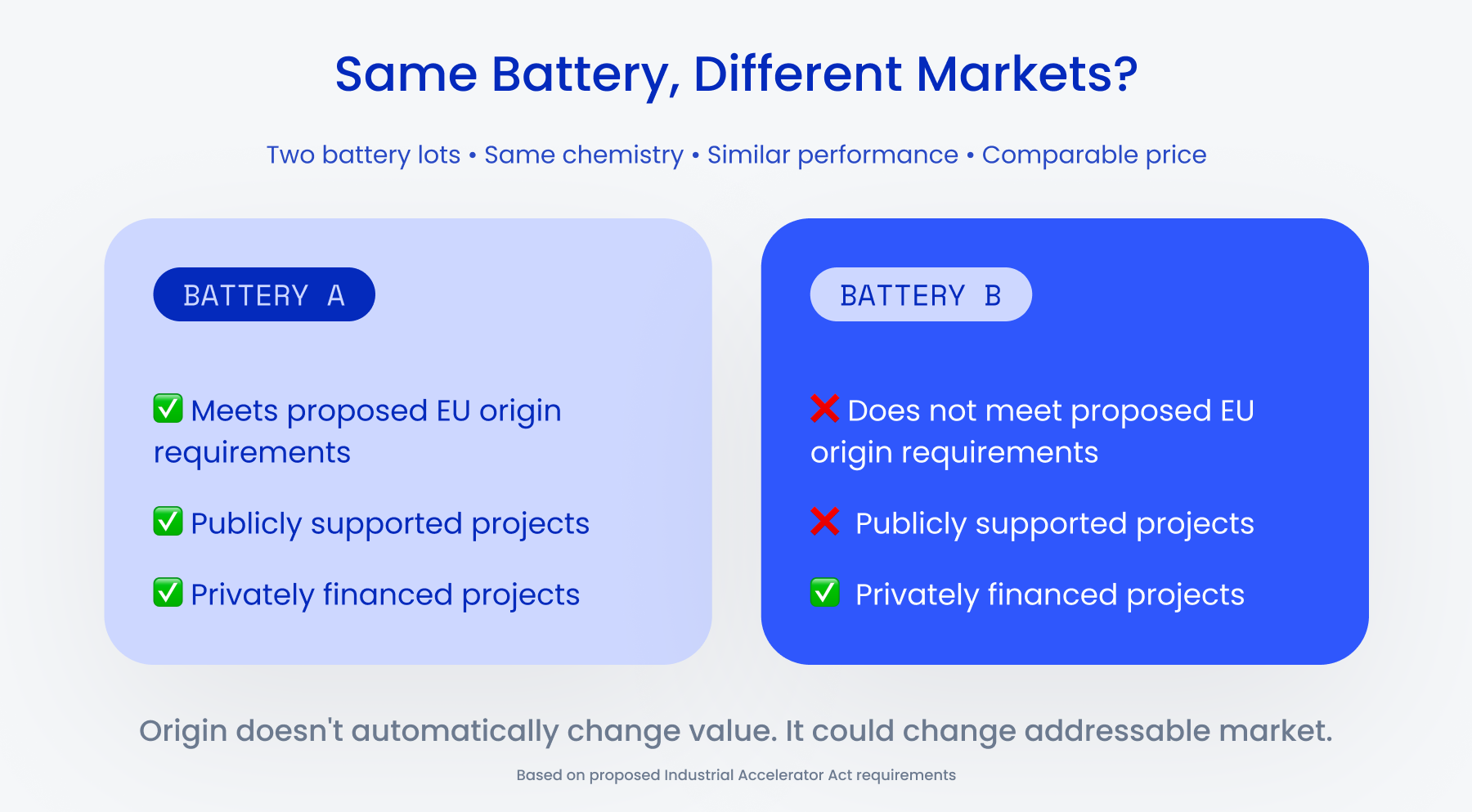
Imagine two battery lots that are technically very similar. Same chemistry. Similar performance. Similar warranty. Comparable price. Today, they compete for the same customers. Tomorrow, one qualifies for public projects and one doesn't, different buyers entirely.
That doesn't automatically make one battery more valuable. It means they may have different addressable markets. For someone selling battery inventory, that changes the question slightly. Don't just ask who wants it. Ask which projects it qualifies for.
Origin could become one part of that answer alongside technical specifications, availability, condition, certification and price. It's better than assuming EU batteries will automatically be more expensive. We simply do not know that yet.
The energy storage industry is already pushing back on some details
There is also a reason not to read too much into the Commission's first draft.
The association wants clearer definitions:
- What counts as a BESS?
- Which components are covered?
- How do the rules affect procurement and subsidies?
The rules shouldn't delay storage projects or make them more expensive, they warn. That debate matters. Europe wants more battery manufacturing at home. It also needs a lot more energy storage, quickly.
Those two goals will have to work together.
What does this mean for BESS buyers and suppliers now?
Probably not a wholesale change in sourcing strategy. The legislation is still moving.
But asking a few more questions now makes sense.
If your project involves public funding or auctions, start checking where your batteries and components come from. Suppliers should verify they have this information ready and can track it consistently.
And anyone making long-term BESS procurement decisions should keep an eye on the legislative process. The scope, definitions, timelines and equivalence rules can still change before the Act is adopted.
The most interesting shift here is not that every BESS in Europe suddenly has to be European. The proposal doesn't say that. It is that battery origin could become another factor in matching the right battery to the right project.
Buyers already weigh price, performance, availability, warranty, and risk. Origin requirements add one more complication. It could also make good information about what you are buying. Including battery traceability and supply chain transparency, a lot more valuable.
Need clarity on where your batteries come from?
Need help with battery traceability? We'll show you what data you have and what you need. Contact us!
FAQ
What are the EU origin requirements for BESS?
The proposed Industrial Accelerator Act would require BESS used in certain public procurement procedures to originate in the EU.
Year one: BESS must be EU-made. Projects over 1 MWh also need an EU-made battery management system (BMS). Three years after entry, battery cells, BMS, and at least one additional main component must be EU-sourced.
When will the EU BESS origin requirements take effect?
There are no fixed dates yet. The requirements would begin one year and three years after the Industrial Accelerator Act enters into force. The legislation is still going through the EU legislative process and has not yet been adopted.
Do all batteries in Europe need to be made in the EU?
No. The proposed rules only apply to BESS used in certain public procurement procedures, auctions, and public support schemes. Batteries from EU trade partners and some WTO countries may qualify under these rules too.
How big is the European battery storage market?
Europe installed 36 GWh of new battery storage in 2025, bringing the operational fleet above 100 GWh. Installations are expected to reach over 50 GWh in 2026, mostly from large-scale projects.
Why is the EU introducing battery origin requirements?
The EU imported approximately €28 billion worth of batteries in 2024, with around €22 billion from China. China holds roughly 83% of global battery production capacity. The EU aims to reduce dependency on imports and strengthen domestic battery manufacturing through these requirements.
What information do BESS suppliers need to provide about origin?
Suppliers need to know: Where was the system built? Where's the BMS from? Where were the cells made? Under the proposal, companies would generally self-confirm compliance rather than go through separate certification.
Will EU-made batteries be more expensive?
It's unclear whether EU-origin batteries will command a premium. The rules may create different addressable markets for different battery inventories rather than automatically making EU batteries more valuable. Origin becomes one factor alongside technical specifications, price, warranty, and availability.
How can BESS buyers prepare for these requirements?
If you're buying for public projects or auctions, ask suppliers about origin and traceability now. Ask about origin early in the buying process. It'll help you comply if the rules pass.