Trading batteries in Europe's secondary market? Three problems consistently kill deals before closing. This guide shows you what they are and how to fix them, for both surplus stock and second-life packs.
None of them are about the battery itself but about the data, the fit, and the paperwork that travels with it. We will go through each battery transaction failure, who owns the fix, and the first question to ask.
👉 Trading batteries in Europe? Download the Stranded Capacity white paper to see the complete qualification checklist that prevents deals from stalling.
TL;DR: Key Takeaways
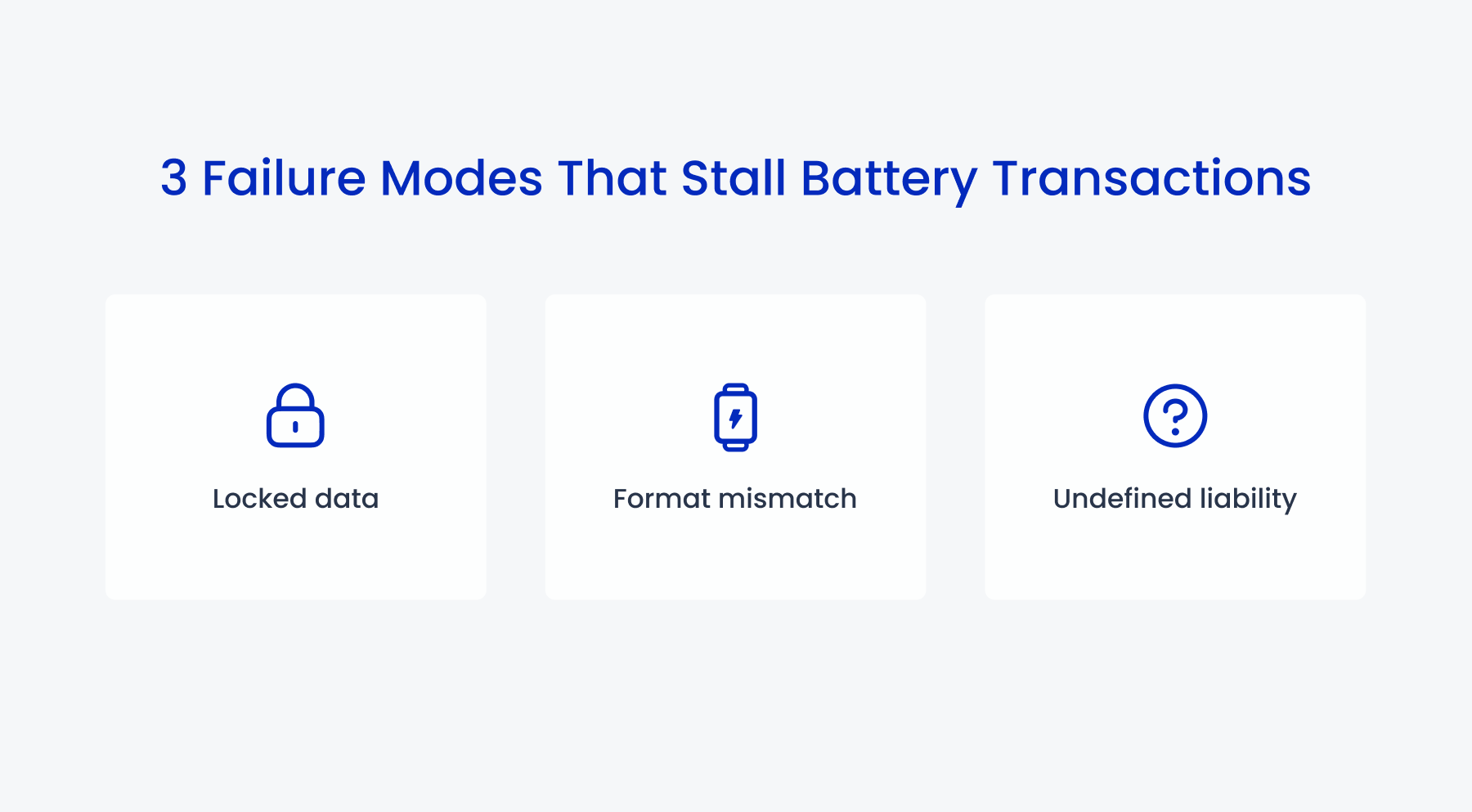
The European secondary battery market faces three critical transaction failures that kill deals after commitment, not before:
- Locked BMS Data: The battery's management system is locked, preventing buyers from seeing how healthy it is or how it was used
- Format Mismatch: Physical, thermal, or communication incompatibility discovered after purchase leads to costly integration rework
- Undefined Liability: Unclear EPR obligations and producer status under EU Battery Regulation creates legal risk neither party will accept
The fix: Address data access, format compatibility, and compliance documentation at the qualification stage, not during contract negotiation. Battery prices dropped to USD 70/kWh. Passport compliance starts February 2027. Margins are too tight and deadlines too close for post-sale issues.
Context & Why the Secondary Battery Market Europe Matters Now
The European secondary battery market has grown up. Battery Energy storage projects need batteries. The market now has two supply streams: batteries retiring from electric vehicles and new surplus stock from manufacturers.
The first source is batteries retiring from electric vehicles. The second is new, unused batteries: overproduction, cancelled orders, and warehouse surplus.
Prices have dropped so far that margins are thin, and a slow deal can wipe them out.
Lithium-ion pack prices for stationary storage fell to USD 70/kWh in 2025. So, you would expect battery deals to move quickly. Many don't.
The reason is usually not the market. It's small, avoidable gaps that only show up once the deal is already well underway.
The important part is that these gaps don't care where the battery came from. A second-life battery pack and a surplus module hit the same three failure modes, just for different reasons.
One lacks history because the data was locked or never logged. The other lacks it because there was no first life to record. The transaction problem is the same regardless of chemistry, age, or origin.
Here is why it matters now:
- Margins are thin: Surprise costs or legal risks after signing make the deal unprofitable. It gets cancelled. The deal doesn't get renegotiated. It gets cancelled
- Deadlines are firm: Digital Battery Passports become mandatory for EU batteries from February 2027. Extended Producer Responsibility (EPR) obligations have been active EU-wide since 18 August 2025. Which means EU Battery Regulation compliance is now part of the deal itself, not something to sort out afterwards. Leave it too late and it becomes the buyer's reason to walk.Surplus stock faces a bigger issue: unsold batteries have no registered producer. Whoever sells them first takes on that legal responsibility automatically
- Buyers are more demanding: Storage integrators and operators require detailed technical and legal answers upfront. Without BMS data and format details upfront, buyers walk away. You never reach the contract stage. What these three battery transaction failures have in common is timing. They rarely show up early, when they would be easy to deal with. They show up late, once both sides are committed. So it helps to know them in advance. Here is each one, why it stalls a deal, who owns the fix, and the question that surfaces it early
Key Insight 1: Locked Battery Management System (BMS) Data
What the failure looks like
The buyer requests State of Health (SoH) verification and cycle history. The seller provides a single percentage figure with no supporting data. The seller says: the data is locked, unreadable, or was never recorded at all.
The buyer can't verify the claim. The battery transaction stops.
This is not theoretical. BMS from major OEMs often restrict data access to authorized service centers or require OEM-specific diagnostic tools. When batteries are resold by fleets or leasing companies, diagnostic access rarely transfers to buyers. The new owner holds a physical asset with no readable history.
Why locked BMS data stalls the deal
Buyers need batteries that will last another 5 to 10 years without failing. Buyers ask: How many charge cycles? What discharge patterns? Any overheating or voltage issues? Are cells degrading unevenly?
A single SoH number is not enough for battery SoH verification. It tells you the current state, not the degradation trajectory or the operational context. Without that, buyers either apply heavy risk discounts or walk away entirely.
Surplus and new-condition batteries have the opposite problem, but the same result. These batteries have almost no usage history. But without baseline measurements or installation records, "new" can't be proven.
An unused battery might be perfect, but without documentation, it will fail verification. No proof means no sale. New or used, unverified is unverified.
Tactical fix: Establish a minimum evidence standard before listing
If you can't extract full BMS telemetry, you can still build a defensible evidence package for battery data verification:
- Commission an independent SoH assessment using external diagnostic equipment. Provide method transparency: what tool was used, at what temperature, and what the measurement uncertainty is
- Document what you do know. Storage conditions, age, original application, any known safety events. Verified partial data is better than unverified claims
- Offer conditional pricing. If the buyer performs onsite diagnostics and discovers worse than stated condition, adjust price or offer a return clause. This transfers verification cost but preserves trust
- Provide OEM contact or service history if available. Some buyers have existing relationships with OEMs and can request data release directly
Who owns this
- Seller responsibility: The seller must disclose data limitations upfront, not after the buyer has invested in due diligence. If BMS access is locked, say so in the listing
- Buyer responsibility: Be clear about what proof you need: will third-party reports work, or do you require direct data access?
What to ask first
- Seller to buyer: "What SoH verification method and documentation do you require to move forward?"
- Buyer to seller: "Can you share the battery's usage data and discharge history, or do we need to bring in independent testers?"
Key Insight 2: Battery Format Mismatch
What the failure looks like
The seller lists battery modules as "320V, 50 kWh, prismatic LFP cells." The buyer's BESS enclosure is designed for a specific mounting pattern, cooling interface, and electrical connector standard. The modules arrive. The voltage and capacity match, but the battery's size, cooling connections, or data protocol don't fit the buyer's system.
Adapting the system requires custom mechanical and electrical rework. The cost was not budgeted. The project delays, or the buyer rejects the lot.
Why format mismatch stalls battery deals
Used batteries rarely fit straight into a new BESS integration system. Storage builders design around a specific battery size, shape, and wiring setup. If your batteries don't match, the buyer can't just plug them in, they must redesign part of the system to make it work. That turns a simple purchase into an engineering job.
And the extra costs add up fast:
- New brackets or housings to hold the batteries in place
- Changes to the cooling setup if the batteries are shaped differently
- Extra electronics so the batteries can talk to the rest of the system (BMS communication protocol compatibility)
- If changes are big enough, the whole system may need to be re-tested and re-approved for safety or grid connection
Buyers usually find out about these BESS integration challenges too late. Sellers list voltage, capacity, and chemistry but skip the physical details: size, shape, and how it connects.
Buyers discover the problem after they've already planned budgets and timelines around batteries that don't fit.
Tactical fix: Specify battery format completely, not just electrically
Provide the full integration picture in your listing or qualification document:
- Mechanical spec. Module dimensions (length, width, height), weight, mounting points, terminal type and position
- Thermal spec. Cooling method (air, liquid, passive), interface type, thermal pad compatibility
- Communication spec. BMS protocol (CAN 2.0, Modbus RTU, etc.), connector type, any proprietary handshake requirements
- Documentation. Integration manual, wiring diagram, or reference design if available from the OEM
Missing this data? Disclose it: "Electrical specs verified, mechanical details on request" or "No OEM manual; buyer must assess fit independently."
If you are the buyer, request this before committing. A 10-minute format check at the qualification stage saves weeks of rework at delivery.
Who owns this
- Seller responsibility: Provide complete format documentation or clearly state what is missing. Don't assume "compatible with BESS" is sufficient
- Buyer responsibility: Verify physical and communication compatibility against your integration design before signing. Do not assume modules are interchangeable because voltage and chemistry match
What to ask first
- Seller to buyer: "Do you need mechanical drawings, thermal interface spec, or BMS communication protocol documentation before committing?"
- Buyer to seller: "Can you provide module dimensions, terminal layout, cooling interface type, and BMS communication protocol?"
Key Insight 3: Undefined Battery Liability Under EU Regulation
What the failure looks like
When you get to the contract, the buyer's legal team asks: who is officially responsible for the battery under EU rules. The seller assumed that responsibility passes to the buyer along with ownership. But it's not that clear.
Under EU law, whoever modifies a battery and resells it counts as the "producer." That means they take on all the associated legal obligations.The seller made no modifications, but because the buyer will integrate the battery into a BESS, the buyer may inherit producer responsibility.
Now neither side is sure who has to handle the paperwork, who pays for recycling at the end of life, or who is liable if something goes wrong later. The contract stalls while both sides bring in their lawyers.
Why undefined EPR obligations stall deals
EPR obligations in the EU aren't optional. They are active since 18 August 2025 and carry financial and compliance risk. If the buyer becomes the producer by integrating the battery into a new system, they must:
- Register as a producer in each EU member state where they operate
- Report battery sales data annually
- Finance collection and recycling at end of life
- Ensure the battery carries correct labeling and documentation
If these battery EPR obligations aren't clearly assigned in the purchase contract, the buyer faces unexpected compliance costs. If the seller didn't disclose whether the battery was already registered under an EPR scheme, the buyer may inherit leftover compliance obligations.
The liability question extends beyond EPR. If the battery causes a safety incident, thermal runaway, fire after sale, who is liable? The original manufacturer? The seller who transferred it? The buyer who integrated it?
Without a clear contractual assignment, the risk is undefined, and risk-averse buyers will not close.
Surplus stock carries a sharper version of this. A battery that retired from first use at least had a producer of record at some point. A surplus battery that was never formally placed on the market may have no assigned producer at all.
Under Article 3(34) of the EU Battery Regulation, whoever places that battery on the market becomes the producer which often means the seller clearing the stock or the buyer integrating it. If you don't sort this out before signing, no one is officially responsible. Until regulators get involved or a problem forces it.
Tactical fix: Assign liability explicitly in the contract
Before the sale, both parties must document the following for EU Battery Regulation compliance:
- EPR status: Is the battery currently registered under an EPR scheme? If so, in which member states, and will the registration transfer or terminate at sale?
- Producer status post-sale: Will the buyer's intended use (integration, repurposing, resale) trigger producer obligations under Article 3(34)? If yes, the buyer must prepare for registration and reporting
- Liability assignment: The contract must specify who's responsible for defects, safety incidents, and recycling obligations. Standard limited warranty language is not sufficient for batteries with compliance obligations attached
- Documentation handover: Sellers must provide compliance records, safety certificates, and technical files for EPR registration and grid connection
If you are the seller and you don't have this information, engage legal and compliance counsel before listing. If you are the buyer, require EPR clarity as a condition of closing, not a post-sale problem.
Who owns this
- Seller responsibility. Disclose EPR status, provide compliance documentation, and clarify whether any liability obligations transfer with the sale.
- Buyer responsibility. Assess whether your intended use triggers producer status. Budget for EPR registration, reporting, and end-of-life financing if required.
- Both parties. Assign liability explicitly in the purchase contract. Do not rely on implied transfer or standard commercial terms.
What to ask first
- Seller to buyer: "Does your intended use of the battery trigger producer obligations under the EU Battery Regulation?"
- Buyer to seller:”Is it EPR-registered? What compliance documents come with it?”
Industry & Operational Implications
What this means for your team
Battery sellers: whether moving surplus or second-life stock, these failure modes are killing your deals. Buyers who encounter locked data, format surprises, or liability ambiguity don't negotiate harder. They move to the next listing.
Your competitive advantage is not just inventory. It's complete, verified documentation that lets buyers assess risk and integration cost upfront.
If you are buying batteries, discovering these issues post-commitment destroys project economics. A 10% discount won't cover three months of delays or EPR registration in five different countries.
Your procurement checklist must include BMS data access, format compatibility, and liability assignment as qualification gates, not contract negotiation points.
This is also why our marketplace is built the way it is. We ask sellers three things:
- Data accessibility
- Physical specifications
- Compliance status
Same questions, every listing. Fix this at the listing stage, not during negotiations. Buyers can evaluate properly upfront, and deals won't stall over missing data.
Actionable Recommendations
For sellers
- Check data access before listing: If BMS data is locked, get independent health verification and tell buyers upfront
- Document format completely: Provide mechanical, thermal, and communication spec, not just electrical ratings. If documentation is incomplete, state what is missing
- Clarify EPR status: Know if the battery is registered, where, and whether obligations transfer when you sell
- Build a handover checklis
- BMS data (or explain limitations)
- Format documentation
- Safety event history
- EPR records
- Liability assignment clause

For buyers
- Require BMS evidence as a qualification gate: Specify what verification method and documentation you will accept before committing
- Check format compatibility before signing: Request mechanical drawings, BMS protocol spec, and thermal interface details: Verify against your integration design
- Assign liability in the contract: Don't assume EPR obligations or safety liability transfer by default. Require explicit contractual language
- If you're the producer, budget for EPR: registration, reporting, and recycling are mandatory
For both parties
Ask the hard questions at qualification stage, not at contract review. Every failure mode listed here is fixable if addressed early. All of them kill deals if discovered late.
Strategic Outlook: The Digital Battery Passport Era
The secondary battery market is professionalizing. Buyers are no longer willing to accept incomplete data or ambiguous liability as normal. Sellers who delay documentation lose deals to competitors who have everything verified and ready upfront.
The Digital Battery Passport, mandatory from 18 February 2027, will standardize much of this. But the passport applies only to batteries placed on the market from that date forward. Most batteries available for sale today come from three sources: retired EV fleets, manufacturer overstock, and pre-2027 vehicles. None of them will ever have a Digital Battery Passport.
For those assets, the minimum evidence standard described here is not a nice-to-have. It is the transaction layer that lets them trade at all.
Circunomics has supported hundreds of battery transactions across Europe. The deals that close fastest aren't the ones with the lowest price. They are the ones with complete data, clear format documentation, and explicit liability assignment from the first conversation.
That pattern will not change. It will become the baseline.
👉 Unsure what data buyers need to close? Download the Stranded Capacity white paper for the full qualification framework and navigate battery transactions with confidence.
Frequently Asked Questions (FAQs)
What is BMS data and why is it important for battery transactions?
BMS (Battery Management System) data covers: battery health, usage cycles, discharge depth, overheating events, and whether individual cells are degrading unevenly. This data is critical for buyers to assess battery degradation trajectory and operational risk. Without BMS data, buyers can't verify the condition. They either demand big discounts or walk away completely.
How do I verify State of Health if BMS data is locked?
If OEM-encrypted BMS prevents direct data access, commission an independent SoH assessment using external diagnostic equipment.
Build trust with transparency:
- Share testing method: tool used, temperature, accuracy
- Document storage conditions and history
- Offer conditional pricing if buyer performs their own diagnostics
What is the Digital Battery Passport and when does it become mandatory?
The Digital Battery Passport (DBP) is a compliance requirement under the EU Battery Regulation that mandates detailed lifecycle documentation for batteries. It becomes mandatory for batteries placed on the EU market from 18 February 2027. Note that pre-2027 batteries and surplus stock will not carry formal passports, making alternative documentation critical for transactions.
Who is considered the "producer" under EU Battery Regulation?
EU law defines the "producer" as whoever first sells a battery or substantially modifies it before resale.
For second-life batteries, this can be the integrator who repurposes them into BESS systems. For unsold surplus stock, the seller or buyer inherits producer status. Depending on contract language and intended use.
What are EPR obligations for battery sellers and buyers?
EPR obligations, active EU-wide since August 2025, require producers to:
- Register in each member state
- Report battery sales annually
- Finance end-of-life recycling
- Ensure proper labeling
These obligations must be explicitly assigned in purchase contracts to avoid post-sale compliance disputes.
Why do battery format mismatches cause integration failures?
BESS integrators design systems around specific battery dimensions, mounting patterns, cooling interfaces, and BMS communication protocols (CAN 2.0, Modbus RTU, etc.). Mismatched batteries create surprise costs: physical modifications, cooling changes, and re-certification. Expenses buyers never budgeted for.
How can I avoid battery transaction failures?
Address three critical areas early:
- Confirm BMS data access or arrange independent verification
- Provide complete specs: dimensions, cooling interface, communication protocol
- Clarify EPR status and assign liability in the contract
What documentation should sellers provide for second-life batteries?
Sellers should provide:
- BMS data or third-party health verification
- Complete specs: dimensions, cooling interface, communication protocol
- Safety incident history
- EPR registration status
- Compliance records
- Manufacturer manuals and technical files