European power markets saw record hours of negative prices in 2025. Solar and wind often pushed wholesale prices below zero. Then in late May 2026, a stretch of heat and low wind sent German day-ahead prices sharply higher in a matter of days.
Same grid. Opposite problems. Same answer: more flexible storage.
That is pushing battery energy storage systems (BESS) up the priority list for project developers, utilities, EPCs, and industrial operators planning new flexibility assets.
Sourcing, qualifying, and integrating batteries on time separates projects that capture value from those that miss it. Sourcing, qualifying, and integrating batteries on time separates projects that capture value from those that miss the window.
A quick scope note before we continue:
This article covers batteries for stationary BESS projects. It does not cover EV parts or component-level resale.
When we talk about a "battery lot" or a "battery offer," we mean cells, modules, or packs.
Buyers source them for a specific storage build.
There is a quieter problem underneath the demand story. A project approved in Q2 can still miss its market window in Q4. This can happen when project teams fail to source, qualify, and integrate batteries on time.
Price volatility is no longer just a grid problem. It is becoming a commercial driver for storage. And BESS battery sourcing is no longer just a procurement step. It is part of the project's risk.
Why Electricity Prices Keep Swinging in Europe
European grids are working through a mismatch between generation and flexibility.
Solar and wind capacity keeps growing. Coal and other thermal generation keep coming offline. When renewable output is high and demand is moderate, wholesale prices fall. In a few hours, they go negative.
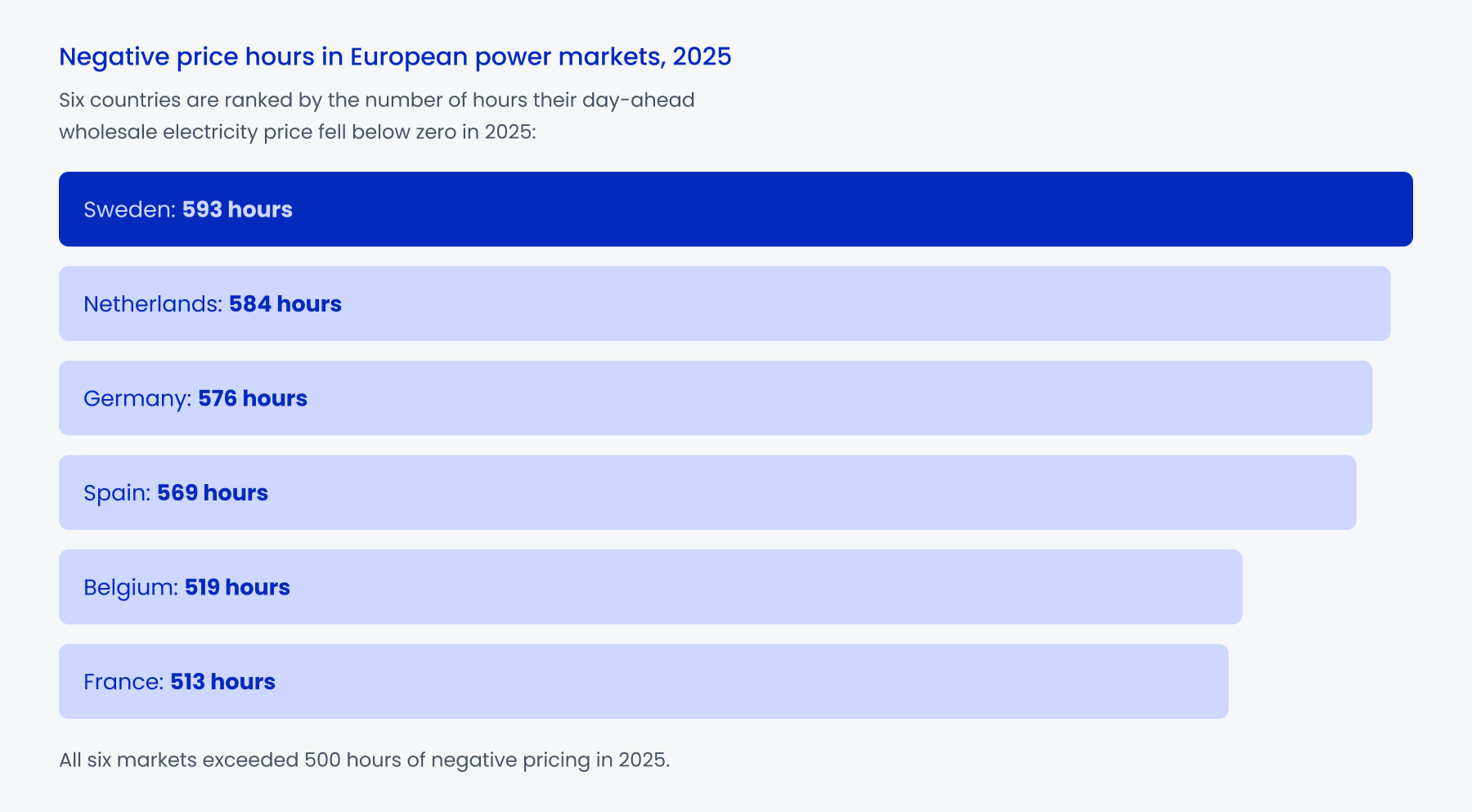
Negative-price events hit about 6% of all hours in several European markets in 2025. Germany, France, the Netherlands, and Spain were among the most affected.
The other side of the same problem appears when renewable output drops and demand rises. Germany saw this clearly in late May 2026.
Heatwaves raised cooling demand. The wind output fell. Day-ahead prices climbed sharply within a few days.
This is not a one-off pattern. It is what a grid with a lot of renewables and limited flexibility looks like in normal operation.
Where always-on thermal plants once filled that gap, storage, demand response, and cross-border flows now step in. Where those are missing, prices either collapse or spike.
BESS exists to close that gap.
Why That Volatility Is Pulling BESS Demand Forward
Battery energy storage systems can be charged when electricity is cheap. They can be discharged when it is expensive. They can respond fast to support a grid that is less predictable.
From a grid perspective, BESS supports frequency, peak management, and the integration of more renewables. From a commercial perspective, it captures value from the spread between low and high price hours.
That spread has been widening. When the gap between low-cost and high-cost hours grows, buying battery energy storage systems makes more sense. When predictability falls, the value of assets that can react in real time goes up.
Developers have responded. According to SolarPower Europe, European BESS deployment grew a lot in 2024 and 2025. This growth happened at a utility scale and behind the meter.
But growing demand for storage does not guarantee developers will build and commission projects on schedule. That part depends on the stationary battery storage supply chain, and the supply chain is where the friction is showing.
Available Is Not the Same as Deployable
There are batteries out there. New cells come from many suppliers. Modules come from surplus production runs. Packs come from end-of-first-life vehicles and fleet programs.
Other assets come from test or pilot installations.
"Available" is not an issue. "Available and deployable in a specific BESS project" is.
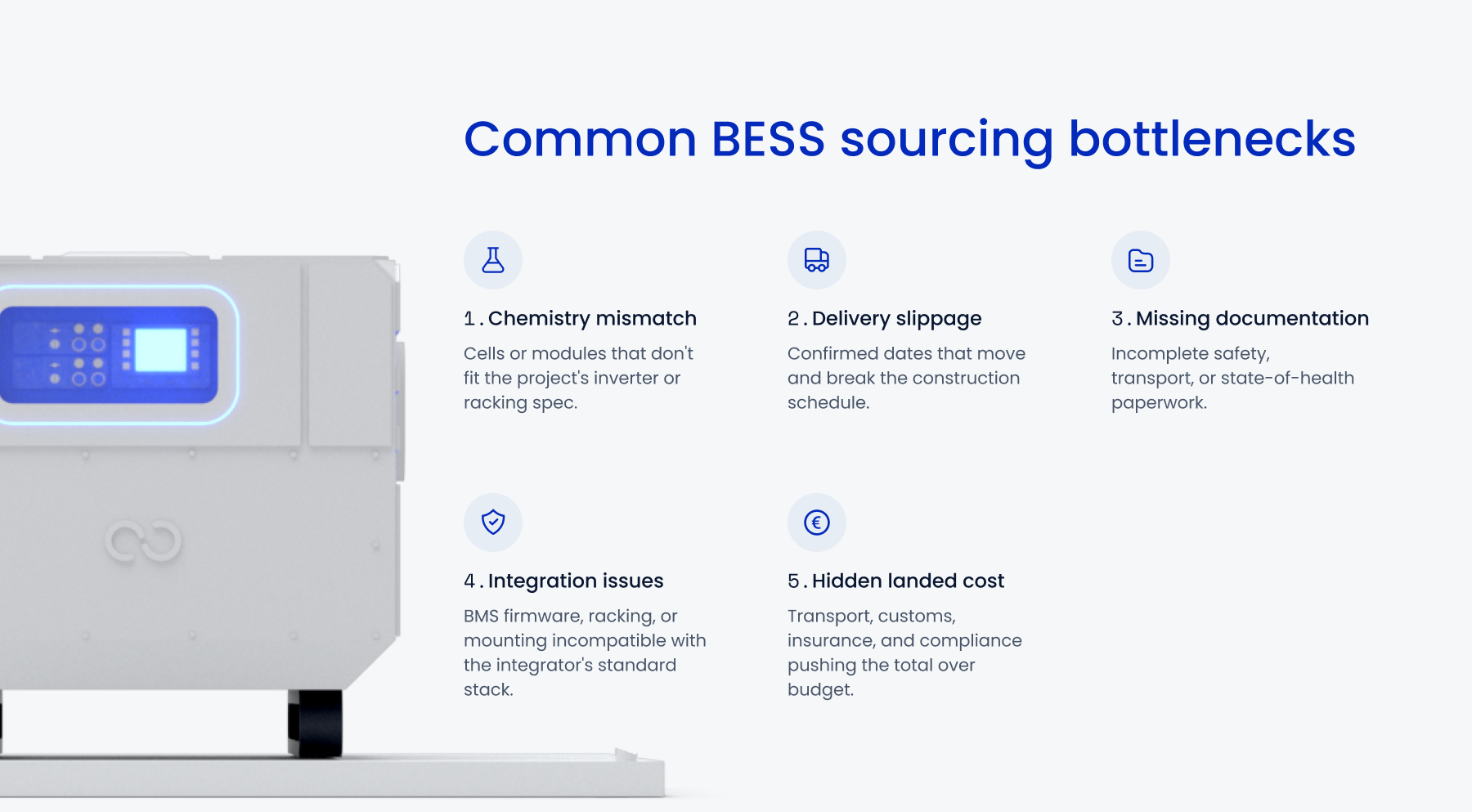
A lot can exist and still not work for a project because:
- The chemistry or format does not match the inverter or racking spec
- The delivery date does not line up with the construction schedule
- The BMS firmware version is not supported by the integrator's standard stack
- A shipment is held because the dangerous goods paperwork format does not match what the destination customs authority expects
- The landed cost (transport, customs, insurance, compliance) makes the deal uneconomical
These are not theoretical edge cases. They are the issues that quietly delay BESS commissioning, push go-live dates back by weeks, and cost projects for key revenue windows.
Where Sourcing Delays Hit the Business Case
Take a simple example. A 10 MW / 20 MWh BESS project in Germany, designed for intraday arbitrage and grid services.
Permits, financing, and grid connection are in place by Q1 2026. Construction starts in Q2. The plan is to live by October, ahead of the winter price spreading.
Battery sourcing kicks off in April. The first round of quotes looks fine on price. Then the questions start.
One supplier cannot commit to a firm delivery date. Another has product ready, but the safety and transport documentation is patchy. A third has the right chemistry, but export constraints are blocking the modules from leaving the warehouse.
Diligence drags into June. Deliveries finally arrive in August. Customs authorities hold two shipments because the dangerous goods paperwork is incomplete.
Integration starts in September. The system goes live in early November, about six weeks late.
In those six weeks, Germany saw several sharp price events. The project misses them.
The hit is not just the construction delay. It is the revenue the project should have earned during a window that has now closed.
That is why BESS battery sourcing belongs in the project risk conversation, not just the procurement plan.
LFP vs NMC for Stationary Storage: Choosing the Right Chemistry Before You Source
One of the earliest and most consequential decisions in battery energy storage system procurement is chemistry selection.
Not every cell fits stationary storage, and a wrong choice can cause integration problems that fast sourcing cannot fix.
- Lithium iron phosphate (LFP): is the dominant chemistry in stationary BESS applications for good reason. It offers a strong cycle life, a well-understood safety profile, and lower thermal management requirements.
- Nickel Manganese Cobalt (NMC): delivers higher energy density, which matters most when space is tight. But it requires more active thermal management and carries different degradation characteristics under frequent cycling. NMC can work in BESS applications. However, you must scope the integration needs carefully before committing to large volumes.
The practical implication for sourcing: define your chemistry requirement before issuing an RFQ.
A supplier with the right price for an NMC lot may not fit in an LFP-spec system. Finding that mismatch after offers wastes time.
Projects with tight commissioning schedules cannot afford that delay.
What BESS Project Teams Should Look at When Sourcing Batteries
Knowing how to source batteries for a BESS project goes well beyond comparing unit prices.
The criteria are different from manufacturing procurement, and the order in which you apply them matters.
- Chemistry and format fit: Confirm voltage, capacity, and form factor against the inverter and racking spec before going deeper. This filters out offers that cannot work regardless of price or timeline.
- Delivery timeline and supplier reliability: Ask for confirmed dates. Ask about similar projects they have shipped to. Ask what happens if they slip. Track record matters as much as unit price.
- Documentation and compliance readiness: Expect safety certificates and shipping documents (UN 38.3, ADR/IMDG, Safety Data Sheet). Include state of health data and the test method used. Show clear ownership and a documented chain of custody. If any of these are missing, plan the time and cost to close those gaps or treat the offer as incomplete.
- Integration readiness: Will the modules work with your battery management system? Is mounting standard or custom? Is technical support available during commissioning? Heavy adaptation work adds both time and risk.
- Total landed cost: A low unit price may not help if shipping, customs, insurance, and compliance raise the total. Get the full cost picture before signing.
- Comparability across offers: When reviewing multiple suppliers, you need data in a comparable form. If one supplier shares detailed specs and another sends a one-page summary, you are guessing instead of comparing. Standardised offer formats are not a luxury. They help diligence move fast enough to match the construction schedule.
What This Means for Buyers
If you are running battery energy storage system procurement right now, three things matter more than they used to:
- Treat documentation as a gating criterion, not a follow-up. Missing paperwork is the most common reason a "good" offer becomes unusable. Build it into your qualification checklist from the first contact with a supplier.
- Pressure-test delivery commitments. A confirmed date with a track record behind it is worth more than the lowest quote. In a market where commissioning delays directly translate to lost revenue, delivery reliability is a commercial variable, not just a logistics detail.
- Compare offers in the same format. Standardized data is what makes diligence fast enough to keep up with the construction schedule. If your sourcing process is generating incomparable offers, you are adding time and risk at the worst possible moment.
Where Circunomics Fits
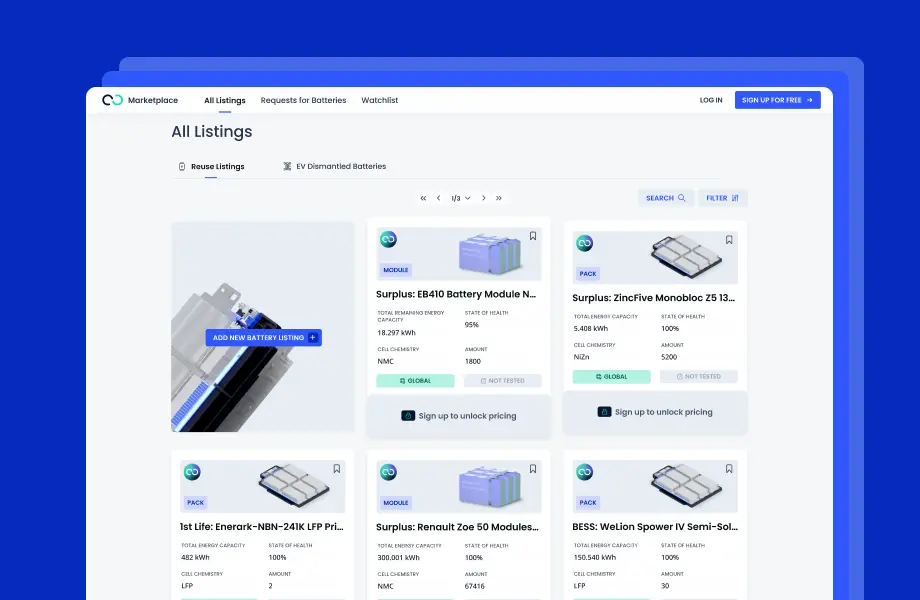
Circunomics is a B2B battery marketplace. It makes battery transactions more structured, qualified, and transparent. Circunomics designed it from the ground up for the stationary battery storage supply chain.
For BESS developers and integrators, that means a few practical things:
- Structured listings that surface chemistry, format, condition, location, and documentation status up front
- Qualification support around state of health, test methods, lot consistency, and compliance
- Lifecycle visibility for buyers who want to understand thermal history, usage profile, and traceability before committing
The point is not just connecting supply and demand. It is to make the transaction easier to assess, so diligence moves faster and with more confidence.
When project economics depend on hitting a commissioning date, the value is not only finding batteries. It is about finding batteries that are ready to be used.
They must have the right chemistry. They must include the correct paperwork. They must arrive within the planned delivery window.
Checklist: Is Your BESS Battery Sourcing Process Ready for a Volatile Market?
- Chemistry and format requirements defined and shared with suppliers
- Delivery dates confirmed, not estimated
- Required certifications and compliance documents listed in the RFQ
- Integration requirements (battery management compatibility, racking, mounting) shared early
- Total landed cost modeled (battery price, transport, customs, insurance, compliance)
- Supplier track record and delivery reliability checked, not just price
- Offers received in a comparable data format
- Backup plan in place if the primary supplier slips
If several boxes are unchecked, sourcing is likely to become the project bottleneck.
Looking Ahead
Price volatility is not going away. As renewable capacity grows and thermal plants exit the market, European grids will experience more low-price hours. They will also see more moments with high prices.
The European battery storage market in 2025 and 2026 is only the beginning of a longer structural shift.
BESS assets will capture more of that swing, but only when developers build and commission projects on time. Teams that know how to source batteries for a BESS project fast, with proper checks and no surprises, gain a real edge.
The ones treating sourcing as a last-minute RFQ will keep meeting the same delays.
BESS battery sourcing is moving from a back-office step to part of the project's competitive position.
Source Smarter for Your Next BESS Project
Explore qualified battery listings on the Circunomics B2B Battery Marketplace. Filter by chemistry, document status, and delivery window. Find lots that match your project plan.
FAQ
Why is battery sourcing now considered a project risk in BESS development?
Battery sourcing is no longer a simple procurement step. Delays in battery approval and delivery can directly affect commissioning dates. In markets where price spreads drive revenue, missing a seasonal window by a few weeks can cause major lost income.
Documentation gaps, customs hold, BMS compatibility issues, and uncertain delivery dates can all delay the project.
These risks should be in the project risk register from day one.
What battery chemistry is best for stationary BESS projects?
Lithium iron phosphate (LFP) is the most widely used chemistry in stationary battery energy storage systems. It offers long cycle life, a proven safety profile, and needs less cooling than nickel manganese cobalt (NMC).
NMC can work in BESS applications but requires more active thermal management. For most utility-scale and behind-the-meter storage projects, LFP is the default starting point.
How do negative electricity prices affect the business case for battery storage?
Negative-price events create a low-cost charging opportunity. When used during high-price discharge windows, such as evening peaks or low-wind periods, a BESS can earn arbitrage revenue.
The revenue comes from the price difference between charging and discharging.
As negative-price hours have risen across European markets, the spread has widened. This strengthens the business case for storage of assets that can respond in real time. In several countries, these hours reached about 6% of all hours in 2025.
What is a B2B battery marketplace and how does it differ from a standard supplier for RFQ?
A B2B battery marketplace is a structured platform where sellers list battery lots, cells, modules, or packs. They use standard details like chemistry, format, condition, location, documents, and delivery window.
For BESS project teams, this means offers are comparable. Each supplier does not need separate onboarding and full qualifications. It shortens the due diligence timeline.
It makes it easier to identify lots that are truly deployable. These are not just available in theory.