You are buying batteries project by project. You don't want a 12-month contract. You still need stable pricing and predictable delivery.
Here is the gap. Suppliers give their best price and fastest delivery when the request is clear, and it stays the same.
Unclear specs, shifting timelines, and uncertain order frequency all work against you. If a supplier can't read your intent, they can't plan and you pay for that uncertainty in the quote. So, they protect themselves.
That usually looks like this. They quote a higher price. They give a longer lead time, or they ask for a bigger minimum order quantity (MOQ).
You don't need to commit to large volumes to get a solid quote. This post shows exactly what to share upfront to make that happen.
Whether you're starting from scratch or improving what you have, one thing holds: structure your request and the quotes get better.
Why It Matters
Battery pack prices hit USD 108/kWh in 2025, an 8% year-over-year decline, with Europe mirroring that same 8% drop according to BloombergNEF 2025 Lithium-Ion Battery Price Survey.
BNEF forecasts a further decline to around USD 105/kWh in 2026, as continued LFP adoption offsets rising raw material costs.
Yet many SME buyers still experience inconsistent quotes, because their buying signals aren't "manufacturer-grade."
Here's the reality:
Large Original Equipment Manufacturers (OEMs) don't just buy volume. They buy with repeatable briefs, predictable call-off orders, and consistent terms. That's what earns them pricing stability and allocation priority, not the purchase order size alone.
The gap: Most SME buyers don't have access to procurement infrastructure that translates their needs into supplier-ready language. Even when demand is recurring, suppliers treat these buyers as one-offs, because nothing in the brief signals otherwise.
This is the core challenge in battery sourcing Europe SME buyers face today.
Better pricing and reliable supply are not exclusive to big buyers. Your team can access both, with the right brief. Structure your requirements clearly, and you can access both, regardless of volume. That's where bundled demand and structured transactions change the outcome.
And yes, battery supplier pricing for small buyers can reach levels much closer to OEM rates when the brief is right.
Why Quotes Are Unstable for SME Buyers, Even in a Soft Market
Why do battery quotes vary so much between suppliers? Three causes drive most of the instability for smaller buyers:
- Spec drift: Format, chemistry, or certification requirements change mid-process. One day it's LFP cylindrical cells. The next it's prismatic preference, or a new certification requirement. Each change makes it harder for suppliers to hold a price. Suppliers can't lock pricing or allocate inventory when the target keeps moving.
- Timeline drift: You say "as soon as possible" but you actually have flexibility. Or the opposite you have a hard deadline, but you communicate it as a preference. Suppliers optimize for certainty. Vague timelines get vague responses.
- Order shape uncertainty: Is this a one-off or the first of many? Will you take split deliveries? Can you flex on quantity if lead time improves? When suppliers don't know, they apply supplier risk pricing, quoting conservatively and moving you down the priority list.
Ambiguity costs you. Suppliers respond to unclear briefs with higher prices, shorter RFQ windows, and lower allocation priority.
The "Manufacturer-Grade Signal" (What Big Buyers Do Differently)
Can SMEs access OEM battery pricing? The answer is closer to yes than most buyers think and it starts with how you communicate, not how much you order.
Large OEMs don't just submit bigger purchase orders. They submit structured briefs that reduce supplier risk and enable faster matching.
Here's what that looks like in practice:
- Repeatable requirements: Same format, same tolerance windows, same compliance baseline across orders.
- Predictable call-off orders: Clear volume bands and delivery windows, even if the exact quantity flexes.
- Consistent terms: Payment, Incoterms (DDP, DAP, EXW), and quality expectations don't change order-to-order.
The result: Suppliers know what to expect, so they can plan production, allocate inventory, and quote a price that works for both sides.
The opportunity for SMEs: You don't need to become an OEM. You need to provide the same clarity in your procurement brief.
3When several SME buyers share structured briefs, Circunomics groups their demand and presents it to suppliers as one. That's when battery procurement for SMEs starts to perform like large-scale sourcing.
The Six Inputs Suppliers Need
Wildly different quotes from the same Request for Quotation (RFQ)? The brief is usually the problem, not the suppliers.
Suppliers are not only quoting the product. They are also quoting the effort and risk of working through missing details.
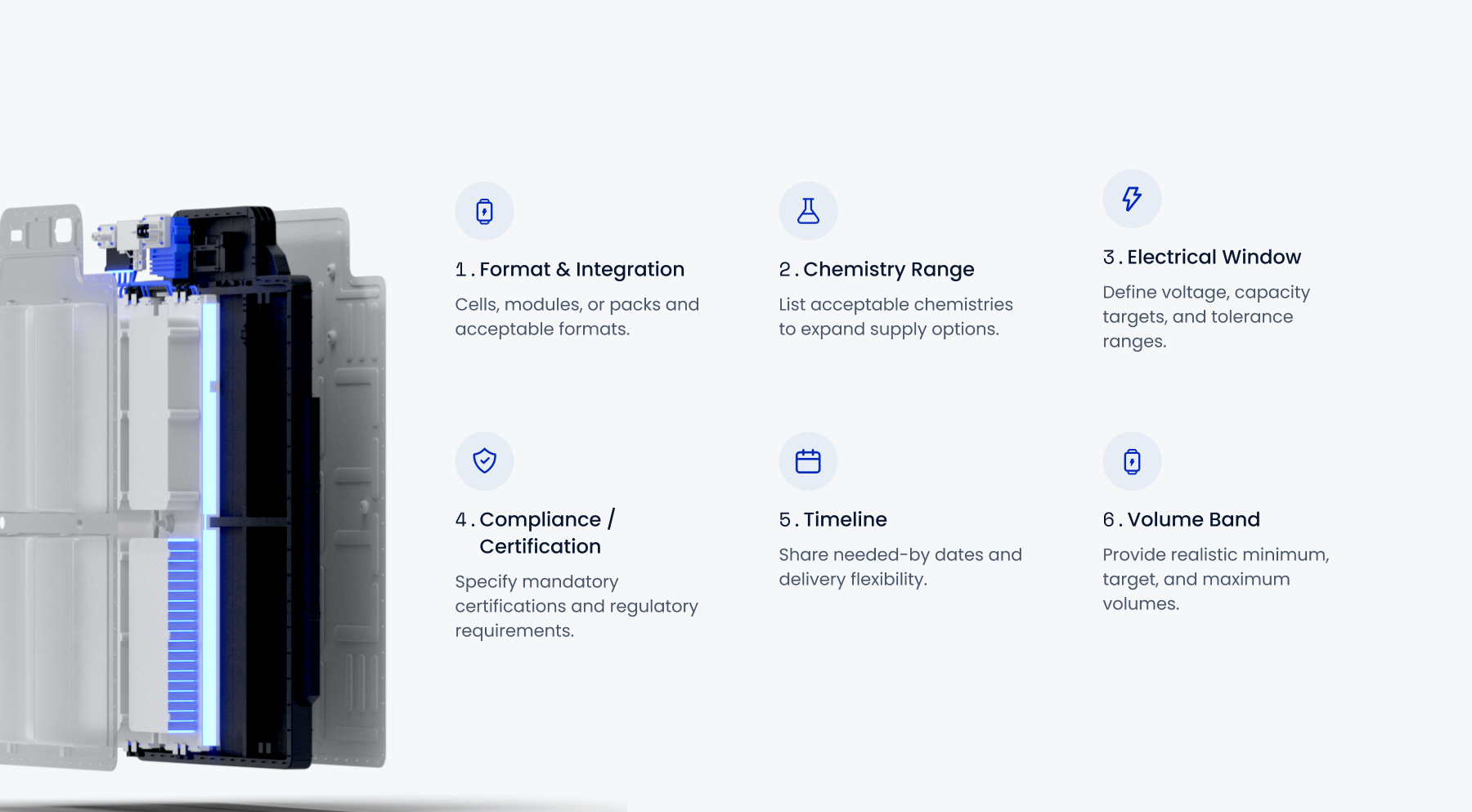
A long email leaves too much to interpretation. A short, six-question brief leaves nothing to chance. This is the foundation of how to write a battery procurement brief that actually works.
1. What are you actually buying
Start with the simple one. Do you need cells, modules, or packs? If you can work with more than one option, say it.
For example, if cylindrical or prismatic cells both works, that flexibility often helps a supplier offer a faster and cheaper option. Being open on requirements also makes it easier for suppliers to bundle your demand with others, unlocking better pricing and availability.
2. What chemistry can you live with
If it has to be lithium iron phosphate (LFP), say that. If nickel manganese cobalt (NMC) is also fine, say that too.
This is not a place to look decisive. It is a place to be honest. Chemistry flexibility is a pricing lever. The more options you can accept, the more competitive quotes you will receive.
3. What is close enough on performance
Instead of only naming a target, add the range.
Suppliers need to know whether a ten percent difference is fine, or whether two percent is already a deal breaker. That one line changes what they can propose.
4. Which certifications are non-negotiable
Tell them what is mandatory for your application.
UN 38.3 transport certification is a baseline, every battery shipment requires it, so it goes without saying. What needs to be specified are the certifications tied to your market and application: CE marking for Europe, UL certification for North America, and IEC 62619 if your application falls under stationary storage safety standards.
For EU-based buyers, Battery Regulation EU requirements and Battery Passport documentation are becoming standard. Flag them early so suppliers can factor them in from the start.
A common mistake is listing every certificate you have ever heard of. That tends to slow things down. Draw a clear line between what your application legally requires and what you would simply prefer. Suppliers need to know which is which before they can quote accurately.
5. When do you really need it
Give a "needed by" date and also tell them how flexible you are.
Can you take split deliveries? Can you accept delivery two weeks later if the price is better?
Those answers help suppliers plan and directly affect how to reduce battery lead times as a small buyer. Clarity on timing is one of the fastest ways to move up a supplier's allocation priority.
6. What is the size of the order
Don't force yourself into a single number too early.
A range works better. For example, minimum, target, and maximum. It signals what you are aiming for without making the whole deal collapse if the number moves.
Not every supplier can serve your scale. State your volume band upfront and let minimum order quantity (MOQ) requirements do the filtering for you.
Why this helps
When you give these six inputs up front, suppliers can respond faster and with more confidence. You usually get fewer follow-up questions, more comparable quotes, and less back and forth.
In other words, you are not trying to sound like a big buyer. You are just making it easy to quote you. That is what a structured procurement brief battery buyers use to their advantage looks like in practice.
Where Bundled Demand Changes the Outcome
This is where a good brief starts to pay off.
Clear, comparable briefs from multiple SME buyers allow Circunomics to group demand into volume bands, giving suppliers something concrete to plan around. This is circular economy battery sourcing in practice multiple buyers, structured demand, shared efficiency.
And that changes three things:
- Pricing: The supplier sees a larger, more predictable order shape, so pricing is closer to what bigger buyers get.
- Planning: Lead times and allocation priority get easier to commit to because the demand looks real and repeatable.
- Speed: Fewer rounds of questions, because the core inputs are already there and the RFQ process moves faster for everyone.
Here is what Circunomics provides in that process.
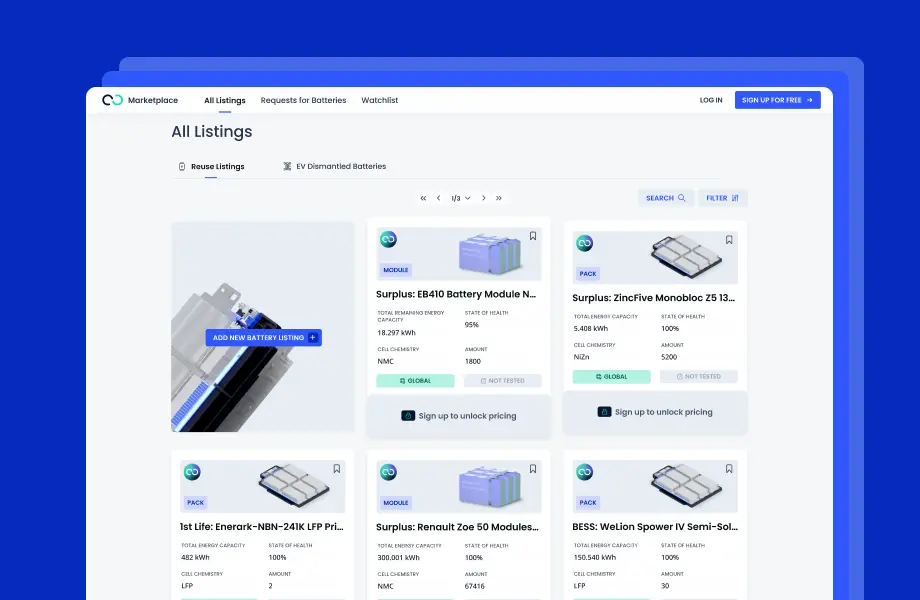
Circunomics takes your structured brief, qualifies it, and matches it with the right supply across Europe and Asia. You see offers side by side with the key terms that matter, so you can choose based on price, lead time, and fit not on who replied fastest.
We are not asking you to force a single chemistry or a single format. Be clear about what is fixed and what is flexible. That gives suppliers room to propose options that actually work.
Supply chain transparency stops being a principle and starts being an advantage, when buyers and suppliers work from the same information.
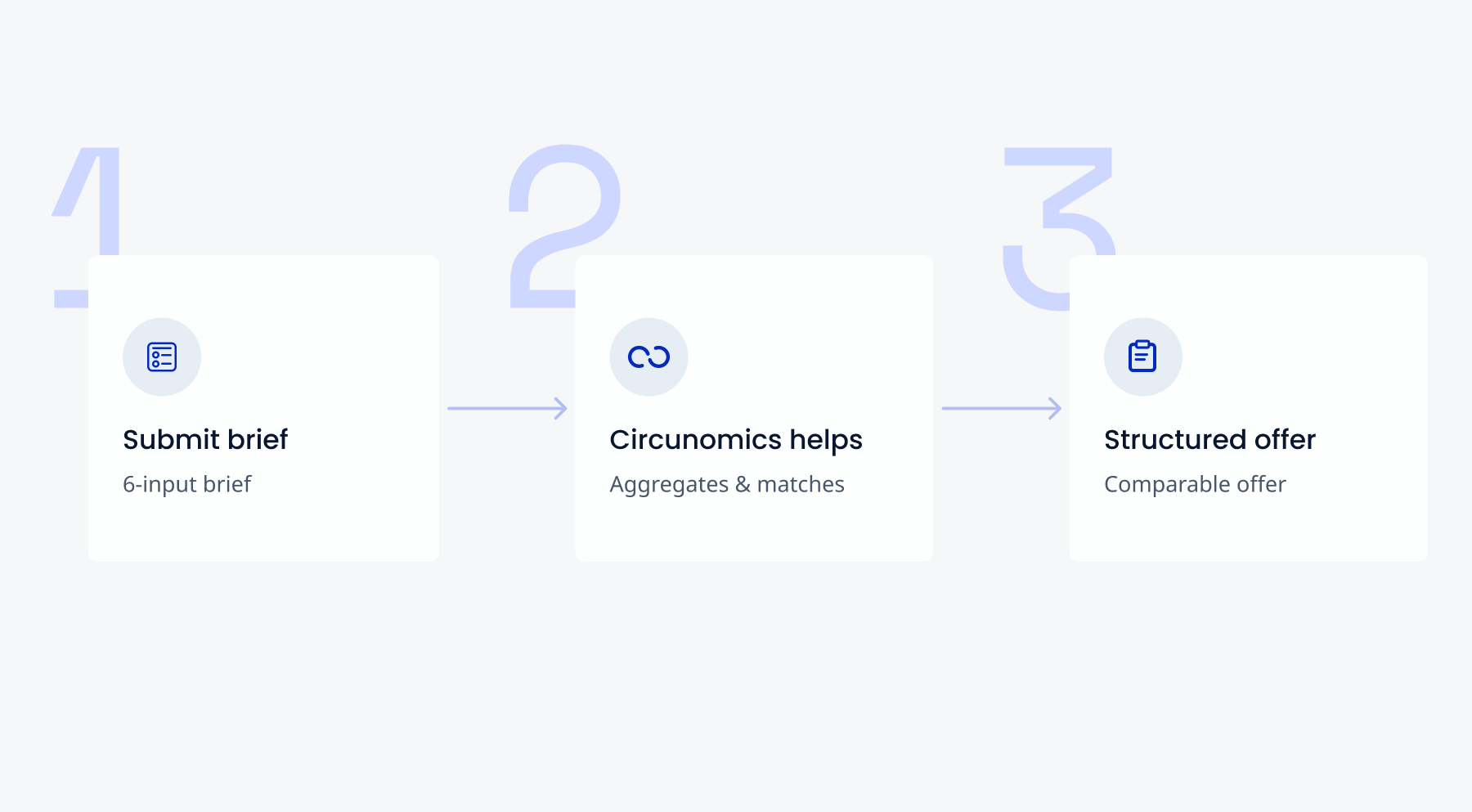
What This Looks Like in Practice (A Simple 3-Step Flow)
Step 1: Buyer provides the 6 inputs
You submit your structured procurement brief format, chemistry range, electrical specs, compliance needs, timeline, and volume band.
Step 2: Circunomics aggregates and matches supply
Your requirements are bundled with other buyers' structured demand. Circunomics matches supply across Europe and Asia based on fit, availability, and pricing.
Step 3: Structured offer comparison and transaction path
You receive comparable offers with transparent terms including Incoterms (DDP, DAP, EXW), lead times, and pricing. You choose based on price, lead time, and fit not on which supplier happened to respond first.
This isn't a Request for Quotation (RFQ) sent to five suppliers and hoping. A structured matching process places your demand inside a larger, predictable market. That's what turns better battery pricing without large volumes from a goal into a real outcome.
What This Means for Your Team
This is not only a procurement improvement. It changes how your team works week to week.
If you sit in procurement or technical purchasing, you get your time back. Less chasing. Less re-explaining specs. More time spent comparing real options on price, lead time, and fit.
Over time, the six-input brief becomes your default template, so each new order starts from a solid baseline.
If you are a CEO or operations lead, the big win is predictability. Pricing stops swinging as much. Lead times stop being a surprise. That makes it easier to plan production, project schedules, and customer commitments.
If you own finance and planning, the benefit shows up in forecasts. When battery costs are not jumping around between quotes, your budgets and scenarios get tighter. It is easier to model best case and worst case without guessing.
The broader shift is simple. Structured buying is not only about getting a better price. Stop renegotiating from scratch. Structured buying turns battery sourcing into a process you can repeat and rely on.
Actionable Recommendations
1. Build your procurement brief template now Use the six inputs as your baseline. Adapt the template for your specific application, but keep the structure consistent across orders. Consistency is what converts one-off buyer status into allocation priority.
2. Be clear about where you can flex and where you can't. In chemistry, accepting both LFP and NMC rather than locking in one option often leads to better pricing and shorter lead times. Format flexibility can too. Know your hard constraints and your soft preferences, and communicate both clearly in every RFQ.
3. Quote variability is a signal. More than 15% variation across similar specs means your procurement brief has gaps, find them and close them. Tighten the inputs and measure whether variability decreases. This is one of the clearest indicators of how well your structured procurement brief is working.
4. Internal misalignment kills pricing stability. Before you send a brief, align engineering, operations, and finance on tolerances, timelines, and volume bands. One round of internal agreement saves multiple rounds of supplier confusion. Spec drift mid-process kills pricing stability and resets supplier risk pricing from scratch.
5. Treat compliance as infrastructure, not an add-on. If you sell into public tenders or use public funding, compliance constraints are tightening. Battery Regulation EU requirements and Battery Passport documentation are moving from optional to expected. Build them into your brief from the start, not as a last-minute requirement.
What's Next for SME Battery Procurement
The European battery market is moving away from pure scarcity dynamics. In many categories, supply is more available than it was a few years ago. But day-to-day sourcing still depends on how clear your request is and how easy it is for a supplier to quote.
The more supplier-ready your brief, the faster usable offers come in, and the easier they are to compare.
That is true whether you are focused on battery sourcing in Europe as an SME or sourcing globally.
That is also why bundled demand is starting to matter for smaller buyers. When multiple buyers share structured briefs, their demand can be grouped in a way suppliers can plan around. The value is not only the combined volume. It is also the consistency of the requirements and the supply chain transparency that comes with it.
If you buy project by project, you don't need to change your business model. Start by changing how you communicate your requirements. The six-input brief is a good place to begin.
In Europe, Battery Regulation EU and Battery Passport requirements are moving from emerging to expected. Build them into your brief now, not later.
As requirements evolve, having traceability and the right paperwork ready early can save time later.
Want to see how a structured request works on Circunomics? Book a meeting with Samuel Lattarulo.
FAQ
Can SME buyers really access manufacturer-level battery pricing without committing to large volumes?
Yes. Order size matters less than you think.Pricing stability starts with a clear, consistent brief. The more defined your specs, timeline, and volume range, the better the quotes, regardless of order size. You don't need OEM-scale volumes. Circunomics groups demand from multiple SME buyers into volume bands that suppliers can actually plan around.
What is a procurement brief for battery sourcing, and why does it matter?
Six inputs. One structured brief. Product type, chemistry, tolerances, certifications, timeline, and volume range, everything a supplier needs to quote accurately and fast.
Without this structure, suppliers face uncertainty and respond by quoting higher prices, shorter validity windows, and longer lead times. A clear brief reduces that uncertainty and typically results in faster, more comparable offers.
What are the most common reasons battery quotes are unstable for small buyers?
Three factors drive most quote instability for SME buyers:
- Spec drift: requirements change mid-process (format, chemistry, certifications), making it impossible for suppliers to lock pricing.
- Timeline ambiguity: vague delivery needs ("as soon as possible") lead to vague responses.
- Order shape uncertainty: if a supplier doesn't know whether you'll order again, they assume the worst and price accordingly. That conservatism shows up directly in your quote.
Addressing all three in your procurement brief is the fastest way to stabilize quotes.
How does chemistry flexibility affect battery pricing and availability?
Chemistry flexibility is one of the most effective levers SME buyers have. When both LFP and NMC are acceptable, suppliers can work with what they have. That means faster matching against current inventory and production schedules and usually better pricing too.
This often results in better pricing and shorter lead times. If LFP is a hard requirement, be upfront about it. A single chemistry requirement gives suppliers clarity, but fewer options. That trade-off can show up in the price.
What certifications should I include in a battery procurement brief?
Include only the certifications that are genuinely mandatory for your application and market. Common requirements include:
- UN 38.3: required for transport of lithium batteries internationally
- CE marking: required for products sold in the European Economic Area
- UL certification: often required for North American markets or specific customer contracts
- IEC 62619: for stationary energy storage safety
Listing every certification you have ever encountered slows down the quoting process. Be specific about what is legally or contractually required, and flag what is preferred but not mandatory.