You can measure State of Health (SoH). You can verify documentation. You can assess thermal history. But if you skip the chemistry question, you are guessing at half the picture.
The LFP vs NMC battery debate is not just a technical one, it is a commercial one. Lithium Iron Phosphate (LFP) and Lithium Nickel Manganese Cobalt Oxide (NMC) batteries can look alike in a listing. This is true even when both show 80% SoH. But they do not age, price, or route in the same way.
According to the IEA’s Global EV Outlook 2026, LFP packs were over 40% cheaper per kWh in 2025. On average, they cost less than NMC alternatives.
This is partly because LFP dominates stationary storage, where cycle life and cost outweigh energy density requirements. These uses have lower energy density needs.
The IEA also highlights that NMC outperforms LFP where higher energy density is the priority. Its nickel and cobalt content also gives it higher recycling value than LFP.
For second-life trading, this changes the question. An LFP lot with solid documentation and usable SoH may still suit stationary Battery Energy Storage Systems (BESS).
In these systems, cycle life, cost, and thermal stability matter more than compact size.
An NMC lot with a similar SoH may still be valuable. But the buyer will usually need more proof of its use profile. They will also need its thermal history and remaining cycle life.
Then they can price it for reuse instead of recycling.
Most buyers and sellers still treat lithium-ion as a single category. That assumption fails as soon as you try to price a large lot. It also fails when you qualify it for BESS.
It can fail when you decide to send it for reuse or recycling.
Context & Why It Matters
The battery market is shifting. According to the IEA, LFP is the main battery type used in China. It made up over half of global EV battery deployment in 2025.
In the United States and Europe, nickel-based chemistries like NMC still make up most EV battery use. This is especially true outside China.
At the same time, LFP now dominates stationary battery storage. Its lower cost and long cycle life make it a strong fit. Stationary storage also needs less energy density.
As more electric vehicle batteries reach the end of their first life, operators must handle more used batteries. The LFP vs NMC battery mix guides sourcing choices, qualification steps, and routing rules across each lifecycle stage.
It also affects pricing and routing. It becomes a question of where to send each battery. It is no longer just a procurement detail.
Here is why it matters:
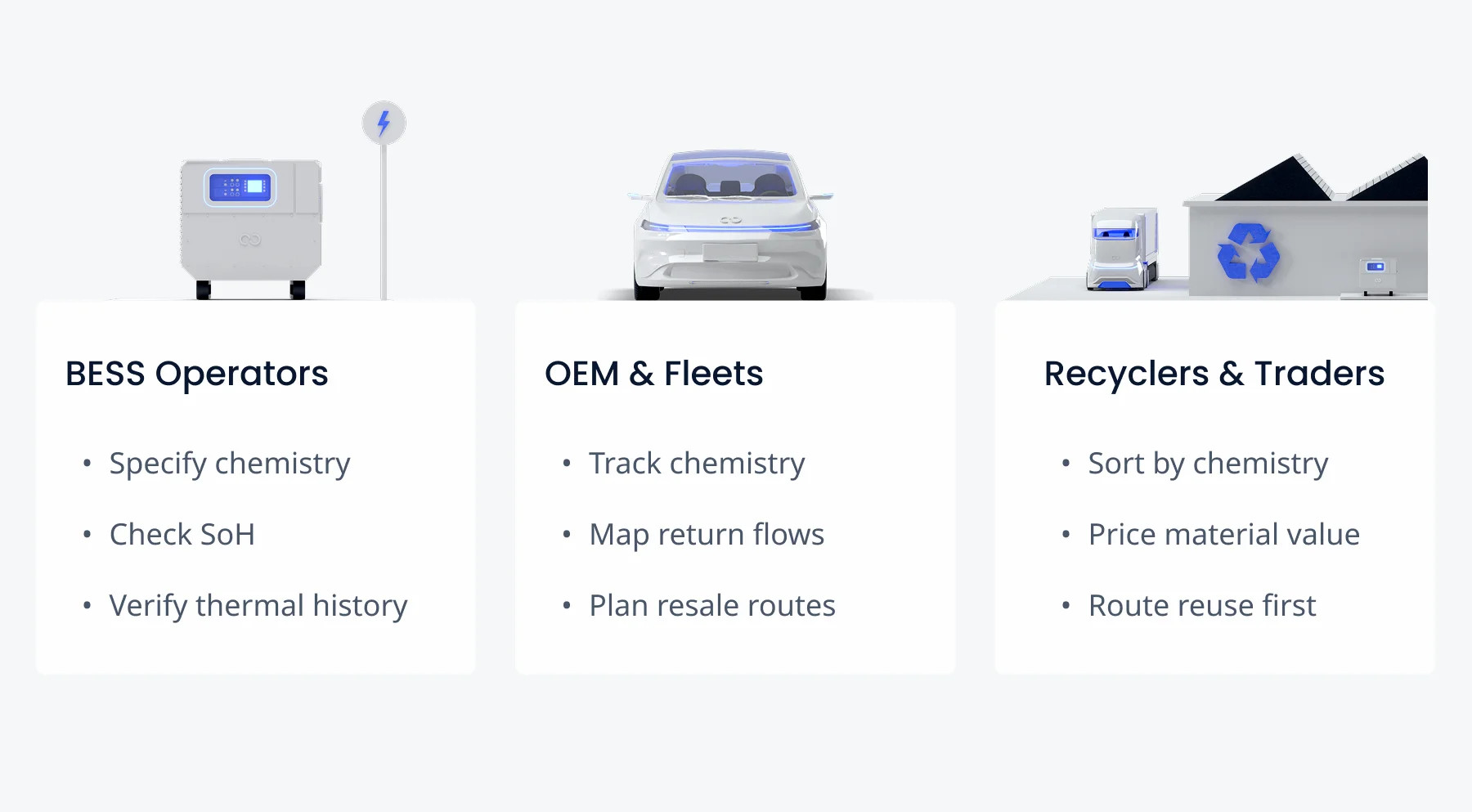
- BESS operators who source second-life packs need to know which LFP or NMC chemistry meets their cycle life and thermal needs
- OEMs and fleet operators who dispose of returned batteries need to know which chemistries have resale value. They also need to know which ones go straight to recycling
- Recyclers need different processes depending on whether LFP or NMC battery packs arrive at the gate
Key Principle: Without chemistry awareness, buyers overpay for the wrong packs. Sellers undervalue viable stock.
Projects stall on mismatched expectations. Chemistry is not a footnote in the datasheet. It is the first filter in every lifecycle decision.
Key Insight 1: What LFP and NMC Battery Chemistries Actually Are
Lithium Iron Phosphate (LFP)
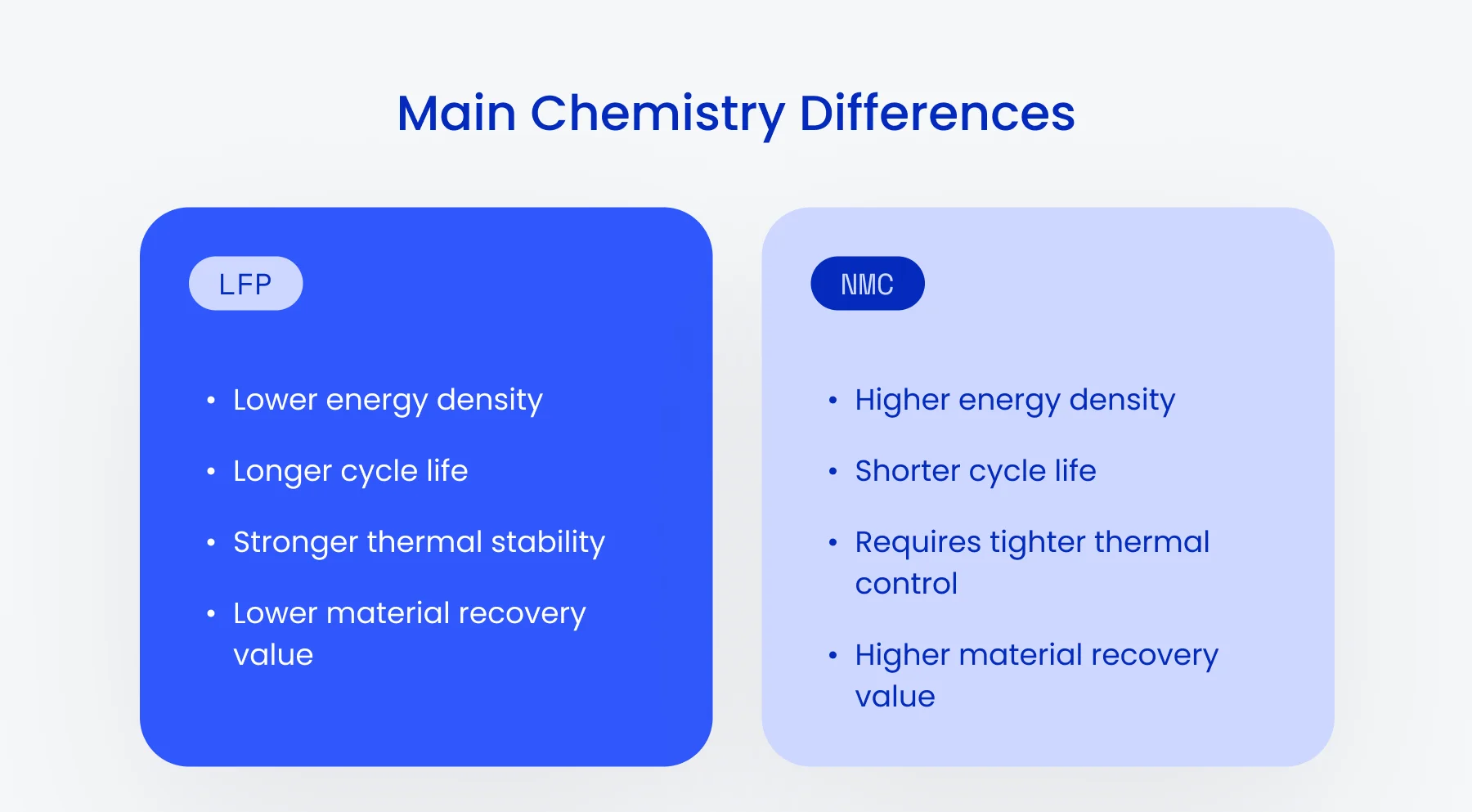
LFP batteries use an iron-based cathode chemistry. The trade-off is simple: lower energy density, but higher thermal stability and longer cycle life. LFP packs are heavier and bulkier for the same capacity. But they tolerate more charge cycles and operate safely across a wider temperature range.
Typical specs:
- Energy density: 120–160 Wh/kg
- Cycle life: 3,000–5,000+ cycles to 80% SoH
- Thermal runaway risk: Lower (threshold ~270°C)
- Cost: Lower per kWh
LFP is the default chemistry for stationary storage, commercial EV's, and other cost-sensitive uses.
It suits cases where weight matters less than durability.
Lithium Nickel Manganese Cobalt Oxide (NMC)
NMC batteries use a lithium-nickel-manganese-cobalt-oxide cathode. They deliver higher energy density, which means lighter, more compact packs. The trade-off: shorter cycle life, higher thermal sensitivity, and higher cost due to cobalt and nickel content.
Typical specs:
- Energy density: 200–260 Wh/kg
- Cycle life: 1,000–2,000 cycles to 80% SoH
- Thermal runaway risk: Higher (threshold ~150–210°C, requires active cooling)
- Cost: Higher per kWh
NMC is the go-to chemistry for passenger EV's where range and weight matter most.
Key Principle: The LFP vs NMC battery chemistry difference is not just technical. It determines what happens to the battery after the first life, where it goes, what it is worth, and who will buy it.
Key Insight 2: How LFP vs NMC Battery Chemistry Affects Second-Life Qualification
Second-life viability depends on three things: remaining capacity, cycle life potential, and safety. In the LFP vs NMC battery comparison, chemistry drives all three.
LFP advantages for second life
LFP batteries degrade more slowly and more predictably. A pack retired from an EV at 80% SoH still has thousands of cycles left. That makes LFP a strong fit for BESS applications where cycle count and calendar life matter more than energy density.
LFP packs also tolerate deeper discharge and less precise thermal management. For second-life integrators working with mixed-vintage lots, that operational margin reduces risk.
NMC challenges for second life
NMC batteries degrade faster, especially under high charge rates or elevated temperatures. How hard a pack worked in its first life determines how much cycle life it carries into retirement at 80% SoH. That narrows the window for economically viable second-life deployment.
NMC packs also require stricter thermal controls. Integrators need to verify cooling system compatibility and assess thermal event history before deployment. That adds qualification cost and time.
What this means for buyers and sellers
If you are sourcing second-life packs for BESS, LFP lots generally offer longer operational life and simpler integration. If you are selling returned EV packs, LFP chemistry supports a stronger resale case.
NMC packs can still qualify, but they demand more documentation, tighter SoH thresholds, and clearer use-case matching. But they require more documentation, tighter SoH thresholds, and clearer use-case matching.
Key Principle: In any second-life qualification workflow, ask if the battery is LFP or NMC first. Do this before checking SoH, price, or routing.
Key Insight 3: How LFP vs NMC Battery Chemistry Drives Resale Value
Resale value is not just about SoH. It is about what the buyer can do with the pack and how much risk they are taking on. The LFP vs NMC battery distinction matters here more than most sellers expect.
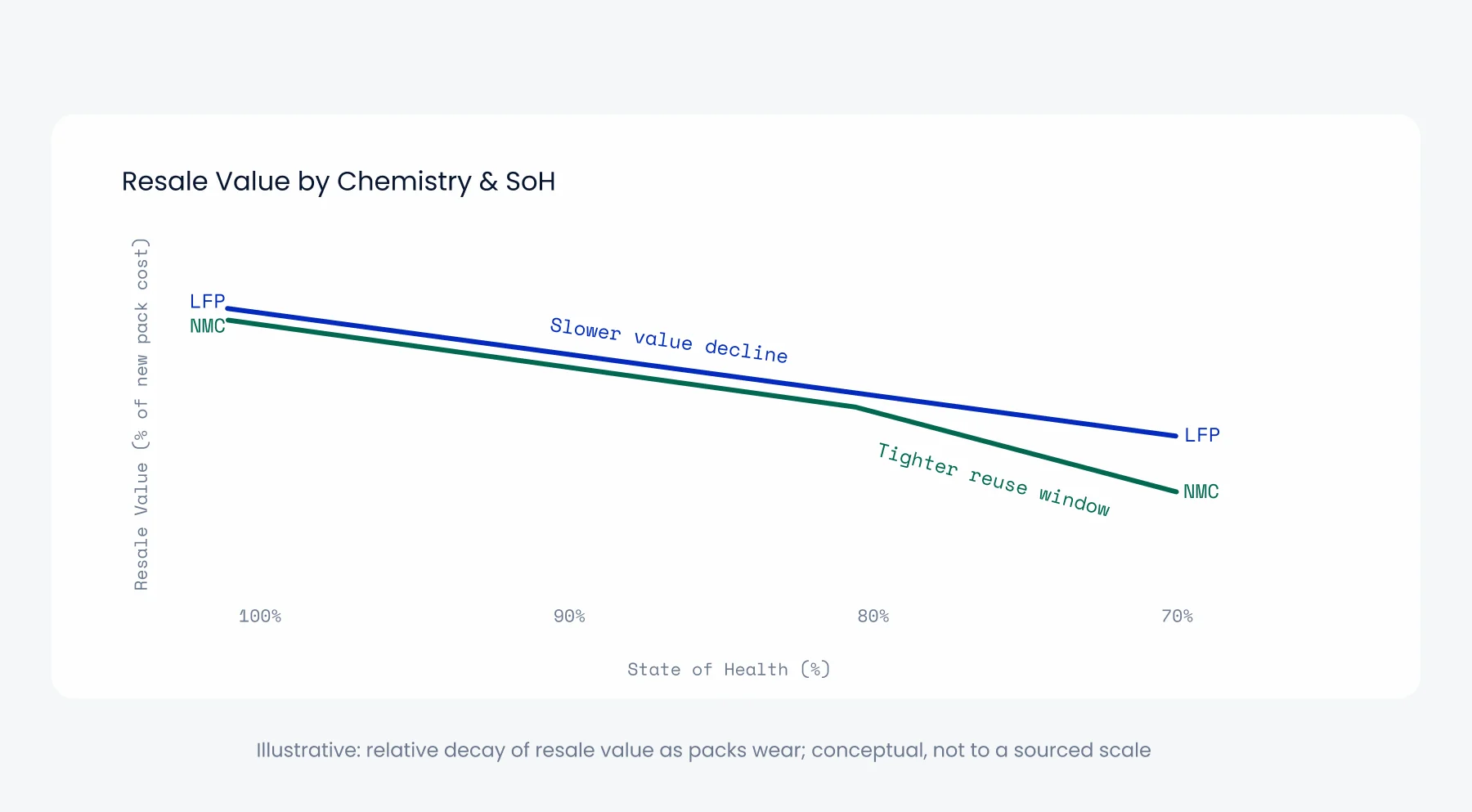
LFP holds value longer
LFP packs keep resale value across a wider SoH range. They still provide usable cycle life, even at lower capacity.
A 75% SoH LFP pack may still be viable for certain BESS or backup power applications. That extends the resale window and supports pricing closer to new-pack cost per usable kWh.
NMC value drops faster
NMC packs lose resale value more sharply as SoH declines. Below 80% SoH, the remaining cycle life may not justify integration cost for most second-life applications. That pushes pricing toward scrap or recycling value rather than functional reuse value.
Market demand reflects chemistry
On B2B battery marketplaces, LFP lots typically see faster transaction times and more competitive bids, especially for BESS applications. NMC lots need more detailed qualification data. They often go to recycling unless SoH is high. The thermal history must be clean.
Round-trip efficiency also affects value
Resale value is not only about what a battery is worth on the day it is sold. For BESS buyers, it is also about how much usable energy the system can return over years of operation.
Round-trip efficiency (RTE) measures how much energy comes back out of a storage system compared with how much energy was put in. If a system charges 100 kWh and discharges 88 kWh, its RTE is 88%. If another system returns 92 kWh, the difference looks small in one cycle. Over one or two cycles per day and 10 to 15 years of operation, it can become a major revenue difference.
ACCURE’s 2025 Energy Storage System Health & Performance Report found that most BESS projects fall between 85% and 88% RTE, while best-in-class systems reach 88% or higher. ACCURE also notes that even small efficiency losses of 1 to 2 percentage points can translate into significant lifetime revenue losses for storage assets.
For LFP vs NMC battery trading, RTE should not be treated as a fixed chemistry rule without comparable system data. Chemistry can influence efficiency, but so can inverter setup, battery management system quality, C-rate, temperature, degradation state, and operating profile.
For sellers and buyers, the practical takeaway is simple: RTE belongs in the evidence pack. A battery lot with attractive purchase pricing may still underperform financially if efficiency losses are too high. A more expensive lot may deliver stronger lifetime value if it returns more usable energy per cycle.
Key Insight 4: LFP vs NMC Battery Chemistry and Recycling Economics
When a pack does not qualify for a second life, chemistry determines recycling value. The LFP vs NMC battery split creates two very different recycling economics.
NMC has higher material recovery value
NMC batteries often have higher recovery values. This is because they contain nickel and cobalt. These metals make up much of the recovered value in nickel-rich battery recycling.
In its report on battery recycling in Europe, DNV, the Norway-headquartered assurance and risk management company, notes that LFP batteries contain less valuable material than nickel- and cobalt-rich chemistries such as NMC. This makes LFP less attractive for recycling from a pure material-recovery perspective. DNV also points out that NMC and LFP black mass trade at different prices.
For recyclers, this often creates a stronger business case for NMC recovery. LFP recycling depends more on scale, lithium prices, and regulatory rules.
LFP has lower material value but simpler processing
LFP contains iron and phosphate, which are abundant and low-cost. Recycling value is lower, but processing is simpler and safer due to lower thermal risk. Some recyclers are building
LFP-specific lines to handle the growing volume, but material recovery economics remain weaker than NMC.
Routing logic
For sellers, the LFP vs NMC battery routing framework looks like this:
- High-SoH LFP → second life (strong cycle life remaining)
- Low-SoH LFP → recycling (lower material value, limited reuse case)
- High-SoH NMC → second life if thermal history is clean
- Low-SoH NMC → recycling (material value supports pricing)
Chemistry drives both the reuse decision and the price a pack earns when reuse is off the table.
Industry & Operational Implications
For BESS operators
When sourcing batteries, specify LFP or NMC chemistry requirements upfront. LFP delivers longer cycle life and simpler thermal management for most stationary applications. NMC may be viable for shorter-duration or weight-sensitive projects, but qualification costs are higher.
Ask for chemistry-specific degradation data and thermal history. Do not assume all lithium-ion packs perform the same. The difference between LFP and NMC batteries can affect your project economics.
For OEMs and fleet operators
When planning battery returns, track chemistry alongside SoH. LFP packs have a longer resale window and broader second-life market. NMC packs require faster disposition and tighter qualification to capture resale value before it drops to recycling levels.
Build chemistry awareness into your return logistics and valuation models. The same SoH number means different things for LFP and NMC battery packs.
For recyclers and traders
Chemistry affects pricing, routing speed, and buyer demand. LFP lots move faster into second-life channels. NMC lots need clear material recovery value communication when second life is not viable.
Transparent chemistry labeling and chemistry-specific qualification workflows reduce friction and improve transaction velocity.
Actionable Recommendations
- Label LFP or NMC battery chemistry explicitly in all listings and documentation. Do not assume buyers will infer it from model numbers or OEM names
- Set SoH thresholds by chemistry, not universally. LFP may be viable for second life at 75% SoH. NMC typically requires 80%+ unless the use case is very specific
- Request thermal history for NMC packs. Thermal events or sustained high-temperature operation reduce remaining cycle life and increase integration risk
- Build LFP vs NMC battery chemistry into your valuation models. LFP resale value degrades more slowly. NMC value drops faster but has a recycling floor
- Align procurement specs with application requirements. Stationary BESS projects should prioritize LFP unless there is a specific reason to use NMC.
- Track chemistry mix in your pipeline. As LFP adoption grows, second-life supply will shift. Plan infrastructure and qualification processes accordingly
- Ask for round-trip efficiency data where available. For BESS use cases, RTE affects lifetime revenue. Even a small efficiency difference can add up over one or two daily cycles and a 10 to 15 year operating life
Looking Ahead
Battery chemistry diversity is increasing, not decreasing. Sodium-ion is entering the market.
Solid-state is on the horizon. LFP and NMC will coexist for years, each serving different applications and lifecycle paths.
Companies that build LFP vs NMC battery awareness into: sourcing, qualification, and trading workflows will move faster. They will also capture more value.
The ones that treat all lithium-ion batteries as interchangeable will face delays, mismatched expectations, and pricing gaps.
Chemistry is not a technical detail. It is a commercial filter. Know it before you buy, sell, or deploy.
Looking to source or sell LFP or NMC battery packs? Explore qualified listings on the Circunomics marketplace.
FAQ
What is the main difference between LFP and NMC batteries for second-life applications?
LFP (Lithium Iron Phosphate) batteries offer longer cycle life and greater thermal stability. They also degrade in more predictable ways. This makes them a strong choice for second-life use in stationary Battery Energy Storage Systems (BESS).
NMC (Lithium Nickel Manganese Cobalt Oxide) batteries deliver higher energy density but degrade faster, especially under demanding first-life conditions. For second-life qualification, chemistry is the first filter.
The same State of Health (SoH) reading can mean different things. It depends on whether the pack is LFP or NMC.
Does LFP or NMC battery have better resale value after first life?
LFP usually holds resale value across a wider SoH range. It keeps usable cycle life even at lower capacity levels. A 75% SoH LFP pack may still qualify for stationary storage applications.
NMC resale value drops faster below 80% SoH.
At that point, the remaining cycle life may not justify integration costs for most second-life uses. However, NMC packs with clean thermal history and high SoH can still command strong prices when routed to the right buyer.
Which battery chemistry has higher recycling value, LFP or NMC?
NMC has a higher material recovery value because it contains nickel and cobalt. These metals often fetch high prices in battery recycling streams. LFP contains iron and phosphate, which are abundant and lower in cost, resulting in weaker recycling economics.
This means low-SoH NMC packs often have a stronger recycling floor price than LFP. For sellers, this affects routing decisions.
A low-SoH NMC lot may be worth more to a recycler. It may be worth less to a second-life integrator. A low-SoH LFP lot has fewer high-value exit routes.
What documentation should I request when buying second-life LFP or NMC battery lots?
At a minimum, buyers should ask for confirmed battery chemistry (LFP or NMC). They should request State of Health (SoH) data and the test method used. They should ask for the cycle count history.
They should request the thermal event history. They should ask for the original OEM specifications. They should also request any Battery Passport or compliance documents, if needed.
For NMC packs specifically, thermal history is critical sustained high-temperature operation or thermal events significantly reduce remaining cycle life and increase integration risk.
How is the battery second-life market changing as LFP adoption grows?How is the battery second-life market changing as LFP adoption grows?
As LFP becomes the leading battery type in EVs and stationary storage, the second-life supply is shifting. Globally, LFP will account for over half of EV battery use in 2025, says the IEA.
More LFP packs will enter the used battery market in the next few years. This will increase supply for BESS uses.
It will also require LFP-specific infrastructure and qualification processes.
Companies that build chemistry-aware sourcing and grading workflows now will be ready to grow. They can move more volume and capture more value as supply increases.