For years, buying batteries from Asia came down to three things: price, volume, and when they would arrive. There is now a fourth, and it changes how the whole conversation works. Data.
TL; DR: Key Takeaways
From 18 February 2027, all industrial and EV batteries sold in the EU need a Digital Battery Passport (DBP).
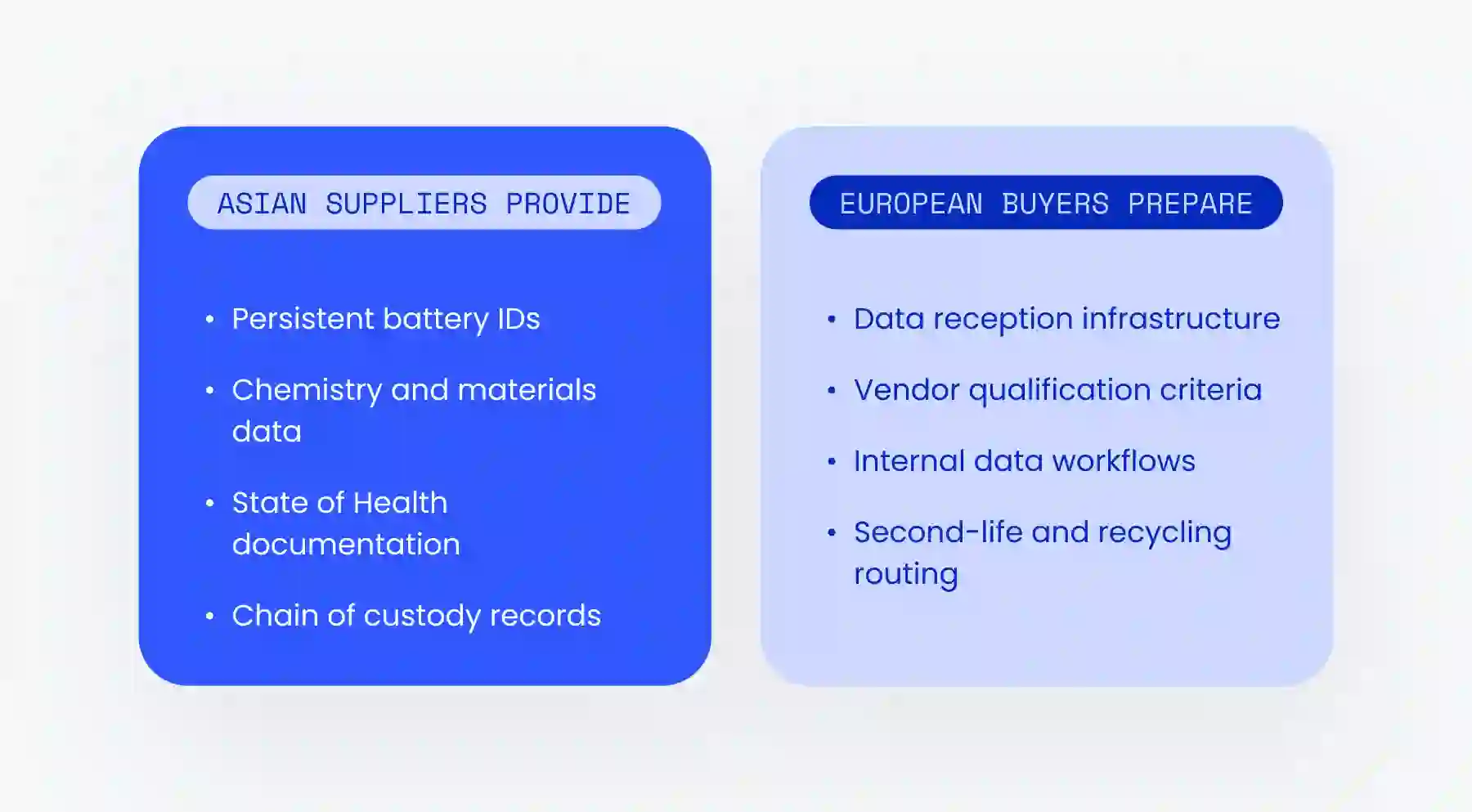
Asian suppliers must provide permanent battery IDs and chemistry data. They must also provide State of Health documents and a chain of custody records.
European buyers need data reception infrastructure and updated procurement processes. EU regulators will block non-compliant batteries from sales, resales, and recycling. Companies without an implementation plan (81% as of February 2026) face market access risks.
Early adopters gain a competitive edge in second-life markets and circular economy opportunities.
From 18 February 2027, every EV battery sold in the EU must have a Digital Battery Passport.
The passport includes persistent ID, chemistry details, and State of Health (SoH).
It also includes a documented chain of custody. Without it, the EU law prohibits battery sales. This raises practical questions on both sides.
Do suppliers already track this data? Do buyers know how to ask for it? For some, the answer is yes, for others not yet, and both cases are worth working through before the deadline.
👉 Not sure if your supply chain is ready for Digital Battery Passport requirements? Book a 15-minute compliance assessment with our team.
We'll review your current data capabilities and show you exactly what needs to change before February 2027.
Why Digital Battery Passports Matter Now
In July 2026, the EU launched its central DBP Registry, along with a public testing environment. The registry doesn't store passport data itself. It works as a central index that points to where each battery's data lives.
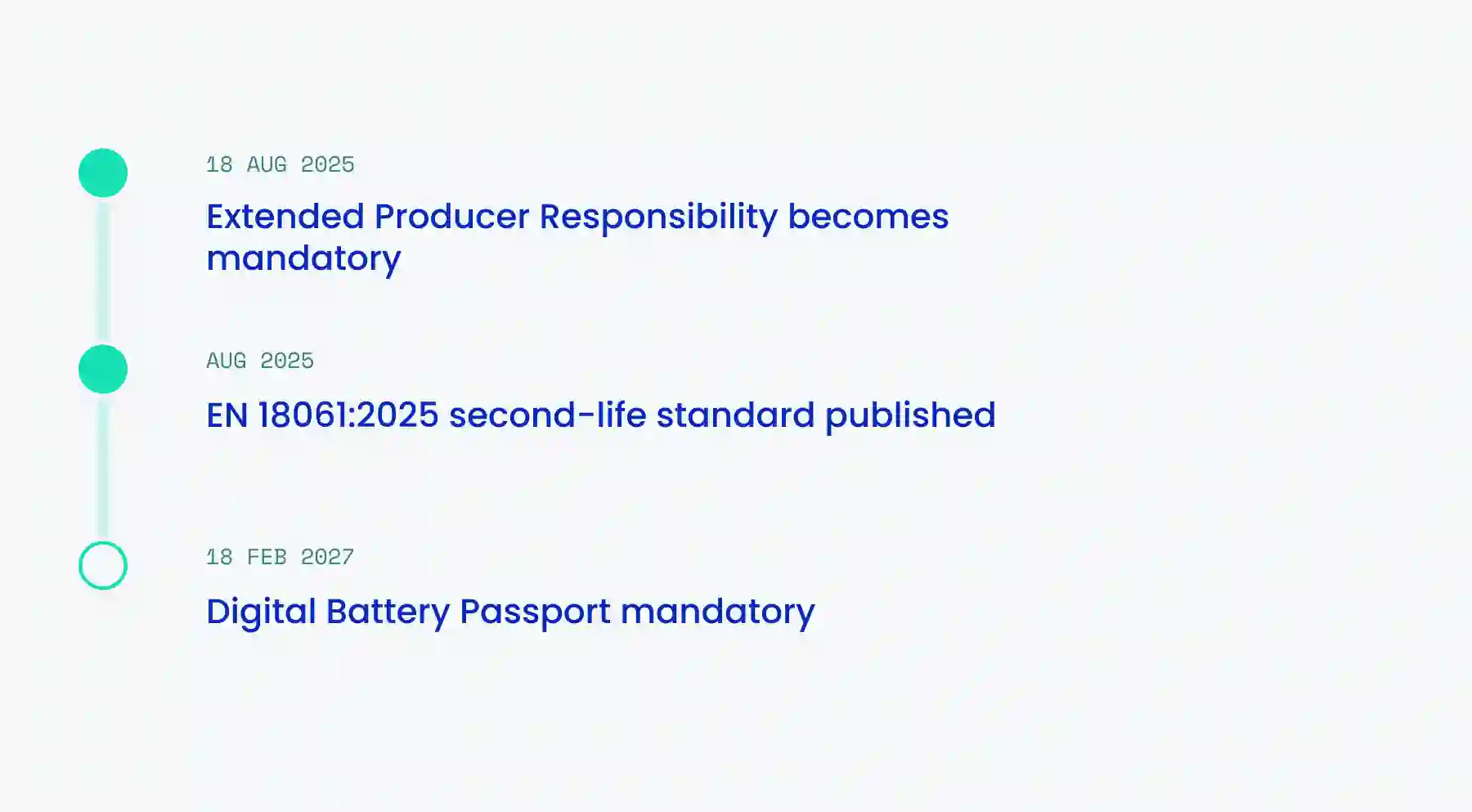
Batteries are the first product category that must use it, with registration becoming mandatory on 18 February 2027. That gives suppliers only a short time. This window runs through 2026 and into early 2027. During this time, suppliers must show that their battery data compliance is compatible.
The gaps are clear. They include who can access which data. They include a QR code linked to a unique battery ID. They also include a clear record of where the battery has been.
Fixing them early is what keeps you able to sell into the EU second-life battery market and resale market.
This sits on top of rules that are already in force. Extended Producer Responsibility (EPR) became mandatory on 18 August 2025. The DBP follows in less than a year. These aren't recommendations.
They are EU Battery Regulation requirements. EU law sets the passport deadline. It applies even if the supporting technical acts change.
For cross-border battery flows, the effect is practical. Asian battery suppliers must deliver structured data alongside the physical product. European battery buyers have to receive, validate, and store it.
Suppliers and buyers must align data requirements, format standards, and transfer timing.
The risk is not only regulatory. It is operational. Without battery traceability data, buyers cannot resell or reuse the battery. Recyclers cannot process it with confidence.
That affects valuation, liability, and market access.
What Asian Battery Suppliers Must Provide
Persistent Battery IDs
Every battery needs a unique battery identifier. This ID must stay with the battery throughout its life, from manufacturing through first use, second life, and recycling.
Many manufacturers already use serial numbers for quality control. The difference is that EU battery passport rules require IDs to be interoperable and machine-readable. These IDs must link to a data record that stays with the product.
Battery Chemistry and Materials Data
The DBP requires disclosure of battery chemistry, key materials, and hazardous substances. This includes cathode and anode composition, electrolyte type, and recycled content percentages. The regulation also links to carbon footprint reporting for batteries. Embedded emissions data is part of the same picture.
State of Health (SoH) Documentation
What is battery State of Health? SoH is different from State of Charge (SoC). It reflects the battery's remaining capacity and performance relative to its original design. SoC is just how full it is right now.
EU buyers need SoH data to assess second-life battery viability, warranty risk, and end-of-life routing. Suppliers who can provide documented SoH from production onward gain a competitive edge.
Chain of Custody Records
Battery traceability is not just about the battery. It is about proving where it came from, who handled it, and under what conditions.
EPR compliance requires a verifiable chain of custody for batteries for reporting, accountability, and cross-border flows. Buyers must demonstrate complete battery traceability to regulators.
What European Battery Buyers Must Prepare For
Data Reception Infrastructure
Receiving a DBP is not the same as receiving a PDF. It requires systems that can accept, validate, and store structured data in interoperable battery data formats.
European buyers need to ask a critical question. Can our systems actually store these battery IDs and connect them to our own data? Can we pass that data downstream to second-life battery evaluators or recyclers?
Without this infrastructure, compliance becomes manual, error-prone, and costly.
A passport only works if it is interoperable and travels with the battery from one holder to the next.
This is the problem Circunomics solves. Our Battery Passport platform connects with other platforms and standards. This keeps battery records readable for manufacturers, recyclers, and regulators.
Vendor Qualification Criteria
Procurement processes must evolve. Price and delivery terms are no longer sufficient. European buyers need to add battery data readiness to their vendor for scorecards.
Questions to ask battery suppliers:
- Can you provide a persistent battery ID?
- Do you track chemistry and materials data?
- Can you document SoH on shipment?
- What format will you use to deliver the data?
- Are you compliant with EU Battery Regulation 2027 requirements?
Suppliers who can't answer these questions represent a compliance risk.
Internal Data Workflows
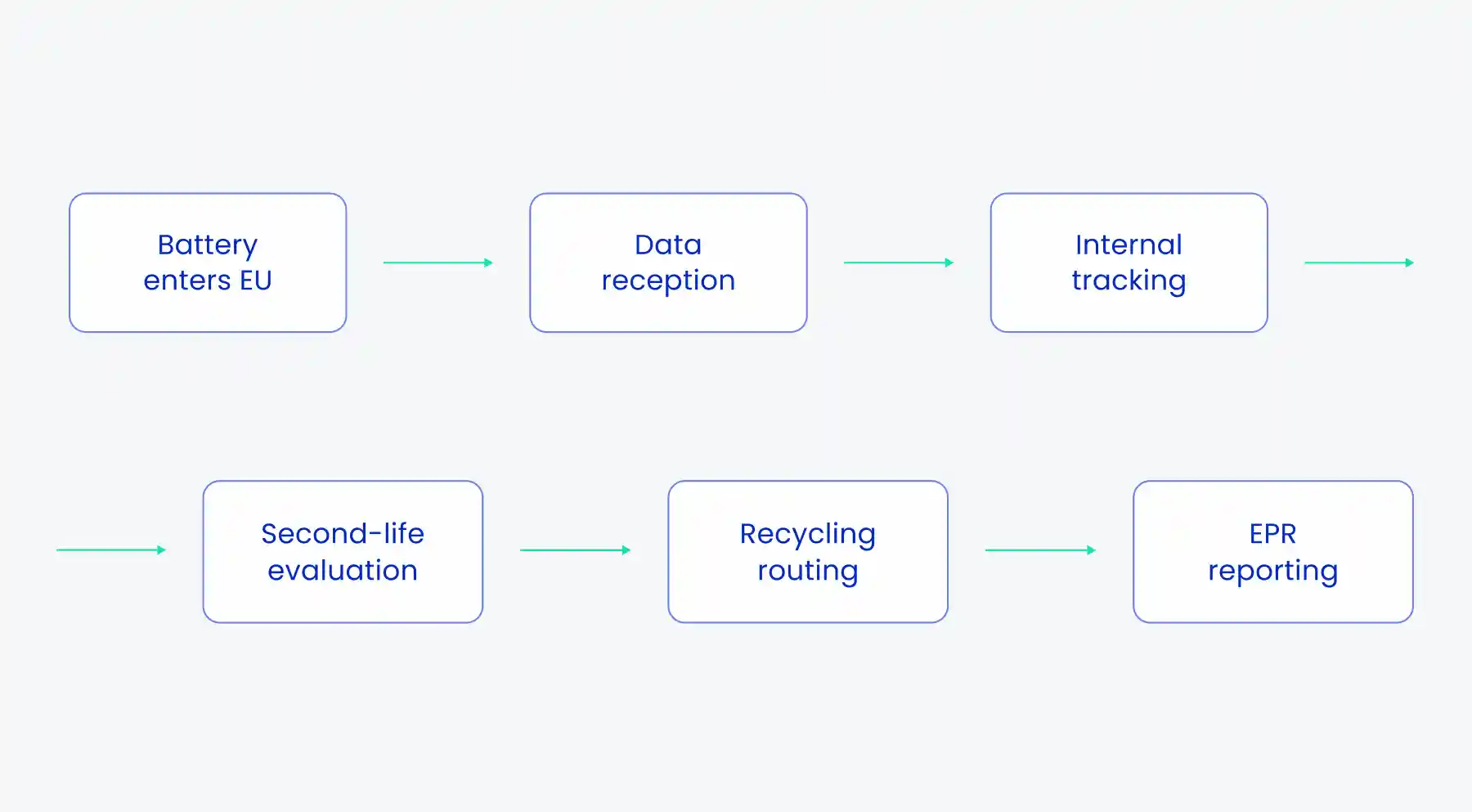
Once data arrives, it must flow through the organization. That means connecting procurement, quality control, warehouse management, and battery compliance reporting.
Many organizations treat battery data as a technical afterthought. Under the new regulations, it is a legal and operational requirement. Buyers who prepare now avoid bottlenecks later.
Where Misalignment Creates Risk
No Data, No Second Life
Second-life battery markets depend on transparency. A battery without documented history can't be confidently requalified. That limits resale options and reduces residual value.
For buyers importing from Asia, that is lost revenue. For suppliers, it is a growing market they miss out on. A passport fixes this.
Trusted battery data shows three things: health, materials, and origin. With this data, you can decide if a battery should go to second-life applications or recycling.
That is the part Circunomics handles: connecting passport data to the right next step for each battery.
EPR Reporting Gaps
EPR requires reporting on battery origins, flows, and end-of-life battery outcomes. Asian suppliers must provide chain of custody data. Without it, European buyers cannot meet their EPR obligations.
That creates compliance risk, potential fines, and reputational exposure.
Battery Recycling Inefficiencies
Recyclers need to know what they are processing. Battery chemistry data determines recovery methods, safety protocols, and material yields.
Batteries arriving without chemistry information slow down battery recycling operations and reduce recovery rates. That increases costs and undermines the circular economy for batteries' goals.
Actionable Steps for Alignment
For Asian Battery Suppliers
- Implement persistent ID systems that link physical batteries to digital records.
- Document battery chemistry and materials data at the battery pack and cell level.
- Capture State of Health metrics during production and quality testing.
- Establish data export processes that deliver structured, machine-readable information to EU buyers.
- Engage with EU buyers early to understand their battery data requirements and system constraints.
For European Battery Buyers
- Audit current procurement processes to identify battery data gaps.
- Update vendor qualification criteria to include Digital Battery Passport readiness.
- Invest in battery data reception infrastructure that can handle persistent IDs and structured records.
- Train internal teams on EPR compliance, traceability requirements, and data workflows.
- Map data flows from receiving through second life and recycling to ensure continuity.
Strategic Outlook: The Future of Digital Product Passports
The battery passport is not a one-off requirement. The battery passport is the first Digital Product Passport (DPP) to become mandatory under EU law. The EU will use it as a template for other products, from textiles to electronics. What suppliers and buyers build for batteries now is likely to carry over to the next wave of rules.
Readiness is still low. A February 2026 KPMG survey found that 81% of companies had no Digital Product Passport implementation plan. That gap is also an opportunity for early movers. Building your data stack now means you arrive in 2027 prepared, not scrambling.
For Asian suppliers, this changes what compliance is worth. Being able to deliver verified, interoperable battery data is not only about market access. It becomes a reason for a European buyer to choose you over a supplier who can't.
For European buyers, the same logic applies in reverse. Battery data readiness is not only about avoiding fines. Battery data readiness unlocks three key benefits. It enables second-life battery value, cleaner recycling routing, and more resilient sourcing.
The industry's direction is now clear. The companies that sort out their battery data early will have far less to fix when the deadline arrives.
Next Steps
Understanding the rules is the first step. Getting your battery data ready for them is the second step.
Our Battery Passport helps suppliers and buyers in three ways. It tracks lifecycle data, meets 2027 requirements, and routes batteries to second-life or recycling.
👉 If you want to see how it fits your supply chain, contact our team.
Frequently Asked Questions (FAQ)
What is a Digital Battery Passport?
A Digital Battery Passport (DBP) is a mandatory digital record for batteries. It applies to all industrial and EV batteries sold in the EU from 18 February 2027.
It contains five key data points. These include a:
- Persistent battery ID
- Chemistry details
- State of Health data
- Carbon footprint information
- Chain of custody records
When does the EU Battery Passport become mandatory?
The Digital Battery Passport became mandatory on 18 February 2027 for all industrial batteries and electric vehicle batteries sold in the European Union.
What is the difference between State of Health (SoH) and State of Charge (SoC)?
State of Health (SoH) measures a battery's remaining capacity and performance compared to its original design specification. State of Charge (SoC) simply indicates how full the battery is at a given moment. SoH is critical for assessing second-life viability and warranty risk.
Do Asian battery suppliers need to comply with EU Battery Passport regulations?
Yes. Any supplier exporting industrial or EV batteries to the EU must provide Digital Battery Passport data. This includes persistent IDs, chemistry information, SoH documentation, and a chain of custody records. Without this, the EU blocks battery sales.
What happens if my batteries don't have a Digital Battery Passport?
Without a compliant passport, buyers cannot sell, resell, or place batteries on the EU market after 18 February 2027. This affects market access, second-life opportunities, and recycling pathways.
What is Extended Producer Responsibility (EPR) for batteries?
Extended Producer Responsibility (EPR) requires battery producers to manage their products throughout the entire lifecycle. This includes:
- Collection
- Recycling
- Proper disposal
It became mandatory in the EU on 18 August 2025.
How does the Digital Battery Passport support second-life battery markets?
The DBP provides verified data on battery health, chemistry, and history, enabling confident assessment for second-life applications. Without this transparency, batteries cannot be requalified for reuse, limiting their residual value and market opportunities.
What battery data do European buyers need from Asian suppliers?
Buyers need battery IDs, chemistry data, health documentation, recycled content percentages, carbon footprint, and custody records. All data must be machine-readable and interoperable.
How can Circunomics help with Battery Passport compliance?
Circunomics provides a Battery Passport platform designed for interoperability across manufacturers, buyers, recyclers, and regulators. It tracks lifecycle data, ensures compliance with 2027 requirements, and routes batteries toward optimal second-life or recycling pathways.
What is the EU DBP Registry?
The EU Digital Battery Passport Registry launched in July 2026. It shows where each battery's passport data is stored. It doesn't hold the data itself but ensures persistent IDs and records are accessible across the battery lifecycle.