Spain has one of Europe's strongest renewable-energy profiles but historically had very little battery storage. That gap is beginning to close and fast.
More solar means more hours when electricity is cheap or even free. Spain struggles to deliver that power to where people need it, when they need it most. The country is providing funding, upgrading the grid and creating new market rules to speed up BESS deployment.
TL;DR: Key Takeaways
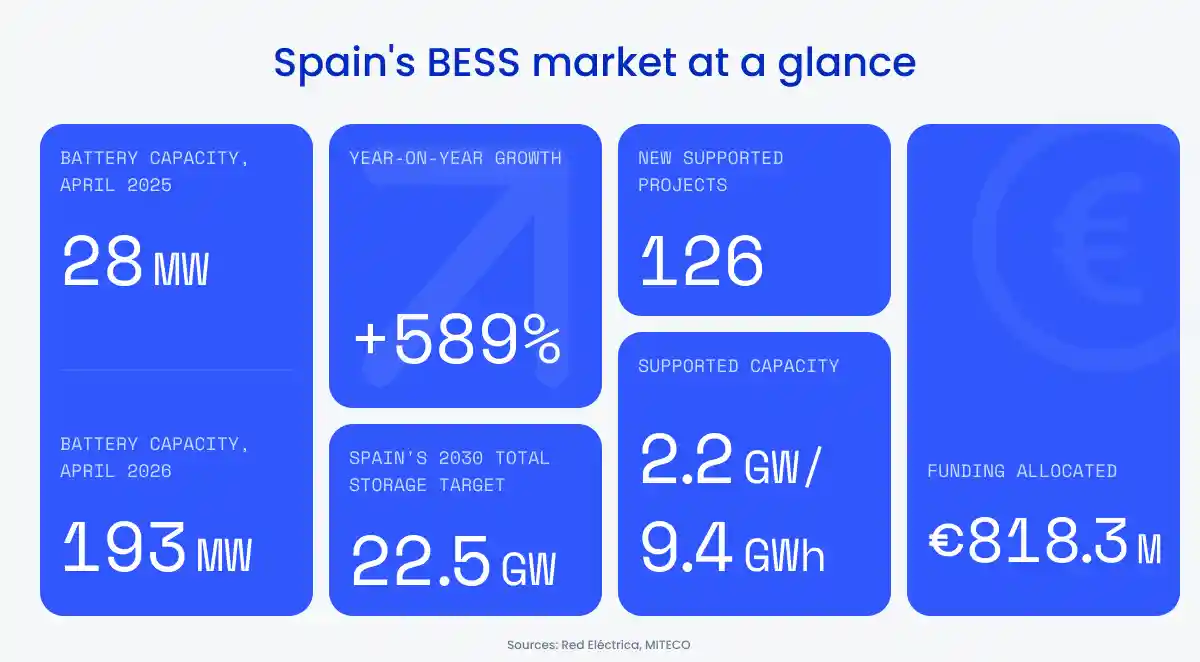
Market Growth: Spain's installed BESS capacity grew 589% in one year from 28 MW (April 2025) to 193 MW (April 2026). Public funding supports 2.2 GW / 9.4 GWh across 126 projects.
Spain's goal is 22.5 GW of total energy storage by 2030. This includes pumped hydro, not only batteries.
Spain's 2026 framework will pay BESS for firm capacity. New projects may get 15 year contracts.
- Battery Sourcing Challenge: Spanish developers are struggling to secure the right equipment, documentation, and delivery dates
- Three Supply Routes: Developers can choose from new, first-life surplus, or second-life batteries. Each with different qualification, warranty, and cost requirements
- Regional Activity: BESS projects are concentrated in Andalusia, Extremadura, Catalonia, Valencia, Castilla y León, and Galicia
Why Spain Needs BESS Now
Spain has plenty of renewable generation. What it needs more of is flexibility.
The country's renewable build-out, particularly in solar PV, is changing the shape of electricity supply. At midday, solar output can exceed demand, creating excess electricity.
This can compress wholesale prices and, in some periods, contribute to very low or negative prices. Price volatility matters, but timing matters more. Electricity generated at midday isn't always available when demand increases later in the afternoon and evening.
Understanding why battery storage is growing in Spain starts with the system's fundamental need for flexibility. Without sufficient battery storage, Spain has fewer options for balancing the grid when renewable output changes.
What Can BESS Address in Spain's Energy Market?
Here's what battery energy storage systems Spain can help address:
- Time-shifting renewable generation: Storing electricity during periods of high solar output and releasing it later
- Managing price volatility: Creating additional value from intraday and daily price spreads
- Reducing renewable curtailment: Providing a place for electricity that might otherwise be constrained
- Supporting grid flexibility: Responding quickly to changes in supply, demand and network conditions
- Improving system resilience: Providing fast-response capability alongside other grid and market measures
- Maximising existing connections: Allowing storage and renewable generation to share grid infrastructure can reduce the need for new connections
Spain's challenge isn't simply to build more generations. It's to coordinate generation, storage, networks and demand more effectively.
That's why battery storage has moved from a niche technology discussion to a core infrastructure priority in Spain.
How Fast Is the BESS Market in Spain Growing?
The battery storage market in Spain is still relatively small, but its pace of growth is increasing.
The figure looks large because the starting point was small. However Spain’s BESS projects are clearly progressing from development into operation.
Understanding Spain's Battery Storage Target for 2030
The comparison also needs to be understood correctly. The 193 MW figure refers to installed battery capacity. It's not the same as:
- Spain's total energy-storage target
- The full pipeline of BESS projects
- The capacity supported through public funding
- Or the amount of storage already available across all technologies
When looking at Spain's battery storage target for 2030, the official objective is 22.5 GW of total energy storage. This broader figure includes technologies such as pumped storage as well as electrochemical batteries. Do not use this figure to claim that Spain will have 22.5 GW of BESS specifically.
At the same time, public funding is helping move a substantial group of projects closer to delivery. The funding round referenced in this article supports 126 projects with a combined capacity of 2.2 GW / 9.4 GWh.
Spain has installed 193 MW of BESS capacity, and support programmes cover a further 2.2 GW of projects. How quickly Spain closes this gap will depend on whether projects secure permits, grid access, financing, equipment, and construction.
What's Driving BESS Investment in Spain?
1. Solar Growth and Price Volatility
Spain is generating more solar power during daylight hours. Batteries store energy during periods of high production and release it when demand rises.
A battery storage project’s value in Spain depends on several factors. Including: how it operates, where it connects, how long it stores energy, and how it earns revenue. Its core purpose is simple: match solar generation with electricity demand.
Choosing the right battery means matching its duration and cycling capability to the project’s needs. A system designed for frequency response may not work for multi-hour solar shifting.
Likewise, a system optimised for daily arbitrage may have different degradation, warranty and augmentation requirements from a system focused primarily on grid services.
2. Government Funding for Battery Storage
Public funding is one of the main accelerators of the Spanish storage market.
The funding round covered standalone storage, hybrid storage system projects and other storage technologies.
The supported portfolio includes 126 projects. With funding of €818.3 million and a combined supported capacity of 2.2 GW / 9.4 GWh.
MITECO’s storage funding supports both independent installations and projects that combine storage with renewable energy. Its large-scale storage call included standalone batteries, hybridised renewable projects, thermal storage and reversible pumped storage.
The importance of this support extends beyond the individual grant amounts. Public funding can help projects reach the next stage of development, improve investment visibility and create demand for equipment, integration services and technical qualification.
It also means that battery energy storage procurement in Spain becomes part of the deployment challenge. Projects can still face delays even after teams secure land, permits, and funding. If suppliers deliver the battery systems late.
3. Standalone and Hybrid BESS in Spain
Spain isn't pursuing a single storage model. The supported project portfolio includes both:
- Hybrid storage system projects, where batteries are combined with renewable generation
- Standalone battery projects, which charge from the grid or operate independently of a co-located renewable plant
The funding portfolio includes 69 hybrid projects and 39 standalone battery projects. This mix matters because the two models have different technical, commercial and procurement requirements.
The project design may depend on:
- How much solar power is generated
- How the grid connection is shared
- When the battery charges
A standalone BESS may require more flexibility in how it charges and discharges. As well as a different approach to market participation, grid access and revenue optimisation.
For battery storage developers, the choice between hybrid and standalone storage isn't simply a technology decision. It affects the project's connection design, operating assumptions, revenue model and battery specification.
4. Grid Flexibility and System Security
Grid constraints and system-security requirements are adding to the case for storage.
Battery storage can respond quickly, but it cannot replace grid investment, system planning, or other flexibility solutions.
The 2025 Iberian blackout increased attention on grid resilience, but batteries are only one part of the solution.
Battery storage is one of the tools Spain can use to manage more variable renewable generation. Especially when the grid needs fast response, local support, or extra capacity.
Spain's New Capacity Market: What Changes for BESS?
Spain's new capacity-market framework is one of the most important regulatory developments for battery storage in 2026.
The scheme provides payments for resources that can offer reliable capacity and flexibility at the right time. Battery storage will be eligible alongside generation and demand-side resources.
Understanding the Spain Capacity Market for Battery Storage
The Spain capacity market for battery storage framework is expected to use:
- Firm capacity measured in MW
- Remuneration expressed in €/MW/year
- Technology-neutral auctions
- Pay-as-bid pricing
- Availability and firmness requirements
- And different service periods for existing assets, new investments and demand-side resources
For new investments, eligibility is focused on renewable energy, storage and demand.As renewable generation becomes more variable, Spain will need several grid-management tools. BESS can provide fast response, local flexibility, and capacity when the system is under pressure.
This could create a new route towards more predictable revenue for qualifying BESS Spain projects.
What This Means for Battery Storage Developers:
Capacity-market revenue doesn't eliminate BESS project risk.Battery storage developers will still need to address:
- The capacity or de-rating factor applied to the battery
- Availability requirements
- Penalties for non-performance
- Degradation over the contract term
- Augmentation strategy
- Market-access arrangements
- Grid connection
- And the cost and timing of battery energy storage procurement Spain
The commercial significance isn't that the capacity market makes every BESS project bankable. It's that it may add another revenue layer to a project's financial model.
The revenue will depend on the auction design, contract terms, payment process, and performance requirements. Developers should see this mechanism as a way to improve revenue visibility, while still carrying out detailed project analysis.
Where Are Developers Building BESS Projects in Spain?
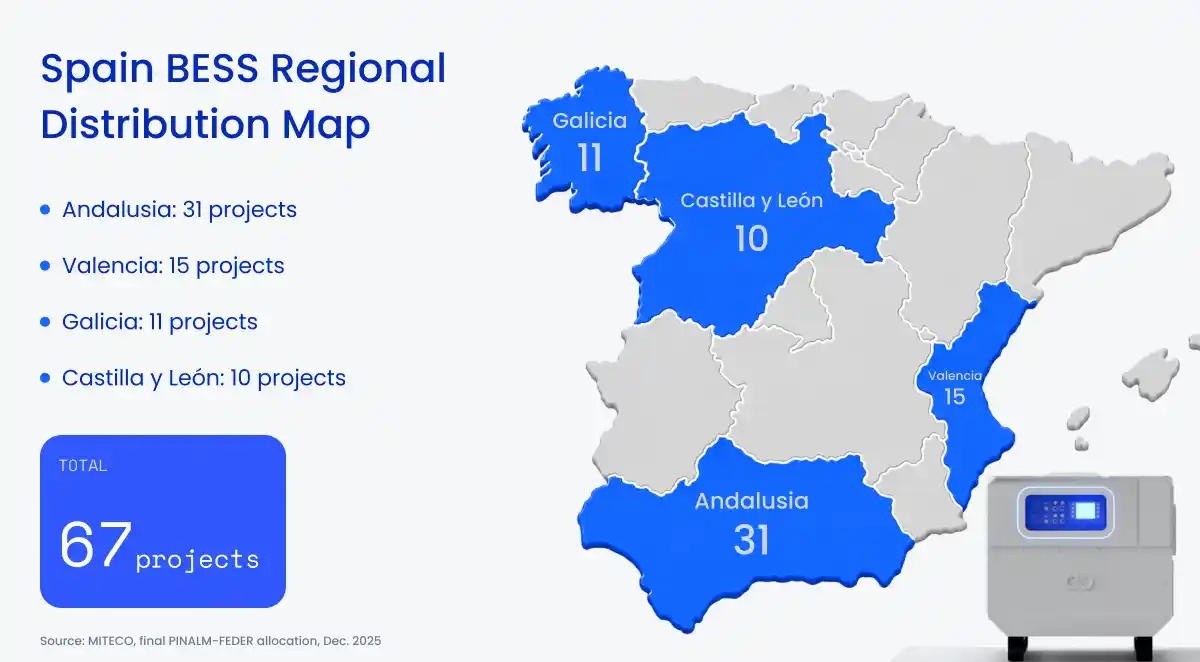
Developers are building BESS projects across several Spanish regions, guided by renewable resources, available grid capacity, and regional funding programmes.
Activity is visible in:
- Andalusia
- Extremadura
- Catalonia
- Valencia
- Castilla y León
- Galicia
Developers are not limiting BESS projects in Spain to one energy market or type of location.
Regional Considerations for Battery Storage Developers
Some projects will be closely linked to solar generation and renewable-resource availability. Some developers will place BESS projects near grid constraints or where the local system needs more flexibility.
For battery storage developers, regional analysis should therefore go beyond identifying where solar irradiation is strongest. It should also consider:
- Available grid capacity;
- Connection and permitting timelines;
- Local planning requirements;
- Proximity to renewable generation or demand;
- Logistics and access;
- Environmental constraints;
- And the availability of suitable battery supplier Spain options.
Battery Procurement Is Becoming the Real Bottleneck
As Spain's storage pipeline expands, the next bottleneck may not be project approval, but battery sourcing.
A 2 GW project pipeline eventually becomes a procurement problem. A successful project depends on securing the right battery systems, documentation, price, and delivery timeline.
That requires more than comparing headline €/kWh figures.
BESS Battery Procurement Challenges Spain: Key Considerations
Understanding BESS battery procurement challenges Spain starts with recognizing the complexity beyond price. Key sourcing considerations include:
- Battery availability
- Delivery windows
- Cell chemistry
- LFP versus NMC suitability
- Cell, module and pack documentation
- Certification
- Provenance
- BMS compatibility
- State-of-health evidence where applicable
- Warranty terms
- EU regulatory documentation
- Battery Passport readiness
- Logistics
- Augmentation requirements
- And total deployable cost
The cheapest battery may become more expensive after accounting for integration, qualification, testing, shipping, certification, warranty risk, and project delays.
Projects targeting a defined market window need batteries delivered on time. A six-month delay can disrupt construction, grid milestones, financing conditions, and commercial operation.
For projects in Spain, battery procurement needs to be part of the overall delivery plan.
How to Source Batteries for BESS Projects in Spain
Battery sourcing for BESS projects in Spain requires careful planning and a systematic process:
- Start with technical requirements: Define MW, MWh, duration, cycling profile and chemistry needs before approaching any battery supplier Spain.
- Assess supply routes: Evaluate new, first-life surplus and second life battery inventory against project specifications.
- Verify documentation: Confirm that batteries come with complete certification, test reports, warranty terms and EU Battery Regulation compliance.
- Plan for integration: Ensure BMS, PCS and EMS compatibility before committing to a specific battery system.
- Factor in total cost: Look beyond €/kWh to include logistics, integration, testing, certification and potential delay costs.
- Secure delivery commitments: Align battery delivery schedules with construction milestones and grid connection dates.
The relevant question isn't only: What battery can we buy?
It's: Which battery inventory can be qualified, integrated and delivered within the project's technical and financial requirements?
New vs Second-Life Batteries for BESS Spain
There are three main ways to source batteries for BESS projects in Spain: new batteries, first-life surplus, and second-life batteries. Each option involves different trade-offs.
1. New Batteries
New batteries remain the most established route for large utility-scale deployment. They typically offer the clearest path to standardised system design, manufacturer support, performance documentation and warranty coverage.
There are three main ways to supply batteries for BESS projects in Spain. Choosing between new and second-life batteries will affect project cost, risk, and delivery.
Choosing a battery requires more than comparing supply routes. Developers must also assess delivery times, chemistry, warranty coverage, degradation, augmentation, and long-term manufacturer support.
2. First-Life Surplus Batteries
First-life surplus inventory can be attractive when project specifications, documentation and available volumes align.
Surplus batteries may offer shorter delivery times or commercial advantages, but the definition of "surplus" matters. Developers should establish whether the inventory is unused, allocated stock, discontinued product, excess production or equipment originally manufactured for a different project.
The qualification process should cover product history, storage conditions, documentation, compatibility, warranty transferability and certification. Working with a qualified battery supplier in Spain can help verify these factors.
3. Second-Life Batteries
Second-life batteries are suitable when their operating profile, cost, and performance align with the project’s needs.
There are three main ways to source batteries for BESS projects in Spain. Developers need to compare the benefits and risks of new and second-life batteries.
Qualification becomes more important for second-life batteries. Developers need reliable data on:
- Battery health
- Remaining useful life
- Cell consistency
- Thermal performance
- BMS compatibility
- Warranty coverage
Second life battery options aren't automatically the lowest-cost solution. The relevant comparison must include testing, sorting, integration, controls, replacement risk and operational requirements.
The Reality: Which Battery Supply Route Is Right for Your BESS Project?
The right sourcing decision depends on the project. A high-cycling utility-scale asset, a grid-support system and a lower-intensity commercial installation may all require different battery specifications.
The question isn't simply which battery is cheapest. It's which inventory can be qualified, integrated and delivered within the project's technical and financial requirements.
For more detail, see:
What BESS Developers in Spain Should Check Before Sourcing Batteries
Before selecting a battery supply route for your BESS Spain project, developers should confirm:
- Required MW and MWh
- Required duration
- Cell chemistry
- Cycling profile
- Depth-of-discharge assumptions
- System format and integration requirements
- PCS and EMS compatibility
- BMS compatibility
- Fire-safety requirements
- Certifications and test reports
- Battery origin and supply-chain history
- Warranty scope and transferability
- State of Health and test evidence
- EU Battery Regulation documentation
- Battery Passport data availability or readiness
- Delivery schedule
- Logistics and import requirements
- Spare parts and service support
- Augmentation strategy
- Total deployable cost rather than headline €/kWh
Use this checklist before you choose the battery and set the project’s technical design.
A battery may be technically available but unsuitable for the intended BESS configuration. It may meet a nominal capacity requirement but lack the documentation, warranty or integration support required by the project.
BESS Spain Outlook to 2030
Spain's storage market is moving quickly, but the gap between ambition and installed battery capacity remains significant.
The country has:
- A high-renewables power system
- Increasing solar output
- Growing flexibility needs
- Public funding for storage projects
- A large development pipeline
- And a new capacity-market framework that could create another revenue stream
The Next Phase: From Pipeline to Operation
The next phase will depend on execution.
Projects need to move through permitting, grid connection, financing, procurement, construction and commissioning. Each step can create delays, and battery availability is becoming part of that delivery equation.
Spain’s BESS market is moving beyond the question of whether it will grow. The focus is now on how quickly projects can secure financing, equipment, and operations.
That's where battery energy storage procurement Spain becomes strategically important.
Battery selection, verification, system integration, and timely delivery can determine whether a project reaches operation successfully.
Planning or Sourcing Batteries for a BESS Project in Spain?
Register on the Circunomics marketplace to explore verified battery inventory. Our team can also advise on battery energy storage procurement in Spain, qualification, and project delivery schedules.
FAQ
What is Spain's BESS target for 2030?
Spain's official target is 22.5 GW of total energy storage by 2030. This figure covers energy storage overall, including technologies such as pumped storage and batteries. The figure describes a broader storage target, not a standalone target of 22.5 GW for battery storage.
How much BESS capacity does Spain have?
Installed battery capacity increased from 28 MW in April 2025 to 193 MW in April 2026. This represents growth of approximately 589% from the previous year.
The figure refers only to installed BESS capacity. Spain tracks its total storage target separately from the wider pipeline of supported projects.
Why is battery storage growing in Spain?
Battery storage is growing because Spain is adding renewable generation, particularly solar, while needing more flexibility to manage differences between electricity production and demand.
BESS can shift renewable electricity into later demand periods, respond quickly to system requirements and support the integration of additional renewable capacity.
Can standalone BESS participate in Spain's electricity market?
Measure Spain’s total storage target separately from the wider pipeline of supported projects. Their ability to participate in specific markets and services depends on the applicable regulatory, grid-access and market-participation rules.
What is Spain's new capacity market for battery storage?
Spain’s new capacity-market framework rewards generation, storage, and demand resources that can provide firm capacity and flexibility.
Spain is developing standalone BESS projects, and public funding programmes have included some in their support schemes. New storage projects could secure service periods of up to 15 years. Depending on the final rules and eligibility requirements.
Are solar-plus-storage projects growing in Spain?
Yes. Spain's supported storage portfolio includes both hybrid storage system projects (where batteries are combined with renewable generation) and standalone battery projects.
Hybrid storage system configurations can help shift solar output and make better use of a renewable project's connection. Standalone BESS can offer different operating and market-participation options.
Which Battery Chemistries Do Spanish BESS Projects Use?
The right battery depends on the project's duration, cycling profile, integration requirements, market strategy, warranty conditions and delivery schedule.
Battery developers choose LFP for its combination of safety, cost, and cycle life. Other lithium-ion chemistries may be suitable when projects have different technical requirements.
Evaluate the battery chemistry alongside the full system and commercial specification.
How do you source batteries for BESS projects in Spain?
Battery energy storage procurement Spain should begin with the project's technical and commercial requirements. Battery storage developers should then assess: new, first-life surplus and second life battery inventory against:
- Availability
- Chemistry
- Documentation
- Certification
- state of health
- Warranty
- Compatibility
- Regulatory requirements
- Logistics
- Total deployable cost
What is the biggest challenge for BESS developers in Spain right now?
Permitting and grid access still matter, but battery procurement is becoming a major challenge for BESS projects in Spain. Developers must secure suitable systems with the right documentation within the project timeline.
Which regions in Spain have the most BESS development?
BESS in Spain projects are concentrated in:
- Andalusia
- Extremadura
- Catalonia
- Valencia
- Castilla y León