BESS buyers have more battery options than they did a few years ago, but the decision hasn't become easier. Battery prices continue to fall as global production scales.
The IEA reports that EV battery use reached 1.2 TWh in 2025. At the same time, global battery manufacturing capacity exceeded 4 TWh.
Europe's battery storage market is shifting to larger, utility-scale projects. SolarPower Europe expects this growth to continue through 2030.
For buyers, availability isn't the issue anymore. The real question is: which battery option delivers the best value after delivery, testing, integration, warranty, and lifespan?
A low price per kWh looks good on paper. But it doesn't show commissioning costs or how reliably the system will perform.
TL;DR: Key Takeaways
BESS battery procurement requires more than comparing upfront costs. We compare new, surplus, and second-life batteries based on real costs, warranty terms, integration work, and how fast you can deploy.
Key Points:
- New batteries offer predictable performance and manufacturer warranties but have longer lead times
- Surplus batteries provide faster availability with unused inventory but variable documentation
- Second-life EV batteries can reduce costs when testing and integration capabilities exist in-house
- Total deployable cost (including testing, integration, warranty, and commissioning) determines the true value
- BESS procurement decisions should prioritize verified state-of-health data and complete documentation
Best for: BESS developers, project financiers, procurement teams, and battery integrators evaluating utility-scale battery storage options.
👉 Explore battery inventory on Circunomics. Compare BESS battery options with verified data that goes beyond price per kWh
Why Battery Procurement Strategy Matters for BESS Projects
Europe's battery energy storage market is shifting toward larger utility-scale projects, creating procurement decisions measured in megawatt hours rather than kilowatt hours.
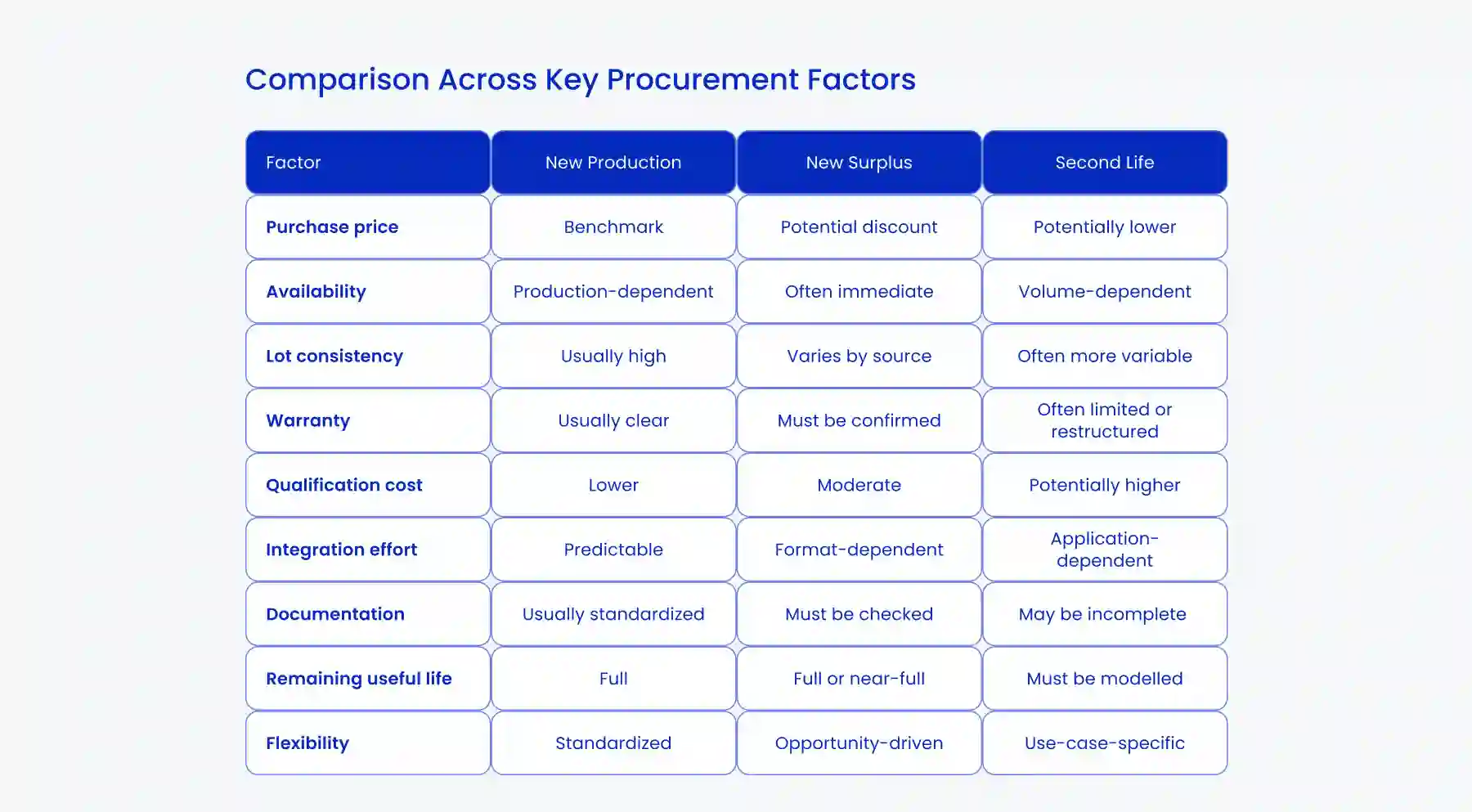
At the same time, three distinct supply categories have emerged in the BESS battery market:
- New production: batteries manufactured to order or from current inventory
- New surplus or overstock: unused batteries from cancelled orders, excess production runs, or end-of-series stock
- Second-life supply: batteries previously used in EV's or other applications, now available for redeployment
These are not interchangeable options with slightly different price tags.
Each category carries different availability timelines, documentation standards, qualification requirements, integration effort, warranty structures, and operational risk. Add up those variables and the cheapest offer become the most expensive deployment.
The gap: Many BESS projects still evaluate batteries using only upfront cost and nominal capacity. That leaves qualification expenses, integration delays, warranty gaps, and degradation uncertainty outside the decision model.
Without full cost data, buyers either overpay for reliability or underestimate how much cheap batteries really cost.
What Defines Each BESS Battery Supply Category
New Production Batteries for BESS
New batteries are manufactured for the current buyer or project. They come with standard manufacturer warranties, consistent documentation, and predictable performance baselines.
Lead times depend on production schedules.
Large projects needing hundreds of MWh in matching batteries usually choose new production as their best option.
The tradeoff: Longer lead times and less pricing flexibility. Rapidly falling battery prices, like we've seen in 2025 and 2026, mean early orders may cost more than buying later at spot prices.
New Surplus or Overstock Batteries
Surplus batteries are unused inventory. They may originate from:
- Cancelled vehicle or grid-storage orders
- Production overruns
- End-of-model-year stock
- Strategic inventory reductions
Surplus inventory is not second-life. They remain completely unused. Chemistry, format, and rated capacity are identical to new production from the same series.
The commercial advantage: Faster availability. You can source and ship surplus stock within weeks.
The risk: Documentation and warranty status vary by source. Some surplus lots include transferable manufacturer warranties. Others are sold as-is.
When buying internationally, check battery origin, storage history, and compliance documentation. Status of surplus inventory requires the same diligence applied to second-life supply.
Second-Life Batteries for Energy Storage
Second-life batteries for BESS are previously used, most retired from electric vehicles. They have accumulated charge-discharge cycles, experienced calendar aging, and degraded to a level below the performance threshold required for their original application.
You must assess the condition and remaining lifespan. Second-life batteries at 80% health from EV's can last another 10-15 years in energy storage, where usage is less intense.
What is the typical lifespan of second-life batteries in BESS applications? Properly tested second-life batteries can run for 10-15 years in energy storage. They're ideal for lighter tasks like peak shaving or renewable energy storage.
Commercial fit depends on:
- Application duty cycle
- Available testing and grading infrastructure
- Integration capability
- Documentation completeness
- Regulatory and warranty frameworks
Second-life batteries don't automatically cost less than new supplies when total deployable cost is calculated.
Total Deployable Cost: The Real BESS Battery Comparison Framework
Price per kWh is a starting point, not a decision.
Total deployable cost for BESS batteries includes every expense required to turn a battery offer into operating BESS capacity:
- Purchase price
- Testing and grading
- Transport, customs, and insurance
- Storage and handling
- System integration and Battery Management System (BMS) compatibility
- Warranty provisions or risk reserves
- Compliance documentation
- Expected degradation and replacement timing
- Time lost before commissioning
The category with the lowest purchase price doesn't always deliver the lowest total deployable cost.
How much does BESS battery integration cost? Integration costs vary widely. New batteries from top suppliers need minimal work because they use standard formats. Second-life batteries can add 15-30% to total costs due to custom integration, thermal adjustments, and longer setup times.
When you need 50 MWh of LFP batteries delivered in six months, price alone isn't the right question to ask.
The better question is, which option gets you operational, warrantied capacity in six months at the lowest total cost?
That reframing changes the result.
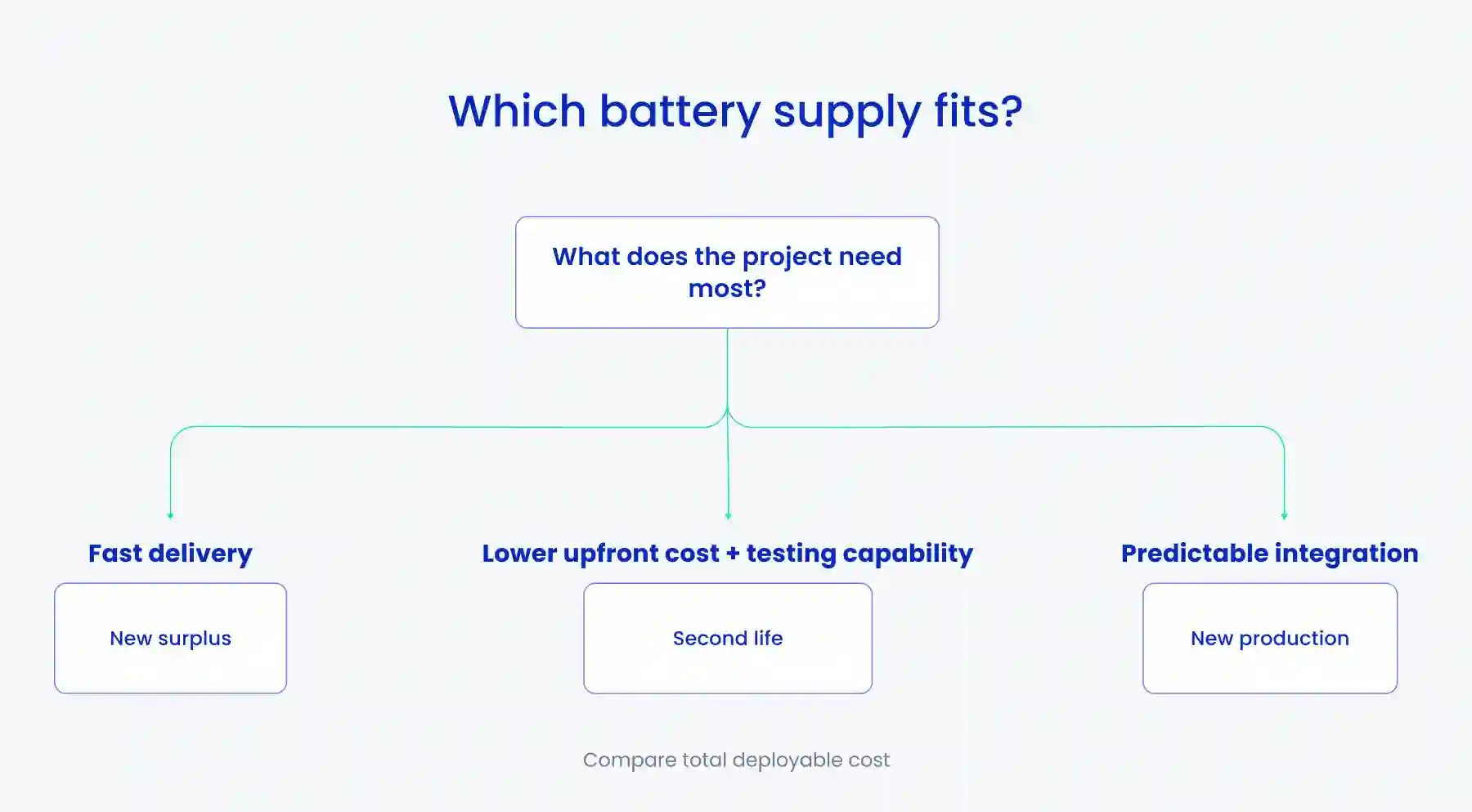
When Each Battery Supply Category Wins for BESS Projects
New Batteries Tend to Win When:
- Large, uniform volumes are required
- Long manufacturer warranties are essential for BESS project financing
- Integration schedules leave little room for format variation
- Compliance and documentation standards must be manufacturer-certified
- New-cell pricing is highly competitive relative to surplus, or second-life offers
Surplus Batteries Tend to Win When:
- The project needs supply quickly and production lead times exceed the project window
- The surplus lot already matches the intended module format and voltage architecture
- Inventory is demonstrably unused and well documented
- The buyer can secure warranty transfer or equivalent protection
- Avoided lead time has measurable commercial value (e.g., earlier revenue generation, avoided grid connection penalties)
Second-Life Batteries Tend to Win When:
- The application can tolerate lower energy density, and the buyer has space to install additional modules
- Testing, grading, and integration capabilities already exist in-house or locally
- Local second-life supply reduces transport lead time or customs exposure
- The purchase price, after qualification and integration, still delivers a material total-cost advantage
- The BESS duty cycle suits the batteries' remaining performance envelope (e.g., peak shaving rather than high-frequency regulation)
Are second-life batteries suitable for all BESS applications? No. They work best for moderate use cases like peak shaving, renewable energy storage, and backup power. They're not ideal for high-frequency grid services or space-limited applications.
No category wins in every scenario. The buyer's operational context determines fit.
Industry & Operational Implications: What This Means for Your Team
For BESS Procurement Teams
Unit-price comparisons will not protect your project budget. Build BESS procurement models that include qualification, integration, warranty reserves, and commissioning delays.
When evaluating surplus or second-life offers, require transparent documentation on:
- Battery origin and storage history
- Cycle count and State of Health (SoH)
- Warranty status and transferability
- Compliance with EU Battery Regulation and local grid codes
If the supplier can't provide that documentation, the discount isn't real, it is a cost shifted to your team.
For BESS Project Developers
Falling new-battery prices compress the margin available to second-life supply. That does not eliminate second life as a competitive category. It does mean second-life battery sourcing requires operational capability, not just access to cheap inventory.
Developers who can test, grade, integrate, and warrant second-life batteries in-house capture the margin. Developers who outsource those steps often find that total deployable cost exceeds new-battery procurement.
For Battery Integrators
System integration effort varies significantly across the three categories. New production from a Tier-1 supplier typically includes standardized module formats, validated BMS protocols, and responsive technical support.
Surplus batteries may use legacy formats or discontinued communication protocols. Second-life batteries often require custom BMS integration and thermal management adjustments.
Budget integration time and cost accordingly.
A discounted battery that adds six weeks to commissioning may cost more than a premium battery delivered on time.
For Lenders and Investors
BESS finance ability depends on performance predictability and warranty enforceability. New batteries from established manufacturers provide both.
Surplus and second-life batteries can be bankable, but only when:
- SoH is independently verified
- Remaining useful life is modelled with transparent assumptions
- Warranty or performance guarantees are legally enforceable
- The supply chain is traceable and compliant
What documents do you need for BESS financing? Lenders want warranties, independent health tests, performance guarantees, compliance proof, and full supply chain traceability.
If your due diligence cannot verify those conditions, adjust project risk weighting or require a larger equity cushion.
What BESS Buyers Should Check Before They Commit
There is no universal winner among new, surplus and second-life batteries. The right choice depends on the project, the timeline, and what the buyer can verify or manage in-house. Before comparing offers, work through six questions.
1. What will the battery cost by the time it is operational?
The quoted price is only the first line in the calculation. Add testing, grading, transport, customs, storage, system integration, warranty provisions and the cost of future augmentation.
A battery that looks inexpensive on a supplier's spreadsheet may be less attractive once it is ready to operate.
Build the comparison around total deployable cost, not price per kWh alone.
2. Is the inventory genuinely surplus or has it already been used?
The distinction matters. Surplus batteries are unused, but that does not automatically make them equivalent to a current production order. Check where the lot came from, how long suppliers stored it, and whether the warranty still applies.
Second-life batteries require a different assessment. Their previous use, cycle history, state of health and expected duty cycle all affect their value.
Treating surplus and second-life inventory as the same type of supply is a quick way to build the wrong cost model.
3. Can the supplier show the evidence behind the offer?
Ask for the documents before the commercial discussion goes too far. For surplus inventory, that should include the battery's origin, storage conditions, warranty position, and compliance records.
For second-life batteries, ask for cycle history, state-of-health data, and information about the battery's previous application.
How do you verify battery state of health for BESS? Independent testing should include capacity testing, internal resistance measurement, voltage analysis, and thermal performance assessment.
Battery Passport-compliant documentation provides standardized, traceable health metrics.
If the evidence is incomplete, do not simply assume the battery is lower risk than the price suggests. Put the missing information into the cost and schedule assumptions.
4. What does the warranty cover?
A warranty only works if it transfers with the battery; the company can pay claims, and the process is clear. "Warranty included" is not enough.
Verify coverage details: who's protected, duration, performance thresholds, and operating conditions.
If those points can't be confirmed, budget for additional testing, a replacement reserve, or self-insurance. The discount may still be worth it, but treat it as a risk, not as guaranteed protection.
5. Does the supply option fit your team's capabilities?
Second-life batteries can make commercial sense when the buyer already has access to testing, grading, and integration expertise. If every one of those steps must be outsourced, the expected savings can disappear quickly.
Choose new production when you need standard equipment, solid support, and easy integration.
Surplus batteries offer a middle ground: quicker delivery with less risk, if they're documented and compatible.
6. Can you prove the fit before buying at scale?
A pilot lot is often more useful than another round of assumptions. If the supplier or inventory category is new to your team, test a small quantity first.
Check the documentation, module consistency, testing results, and integration effort in practice.
That step costs time and money. This can save you from buying large quantities of batteries that underperform once they arrive.
Strategic Outlook: Evidence Wins the Long Game
New-battery prices will continue to decline through 2026 and 2027. That trend pressures second-life economics, but it doesn't eliminate second life as a competitive category.
Second-life batteries will remain commercially viable where:
- Buyers have in-house testing and integration capability
- Applications tolerate lower energy density
- Local supply chains reduce transport cost and lead time
- Regulatory frameworks support traceability and warranty structures
Surplus inventory can offer faster availability and attractive pricing, but supply is less predictable than new production. Lot sizes, specifications, and documentation can vary depending on what stock is available.
BESS buyers are looking beyond the initial price. The real question is: which battery type works best when you include delivery time, testing, integration, warranties, and lifespan?
What is the future of second-life batteries in BESS? As EV adoption accelerates, second-life battery availability will increase significantly through 2030. Success will depend on standardized testing protocols, Battery Passport implementation, and buyers developing in-house integration capabilities to capture value.
That question can't be answered with a price list. It requires operational capability, transparent data, and total cost accounting.
Circunomics builds the infrastructure that makes those comparisons possible: Battery Passport-compliant data, independent state-of-health assessment, warranty-grade documentation, and marketplace transparency.
Because the best battery for your BESS project is not the cheapest one offered. It is the one you can put into operation fastest, at the lowest total cost, with the highest certainty.
👉 Explore verified battery inventory on the Circunomics platform. Compare batteries using verified health data, complete documentation, and cost models built for real BESS projects.
Frequently Asked Questions (FAQ)
What is the difference between surplus and second-life batteries?
Surplus batteries are unused inventory from cancelled orders, production overruns, or end-of-series stock. They have not been cycled and maintain the same specifications as new production.
Second-life batteries were previously used in EVs. They've degraded past their original use case but still work well for energy storage.
Are second-life batteries safe for BESS applications?
Yes, when properly tested, graded, and integrated. Second-life batteries must undergo rigorous state-of-health assessment, capacity testing, and safety verification.
Proper BMS integration and thermal management are essential. Batteries meeting these standards can safely operate in BESS for 10-15 years in appropriate applications.
How much can you save with second-life batteries for BESS?
True savings depend on the total cost. Second-life batteries look 30-50% cheaper initially. However, testing, integration, and warranty costs often cut that to 10-20% or nothing if you outsource. In-house capabilities are essential for real savings.
What is the total deployable cost for BESS batteries?
Total deployable cost means every expense from purchase to operation: price, testing, transport, storage, integration, warranties, compliance docs, commissioning, and degradation. This metric provides a more accurate comparison than price per kWh alone.
Can second-life batteries be financed for utility-scale BESS projects?
Yes, with proper documentation. You need verified:
- Battery health data
- Clear remaining-life models
- Enforceable warranties
- Full compliance records including Battery Passports
Missing any of these means higher equity needs or worse risk ratings.
What testing is required for second-life BESS batteries?
Essential testing includes capacity verification, internal resistance measurement, voltage curve analysis, thermal performance assessment, cycle history documentation, and state-of-health certification. Battery Passport-compliant testing provides standardized, traceable data that supports warranty claims and project financing.
Which BESS applications are best suited for second-life batteries?
Second-life batteries perform best in peak shaving, renewable energy storage, backup power, and off-grid applications. They are less suitable for high-frequency grid services, primary frequency response, or applications requiring maximum energy density.
How long do surplus batteries remain viable before they need to be used?
Battery shelf life depends on storage conditions and chemistry. Lithium-ion batteries experience calendar aging even when unused. Surplus batteries stored properly can last 1-2 years unused. But for older stock, warranty coverage and complete documentation have become increasingly important.
What is the EU Battery Regulation and how does it affect BESS procurement?
The EU Battery Regulation establishes requirements for battery sustainability, safety, labeling, and end-of-life management. It mandates Battery Passports for industrial and EV batteries, documenting origin, materials, carbon footprint, and battery health. BESS buyers must verify supplier compliance to avoid regulatory risk and ensure project financeability.
How does the Battery Passport affect second-life battery sourcing?
The Battery Passport provides standardized, traceable documentation of battery history, composition, performance, and state-of-health throughout the lifecycle. For second-life batteries, this dramatically improves transparency, reduces qualification costs, and supports warranty and financing requirements. Battery Passport compliance will become essential for commercial second-life supply.