Battery state of health (SoH) shows how much of its original capacity a battery still has, as a percentage. For anyone buying or selling used batteries, SoH is the first number to check. It shapes the price, the risk and often whether a deal goes ahead at all.
SoH is also becoming a legal requirement. From 18 February 2027, EV batteries and industrial batteries over 2 kWh need a digital battery passport. The passport must include up-to-date SoH data. The EU Battery Regulation (EU) 2023/1542 sets out this rule.
TL;DR
- What is battery SoH? A battery's remaining capacity compared with its original rated capacity, as a percentage. A battery with 85% SoH holds 85% of the charge it held when new.
- How is SoH measured? A full charge and discharge test in a lab is the most accurate method and takes several hours. Fast methods estimate SoH in minutes, but you should check them against lab data.
- What makes an SoH certificate credible? It states the test method, date, test conditions and who tested, with results per module or cell.
- How does SoH affect price? Buyers often set a minimum SoH. A few percentage points can decide whether a lot goes to reuse or recycling. Around 80% is a common minimum for second-life storage.
- What does EU law require? From 18 February 2027, the battery passport for EV and industrial batteries must include up-to-date SoH information.
- What to do now: Test before you trade, and keep retesting stock you hold.
- Who this is for: Buyers, sellers and compliance teams working with used EV, industrial and BESS batteries.
What is battery state of health (SoH)?
Battery state of health compares how much charge a battery can hold today with how much it could hold when it was new.
SoH (%) = measured capacity ÷ original rated capacity × 100
For example, a cell held 100 Ah (amp-hours, a measure of capacity) when new. In the same test today, it delivers 85 Ah. Its SoH is 85%.
When a battery tester or a battery management system (BMS) shows "SoH", it reports the same percentage. That figure is usually an estimate, not a full capacity test, so treat it as a quick indication.
Capacity isn't the whole story, though. As batteries age, their internal resistance rises, which makes it harder for them to deliver high power. Two lots with the same SoH can behave differently under heavy loads, so a good assessment checks resistance too.
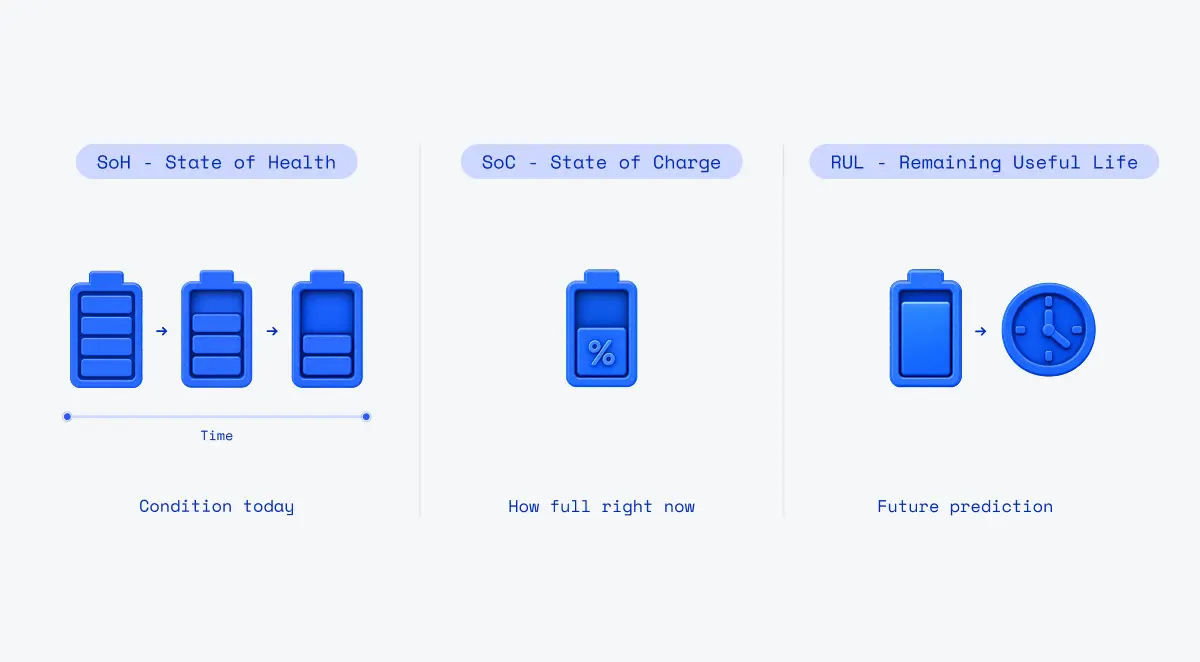
SoH is often confused with two other terms:
- State of charge (SoC): how full the battery is right now, like a fuel gauge.
- Remaining useful life (RUL): an estimate of how many years or cycles the battery has left, based on SoH and expected use.
In short, SoH describes the battery today. RUL is a prediction about the future. And an SoH figure is a measurement, not a warranty.
What causes battery degradation and a lower SoH?
Battery degradation lowers state of health through use and through time. The main drivers are:
- Charge cycles: every cycle wears the electrodes a little.
- Heat: high temperatures in operation or storage speed up ageing.
- Fast charging and high power loads: these add stress, especially in the cold.
- Storage at high or low charge: keeping a battery full or empty for a long time makes it lose capacity faster.
- Calendar ageing: capacity falls slowly even when a battery is not in use.
This is why two EV batteries or modules of the same type and age can show different SoH.
Why does SoH matter in B2B battery trading?
SoH matters because a visual inspection does not show a used battery's real condition. Two modules of the same type and age can differ widely, depending on how people charged them, how hot they got and how hard they worked.
SoH gives buyers and sellers a shared reference point. Without it, sellers struggle to price a lot, and buyers have to guess how much risk they're taking on.
But not all SoH figures are equally reliable. The number on a spreadsheet might come from a full lab test, a quick estimate or no clear source at all. That's why the method and the paperwork behind it matter as much as the number itself.
How is battery SoH measured and checked?
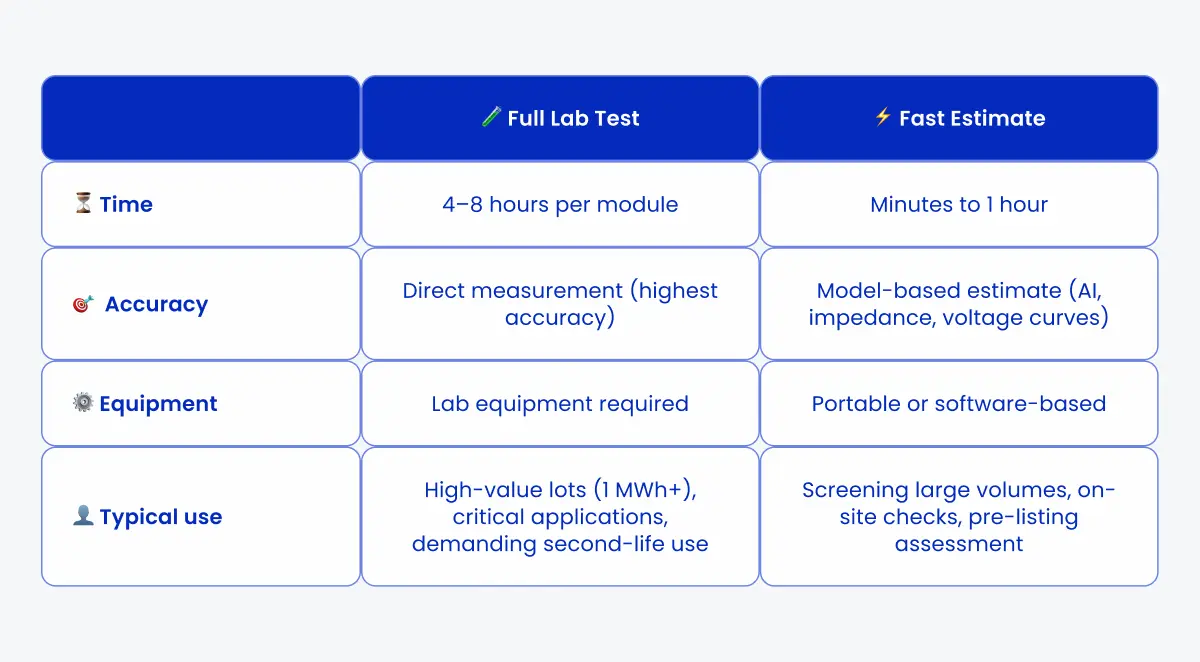
You can measure battery SoH in two ways: a full charge and discharge test in a lab, or a faster estimate.
Method 1: Full charge-discharge test (most accurate)
- Fully charge the battery under controlled conditions.
- Discharge it at a set rate and temperature until it's empty.
- Measure how much capacity it delivered.
- Compare that with its original rated capacity.
It measures capacity directly, so it’s the most accurate approach. The downside is cost and scale. A full cycle takes several hours per module or pack, consumes energy and ties up lab equipment and staff, so testing every unit in a large lot is rarely practical..
Method 2: Fast and software-based SoH estimation
Faster methods estimate SoH without a full cycle. Some measure how the battery reacts to small electrical signals (impedance testing) or analyse part of a charging curve. Others use software to estimate SoH from the battery's history, such as data from its battery management system (BMS).
These methods take minutes rather than hours, which makes them practical for large volumes and on-site checks.
Which method fits which lot?
No single rule applies. For high-value lots or demanding uses, buyers often want full lab tests, at least on a sample. Buyers often accept faster methods to screen large volumes. The provider should explain how each method works and how they checked it.
Many providers combine both. Circunomics takes a different route. Instead of cycling each battery, our physics-based model estimates SoH in the cloud from just a short sample of an asset’s recent operating data. That means we can assess an entire fleet at once, from hundreds to tens of thousands of assets, without ever taking them offline. We validate the model against controlled charge and discharge tests at our battery lab in Roßdorf.
What should a battery SoH certificate include?
A credible battery SoH certificate shows who measured SoH, when, how and under what conditions. It also gives results per module or cell.
A solid certificate includes:
- Battery identifiers: serial numbers, batch codes or battery passport IDs.
- Test method: for example, a full discharge test, an impedance test or a software estimate.
- Test date: SoH changes over time, so recent data matters.
- Test conditions: temperature and charge and discharge rates.
- Who did the test: an independent lab is more convincing than the seller's own figures. Accreditation under ISO/IEC 17025, the international standard for testing labs, is a plus.
- Results per module or cell: not just one average for the whole lot.
- Visual inspection notes: damage, corrosion or swelling.
Warning signs
- The test method isn't stated.
- A mixed lot has only one average SoH.
- The certificate is old and there's no retest or storage history.
- You can't trace the results back to a lab.
Questions to ask the seller or testing provider
- Which test method did you use?
- If you estimated the SoH, how did you check the estimate against lab measurements?
- Who carried out the test, and are they independent of the seller?
- Can I see the raw test data?
If these details are missing, you're mostly relying on the seller's word. Buyers usually respond by offering less to cover the risk.
How does SoH affect battery price?
Higher SoH usually means a higher price. But whether a lot meets the buyer's minimum matters more than the exact number. Buyers often set a minimum SoH for each use. A lot just above that minimum can be much easier to sell than one just below it.
As a rough guide, the market tends to group batteries like this. Exact cut-offs vary by chemistry, buyer and application.
- Around 90% SoH and above: close to new. Often resold as surplus or used in demanding applications.
- Around 80 to 90% SoH: a common range for second-life use, such as stationary energy storage.
- Around 70 to 80% SoH: may suit lighter uses such as backup power. Depending on chemistry and condition, it may go to recycling instead.
- Below about 70% SoH: usually recycled, unless there's a suitable low-demand use. Read more in Battery Routing: Trade, Repurpose, or Recycle?
Is 80% SoH good? For second-life stationary storage, buyers often want at least 80%. A lot at or above that level is usually easy to sell.
Whether it is "good" depends on chemistry, resistance and the intended use.
What else affects price?
- Chemistry: LFP batteries usually last more charge cycles than NMC batteries. In some cases, that makes an LFP lot with a lower SoH worth more than an NMC lot with a higher one. See LFP vs NMC Battery: Second-Life Value Explained.
- Format: how easy the packs or modules are to take apart and build into a new system.
- Documentation: clear test records give buyers confidence. The European standard EN 18061:2025 shows, step by step, how to safely repair, reuse and repurpose EV batteries.
Step one is a battery health check.
- New battery prices: new LFP battery prices have fallen sharply in recent years. That narrows the gap between new and used batteries, so used lots need solid data to compete.
The bottom line: a few percentage points of SoH can decide whether a lot goes to reuse or recycling. More on valuation in Battery Residual Value: What Your Battery Lot Is Worth.
Does the EU battery passport include SoH data?
Yes. From 18 February 2027, three types of battery need a digital battery passport in the EU. These are EV batteries, batteries for light means of transport (LMT) such as e-bikes, and industrial batteries over 2 kWh. The passports for EV and industrial batteries, including battery energy storage systems (BESS), must show current SoH data.
This part of the passport isn't public. Only people with a "legitimate interest" can see it, and the EU is still finalising exactly who that includes. A repurposed battery, like an EV battery reused for stationary storage, needs a new passport. This new passport must link to the original one.
For who is responsible in each case, see Battery Passport for BESS: Who Is Responsible in the EU? For the full data list, see EU Battery Passport: 71 Data Points Explained.
What should buyers, sellers and compliance teams do now?
- Buyers: ask for SoH test data before you buy, and check the test method and date.If the certificate is old, plan for a retest.
- Sellers: test before you list. Clear SoH data answers buyers' questions early and makes negotiations smoother. See Surplus Battery Qualification for BESS: A Proven Workflow.
- Compliance teams: decide now where the passport's up-to-date SoH data for EV and industrial batteries will come from. The deadline is 18 February 2027.
- Anyone holding stock: batteries slowly lose capacity even when they're not in use. Retest at regular intervals and keep the records.
- Everyone: agree which test methods you accept, for example full lab tests for high-value lots and faster methods for screening.
FAQ: battery state of health
What is battery SoH (state of health)?
Battery state of health (SoH) shows how much capacity a battery has left compared with when it was new. It usually appears as a percentage.
How do you calculate battery SoH?
Divide the battery's capacity today by its capacity when new. Then multiply by 100. A cell rated at 100 Ah that now delivers 85 Ah under the same test conditions has an SoH of 85%.
What does SoH mean on a battery tester?
On a battery tester, SoH shows how much capacity the battery has left compared with when it was new, as a percentage. Handheld testers usually base it on internal resistance or conductance. Treat it as a quick check, not a full capacity test.
What is SoC and SoH in a battery?
SoH describes a battery's long-term condition: how much capacity it has left. State of charge (SoC) describes how full the battery is right now, like a fuel gauge.
What causes a low battery SoH?
Charge cycles, heat and fast charging all lower SoH. So does storing a battery full or nearly empty for a long time. Capacity also falls slowly with age, even when nobody uses the battery.
What is a good SoH for a used battery?
It depends on the use. For second-life stationary storage, many buyers look for around 80% or more. Above about 90%, batteries often sell as surplus. Below about 70%, they usually go to recycling.
At what SoH are EV batteries retired?
EV batteries often leave vehicle use at around 70–80% SoH. The exact point depends on the vehicle and how people drive it. Many then move to second-life uses such as stationary storage, and only go to recycling later.
Is 80% SoH good?
For second-life stationary storage, around 80% is a common minimum, so it is usually a sellable level. Chemistry, internal resistance and the intended use decide how much it is worth.
How do you check or measure battery SoH?
The most direct way is to fully charge and discharge the battery in a lab. Faster methods include impedance tests and checking part of a charging curve. They give an estimate, not a direct measurement.
How long does a battery SoH test take?
A full charge and discharge test usually takes several hours per module or pack. Fast and software-based estimates take minutes.
Can software or AI estimate battery SoH?
Yes. Software models can estimate SoH from a battery's history, such as data from its battery management system (BMS). How accurate they are depends on the model and the data, so check them against lab results.
Who issues a battery SoH certificate?
Certificates can come from the seller, a testing provider or an independent lab. An independent lab, ideally accredited under ISO/IEC 17025, gives buyers the most confidence.
Can you improve a battery's SoH?
You generally can't restore capacity a battery has lost to ageing. But if a pack's cells have drifted apart, rebalancing them can win back some usable capacity. A retest afterwards may then show a higher SoH.
Do batteries lose SoH in storage?
Yes. Batteries slowly lose capacity even when nobody uses them. They lose it faster in warm storage, or when kept fully charged or nearly empty.
How often should you retest battery SoH?
No fixed schedule applies. If you hold stock for a long time, retest it at regular intervals. Update an old certificate before you sell.
Does the EU battery passport include SoH data?
Yes. From 18 February 2027, EV batteries and industrial batteries over 2 kWh need a passport. It must include up-to-date SoH data.
Who can see SoH data in the battery passport?
SoH information sits in the passport's restricted section, not the public one. Only people with a legitimate interest can access it, and the EU is still finalising exactly who qualifies.
Does a repurposed battery need a new battery passport?
Yes.Before you sell or use a repurposed battery, it needs a new passport linked to the original one.
Need reliable SoH data for your battery lots?
Circunomics combines software-based SoH estimation (Circunomics Analytics) with lab testing at its battery lab in Roßdorf, near Darmstadt. The Circunomics marketplace lists battery lots with SoH and condition data. With this data, buyers can compare lots before they negotiate price.
Contact our team member Julian Kosgalwis to discuss SoH data for your batteries or browse the Circunomics marketplace to see SoH data for real battery lots.