On 21 August 2026, the European Commission published updated implementation guidance for the Digital Battery Passport. It outlines 71 data points and shows which are mandatory, optional, or conditional for EV, LMT, and industrial batteries.
The real question for battery companies: Can you complete a Battery Passport today for one of your products?
TL;DR
- 71 data points are now defined for the EU Digital Battery Passport, mandatory from 18 February 2027
- Applies to industrial batteries >2 kWh, EV batteries, and LMT batteries placed on the EU market
- Data is fragmented across departments: engineering, supply chain, sustainability, BMS systems, and service teams
- Not all data points are mandatory! Applicability varies by battery type and lifecycle stage
- Main challenges: supply chain transparency, carbon footprint calculation, BMS data interoperability, and structured repair records
- Action now: Map your data landscape, audit supplier transparency, standardize formats, and test with one real battery
- The passport is a competitive asset, not just compliance, it proves quality, sustainability, and enables circular economy value
For many companies, that's not a straightforward question to answer. The data lives across five different teams: engineering, manufacturing, supply chain, sustainability, and service. It's rarely structured for easy sharing.
Circunomics' Battery Passport service solves this problem by connecting fragmented data and making it accessible, interoperable, and compliant throughout the lifecycle.
Context & Why the EU Battery Passport Regulation Matters
Starting 18 February 2027, you need a Digital Battery Passport for:
- Industrial batteries above 2 kWh
- EV batteries
- LMT batteries
It's more than compliance. It's a data system tracking each battery from manufacturing through repair to recycling.
The August 2026 guidance is the most detailed operational specification published to date. It clarifies what data to include, when it applies, who provides it, and how requirements vary by battery type and stage.
Here's why Battery Passport compliance matters:
The data burden is not uniform. EV battery manufacturers, industrial battery importers, and e-bike producers all have different compliance requirements. The 71 data points do not apply equally to everyone.
Most of the required data already exists, but not in one place. Product specs live in Product Lifecycle Management (PLM) systems. Carbon footprint data sits with sustainability teams. Performance and health data come from the Battery Management System (BMS).
Repair records are maintained by service providers. Recycling information is held by waste operators. The passport requires all of it to be accessible, interoperable, and updated over time.
Data handovers are the operational gap. A battery passes through many hands:
- Cell supplier to pack assembler
- Manufacturer (OEM) to fleet operator
- First user to refurbisher
- Refurbisher to recycler
Each handover is a point where data can be lost, withheld, or rendered incompatible. The Battery Passport is only as strong as the weakest link in that chain. Without a data plan, you risk non-compliance, failed audits, and unverifiable product claims.
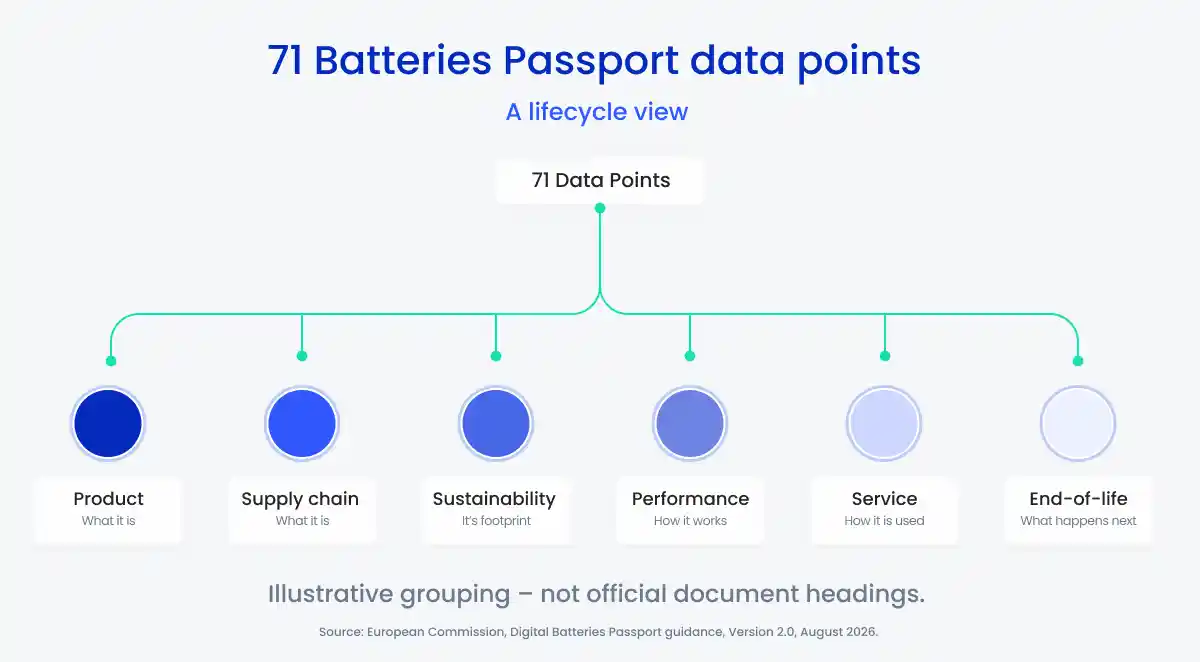
Breaking Down the 71 Battery Passport Data Points: Where Does This Data Actually Live?
The 71 data points are not 71 new obligations for every company. Applicability depends on battery type, lifecycle stage, and the role of the economic operator. But even a simplified passport requires data from multiple internal and external sources.
Here's how the data breaks down by category and typical ownership:
1. Product & Engineering Data
What it includes: Battery model, chemistry, capacity, voltage, weight, dimensions, hazardous substances.
Who typically owns it: Product development, engineering, R&D.
Readiness level: High. Most OEMs and manufacturers have this data in PLM or Enterprise Resource Planning (ERP) systems.
The gap: Data may not be structured for external sharing or linked to individual battery serial numbers.
2. Manufacturing & Supply Chain Data
What it includes: Manufacturing date, place of manufacture, supplier information, due diligence documentation.
Who typically owns it: Supply chain, procurement, quality assurance.
Readiness level: Medium. Manufacturing data exists, but supplier transparency, especially for cells sourced from Asia, can be incomplete.
The gap: Traceability to cell and component level. Many OEMs do not have full visibility into their upstream supply chain, particularly for cobalt, lithium, and graphite sourcing.
3. Sustainability & Carbon Footprint Data
What it includes: Carbon footprint (total and per lifecycle stage), recycled content, due diligence on raw materials.
Who typically owns it: Sustainability, Environmental, Social, and Governance (ESG), compliance teams.
Readiness level: Low to medium. Carbon footprint calculation is complex and often relies on supplier-provided data that is incomplete or inconsistent.
The gap: Granular, battery-specific carbon data. Many companies use industry averages rather than product-specific Life Cycle Assessments (LCAs). The passport requires the latter.
4. Performance & Battery Management System (BMS) Data
What it includes: State of health (SoH), state of charge (SoC), cycle count, capacity fade, temperature history, expected lifetime.
Who typically owns it: BMS providers, fleet operators, service teams.
Readiness level: Medium to high for connected batteries. Low for batteries without telemetry.
The gap: Data access and interoperability. BMS data is often proprietary, locked in OEM systems, or not designed for third-party access.
5. Service, Repair & Maintenance Data
What it includes: Repair history, replacement parts, software updates, safety incidents.
Who typically owns it: Service providers, warranty teams, fleet operators.
Readiness level: Low. Repair data is often recorded in non-standardized formats or not digitized at all.
The gap: Structured, machine-readable records. A passport must be updated when a battery is repaired or refurbished. Most service workflows are not designed for this.
6. End-of-Life & Battery Recycling Data
What it includes: Dismantling instructions, recycling content, waste treatment information, collection points.
Who typically owns it: Recyclers, waste management operators, compliance schemes.
Readiness level: Low. Recycling happens at the end of life, but you must include dismantling instructions and recycling design information upfront.
The gap: Proactive documentation. Most OEMs do not yet provide structured dismantling or recycling instructions with their products.
What Is Mandatory, What Is Optional, and What Is Still Being Finalized?
Not all 71 data points are mandatory at launch. The August 2026 guidance clarifies applicability:
Mandatory from February 2027: Product identification, manufacturer information, capacity, chemistry, carbon footprint (for batteries >2 kWh), hazardous substances, due diligence documentation. Conditional (depends on battery type): State of Health and State of Charge apply to EV and industrial batteries only. Recycled content requirements depend on battery size.
Optional or future phases: Some performance and circularity metrics are listed as "recommended" but not yet enforceable. These may become mandatory in later updates.
Still being finalized: Access rights and data-sharing protocols. Access rights are coming in Q4 2026. Until then, data-sharing rules who sees what, when, and how remain unfinished.
This creates a planning problem. You can collect the data now, but you can't build the final system yet.
The Uncomfortable Question: Who Owns Each Battery Data Field Internally?
Here's the operational reality most companies face: A product manager knows the battery's rated capacity. A supply chain lead knows where the cells were manufactured. A sustainability analyst has calculated the carbon footprint. A service technician has the repair log. A BMS engineer has the SoH data. A recycling partner has the dismantling instructions.
But no single person or system owns the complete dataset required for the Battery Passport. This is not a data problem. It is a coordination problem.
The passport assumes that data flows seamlessly from design through manufacturing, use, and end of life. In practice, this data often sits in separate systems.
Engineering and sustainability teams may use different tools. Manufacturing data doesn't always flow automatically to service teams. Suppliers don't always provide data in structured, standardized formats.
The outcome: completing a passport requires more time and coordination than companies expect.

What Companies Probably Already Have vs. What Is Often Missing
What most companies already have:
- Product specifications (capacity, voltage, chemistry, weight)
- Manufacturing date and location
- Hazardous substance declarations (RoHS, REACH compliance)
- Basic supplier information
What is often fragmented or missing:
- Battery-specific carbon footprint data (not industry averages)
- Full supply chain traceability (especially for raw materials)
- Real-time or historical SoH and SoC data in a shareable format
- Structured repair and maintenance records
- Dismantling and recycling instructions linked to specific battery models
- Due diligence documentation for cobalt, lithium, and natural graphite sourcing
The gap is not always the data itself. It is the structure, accessibility, and interoperability of that data.
Industry & Operational Implications: What Battery Passport Compliance Means for Your Team
The Battery Passport is not a document. It is a data system that must be maintained and updated throughout the battery's life.
That has several implications:
- Compliance is a cross-functional project. No single department can deliver a passport. It requires coordination across product, supply chain, sustainability, IT, and service teams.
- Data must be structured from the start. Retrofitting passport data onto existing products is expensive and often incomplete. Companies that design data collection into their product development and manufacturing processes will have a significant advantage.
- Supplier collaboration is non-negotiable. OEMs cannot populate a passport without data from cell suppliers, BMS providers, and raw material sources. This requires contractual agreements, data-sharing protocols, and, in many cases, new supplier relationships.
- Interoperability is the real challenge. The passport must be readable by multiple actors: customs authorities, recyclers, second-life operators, fleet managers. That requires standardized data formats, APIs, and access controls. Most companies do not yet have this infrastructure.
- The passport is a competitive asset, not just a compliance burden. A well-maintained passport proves battery quality, sustainability, and residual value. It enables second-use markets, simplifies due diligence, and reduces transaction friction. Companies that treat the passport as a value-creation tool, not a regulatory checkbox, will differentiate themselves.
Actionable Recommendations: What to Do Now for Battery Passport Readiness
If your company places batteries on the EU market, here's what you can do before February 2027:
- Map your data landscape. Identify where each of the 71 data points currently lives (or doesn't). Assign ownership for each category. Flag gaps.
- Audit your supply chain transparency. Can you trace your batteries to the cell level? Do you have carbon footprint data from your suppliers? If not, start those conversations now.
- Standardize your data formats. The passport requires machine-readable, interoperable data. If your product specs, BMS outputs, and service records are in incompatible formats, fix that.
- Build data handover processes. Create a data transfer plan for each stage: manufacturing, sale, service, second use, and recycling.
- Test with one real battery. Pick a single product. Try to populate a complete passport for it. You will quickly discover where your data infrastructure breaks down.
- Engage with your IT and legal teams early. The passport has data privacy, cybersecurity, and IP protection implications. These are not last-minute considerations.
Strategic Outlook: The Battery Passport Is Just the Beginning of Digital Product Passports
The Digital Battery Passport is the first mandatory, product-level data infrastructure in the circular economy. It will not be the last.
The EU is already working on similar frameworks for electronics, textiles, and construction materials. Other jurisdictions, including the UK, US states, and parts of Asia, are watching closely.
For companies that get this right, the passport becomes a blueprint for managing product data throughout any product's lifecycle. It builds internal capabilities in traceability, interoperability, and data governance that will be required across multiple product categories in the coming years.
But if you treat it like a compliance checkbox, it will only cost money and create problems. The difference is not technical. It is strategic.
If February 2027 Were Tomorrow, Could You Populate a Battery Passport for One Real Battery?
Most companies cannot yet answer that question with confidence.
The 71 data points are now defined. The applicability is clear. The deadline is fixed. Now comes execution: building systems, processes, and partnerships to transform fragmented data into a structured, compliant passport. That work does not start in January 2027. It starts now.
Need a Battery Passport Solution?
Circunomics provides the infrastructure to track and manage the 71 data points required for EU Battery Passport compliance. Built for interoperability and designed to meet February 2027 requirements.
It is also a supporting partner of Battery Pass Ready, helping advance practical implementation of the Digital Battery Passport.
.webp)
FAQ
What is the EU Digital Battery Passport?
The EU Digital Battery Passport is a mandatory digital record containing sustainability, circularity, and performance data for batteries placed on the EU market. It tracks batteries throughout their entire lifecycle, from manufacturing through use, repair, second life, and recycling.
When does the Battery Passport become mandatory?
As of 18 February 2027, three battery types require a Digital Battery Passport:
- Industrial batteries above 2 kWh
- EV batteries
- LMT batteries
How many data points are required for the Battery Passport?
The EU Battery Passport requires up to 71 data points, though not all are mandatory for every battery type. Applicability depends on battery category, lifecycle stage, and the role of the economic operator.
What are the mandatory data points for Battery Passport compliance?
Mandatory data from February 2027 includes: product identification, manufacturer information, capacity, chemistry, carbon footprint (for batteries >2 kWh), hazardous substances, and due diligence documentation.
Who is responsible for creating the Battery Passport?
The economic operator placing the battery on the EU market (manufacturer, importer, or authorized representative) is responsible for creating and maintaining the Battery Passport.
What is the difference between mandatory, conditional, and optional Battery Passport data?
- Mandatory: Required for all applicable batteries (e.g. carbon footprint, chemistry)
- Conditional: Required only for specific battery types or use cases (e.g., SoH for EV batteries)
- Optional: Recommended but not yet enforceable (may become mandatory in future phases)
How do I calculate the carbon footprint for my battery?
Article 7 of the EU Battery Regulation requires a carbon-footprint declaration for EV batteries. However, the calculation methodology must first be established in a delegated act, while the declaration and verification requirements must be set out in an implementing act. Neither act has been formally adopted and published in the Official Journal, so the carbon-footprint requirement is not yet mandatory.
The declaration is expected to become mandatory 12–18 months after the relevant delegated and implementing acts enter into force. In the meantime, companies can prepare by collecting product-specific data and using the draft JRC methodology as a working reference. This methodology is based on a life-cycle assessment approach and covers areas such as raw-material extraction, processing, battery manufacturing, and transport. The final requirements, calculation method, and reporting format may still change once the acts are adopted.
Do I need Battery Passport data from my suppliers?
Yes. Full supply chain traceability is essential. You'll need carbon footprint data, due diligence documentation for raw materials (cobalt, lithium, graphite), and manufacturing information from cell suppliers and component manufacturers.
What happens if I don't comply with Battery Passport requirements?
If you don't comply, you face fines, customs failures, market access blocks, and you won't be able to sell in the EU.
Can the Battery Passport be updated after the battery is placed on the market?
Yes. The Battery Passport must be updated continuously with:
- Repair records
- Performance data
- Second-use information
- End-of-life recycling data
What is the biggest challenge in implementing the Battery Passport?
The biggest challenge is data fragmentation. Required information sits across multiple departments (engineering, supply chain, sustainability, service) and systems (PLM, ERP, BMS), making coordination and interoperability difficult.
How does the Battery Passport enable the circular economy?
The passport proves battery quality, performance, and sustainability. Enabling second-life sales, simpler recycling, residual value verification, and support for circular economy business models.
What is battery traceability and why does it matter?
Battery traceability means tracking components and materials from raw material extraction through manufacturing to end-of-life. It's required for due diligence, carbon footprint verification, and proving sustainability claims.
How can Circunomics help with Battery Passport compliance?
Circunomics provides the infrastructure to collect, structure, and manage the 71 data points required for compliance. We connect all the data across the lifecycle:
- Material origin
- Carbon footprint
- Battery performance
- End-of-life info
Ready for February 2027.