Who creates the EU battery passport for a battery energy storage system (BESS)? The company that first places the system on the EU market or puts it into service. That can be the manufacturer, the importer, the integrator, or the operator.
Article 77 of the EU Battery Regulation (EU) 2023/1542 sets out this rule. It applies to industrial batteries above 2 kWh from 18 February 2027.
Responsibility does not automatically sit with the battery owner. It depends on who manufactures the system, who imports it, who assembles it, and where it enters the EU market. This guide explains who is responsible in four common BESS scenarios and what each party needs to check before the deadline.
[TL;DR box]
- Deadline: From 18 February 2027, the digital battery passport is mandatory for industrial batteries above 2 kWh. This includes most BESS.
- Who creates it: The company that first supplies the finished battery to the EU market or puts it into service. This is the EU manufacturer, the importer, or the EU integrator who assembles the system.
- Buyers: If you buy a BESS already on the EU market, you do not create the passport. You verify it exists and get the identifier, QR code, and data access at handover.
- Second life: Repurposing EV batteries into stationary storage requires a new passport, linked to the original battery's passport.
- Delegation: A service provider can create and manage the passport with written approval. The company that places the battery on the market stays legally responsible.
- Contracts: BESS purchase agreements should state who creates the passport, when it must be ready, and how the supplier hands over the passport data.
Battery passport requirements 2027: does a BESS need a battery passport?
Yes. From 18 February 2027, every industrial battery above 2 kWh needs a digital battery passport. This applies when a company places it on the EU market or puts it into service. Most BESS fall into this category.The requirement also covers EV and light means of transport (LMT) batteries. The passport obligation does not cover BESS that reached the EU market before that date.
The responsible economic operator must create the passport before placing the battery on the market or putting it into service, whichever comes first.
- Placed on the market means the first supply of the battery for distribution or use on the EU market, paid or free of charge, including import.
- Put into service means the first use of the battery in the EU for its intended purpose. For a BESS, this is usually commissioning and grid connection.
The distinction matters. A company that imports a finished BESS and sells it places the battery on the market, so the passport obligation applies to the importer. If you assemble modules into a BESS and commission it for your own use, you put it into service. In both cases, the passport obligation is yours.
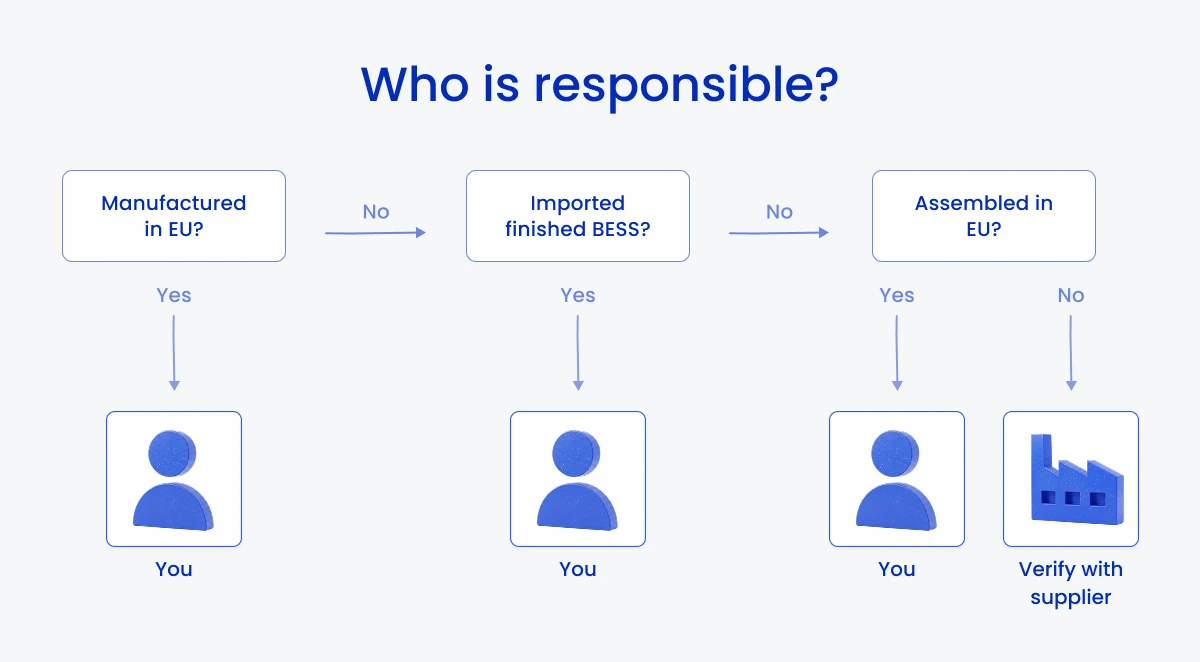
Who is responsible for the battery passport for a BESS?
The company that first places the finished battery on the EU market or puts it into service is responsible. In order, this is:
- The EU manufacturer, if the battery is placed on the market under its name or trademark.
- The importer, if a manufacturer outside the EU produced the battery.
- The EU integrator, if it assembles or substantially modifies components into a new finished battery.
- The operator putting it into service, if no other economic operator has created the passport, for example a company assembling a BESS for its own use.
If you buy a finished BESS that is already on the EU market, the manufacturer or importer is responsible. The buyer's task is to verify the passport and make sure the supplier transfers access to it.
How is a finished battery defined for a BESS battery passport? A battery system ready to perform its function without further assembly, typically with an integrated battery management system (BMS), thermal management, and safety features. A container or rack system ready for grid connection is a finished battery when its packs depend on a common BMS and only work together. It then needs one passport, and the 2 kWh threshold applies to the combined capacity. If the packs or racks are complete batteries that operate independently, each with its own BMS, each one is a separate battery with its own passport, and the threshold is assessed per unit. The European Commission’s FAQ states this must be assessed case by case. Loose modules or cells are components and do not need their own passport unless they are sold as finished products.
Four BESS scenarios: who creates the battery passport?
Scenario 1: Importing a finished container BESS
A Polish energy company orders a 2 MWh container BESS from a Chinese manufacturer. It arrives fully assembled and ready for commissioning.
Responsible: the Polish company is responsible for the battery passport as the importer, because the manufacturer is based outside the EU. It collects the required data from the manufacturer (composition, capacity, chemistry, manufacturing location), makes sure a unique identifier is assigned, makes the passport accessible through a compliant passport system, and makes sure the QR code is on the battery before placing it on the market.
Scenario 2: An EU integrator assembles modules into a BESS
A German integrator imports battery modules from South Korea. It assembles them into a rack-mounted BESS with a BMS, cooling, and safety systems. It then sells the finished system to a customer in the Netherlands.
Responsible: the German integrator is responsible for the battery passport. By creating a finished battery and placing it on the EU market, it becomes the responsible economic operator. It obtains component data from the module supplier, documents the assembly, assigns the identifier, creates the passport, and transfers access at handover.
Scenario 3: Buying a finished BESS for operation
A Spanish logistics company buys a finished BESS from an Italian manufacturer. The manufacturer had already placed the system on the EU market.
Responsible: the Italian manufacturer is responsible for the battery passport. The buyer verifies the passport exists and is accurate, receives the identifier and access at handover, and agrees who updates dynamic data such as state of health, charge cycles, and maintenance records.
Scenario 4: Repurposing EV batteries for stationary storage
A French company collects end-of-life EV battery packs, tests them, and integrates them into a stationary BESS for a microgrid.
Responsible: the company that repurposes the batteries is responsible for the battery passport. A repurposed battery placed on the market or put into service needs a new passport, linked to the passport of the original battery. The repurposer retrieves the original data where available, documents testing and reconfiguration, creates the new passport, and keeps traceability from the vehicle battery to the second-life system.
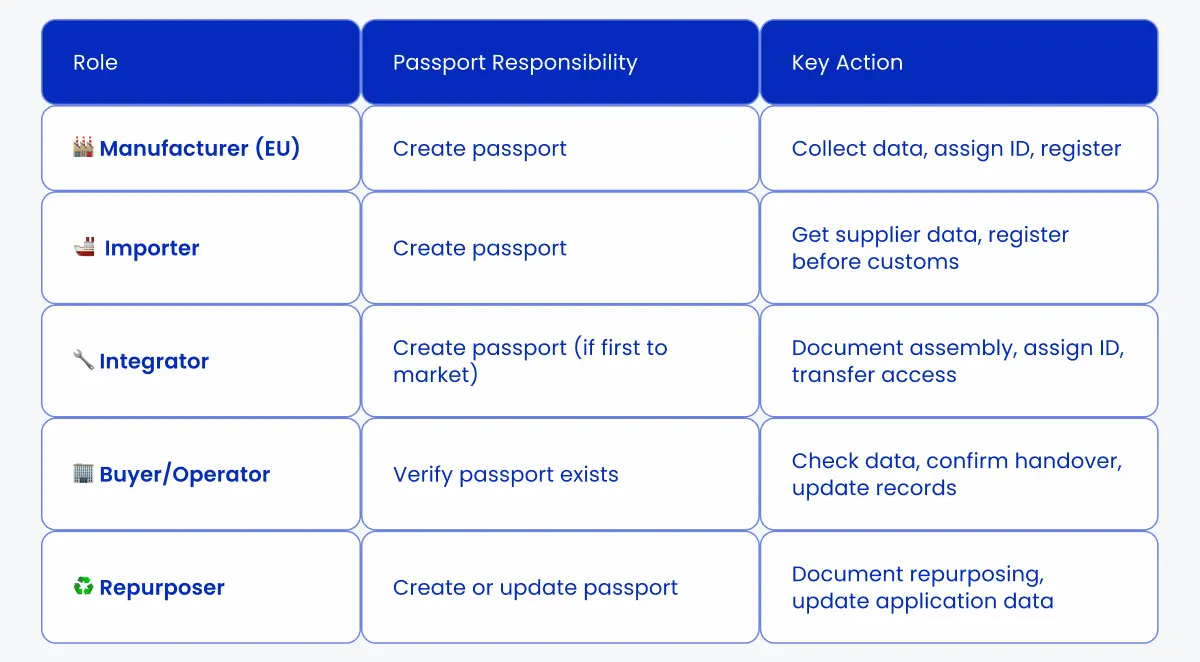
Can responsibility for the battery passport be delegated?
Yes, but only the operational work, not the legal accountability. You can mandate a service provider in writing to create, host, and manage the passport for you.
What can be delegated?
- Data collection and structuring
- Passport creation and registration
- QR code generation and affixing
- Data hosting and access management
- Updates and lifecycle data management
What cannot be delegated?
- Legal accountability for compliance
- Accuracy and completeness of data
- Timely passport creation before market placement or commissioning
- Making sure the passport meets all regulatory requirements
Written authorization is required
If you delegate passport creation or management, you must provide written authorization to the service provider.
This does not transfer responsibility. If the passport is incomplete, inaccurate, or missing, the economic operator is liable, not the provider.
What changes when a BESS is repaired or repurposed?
Repair does not trigger a new passport. Replacing a defective module, updating firmware, or routine maintenance does not create a new battery. The original passport stays valid; dynamic data such as state of health and maintenance history should be updated.
Repurposing triggers a new passport. When a battery from one application, such as an EV, is reconfigured for another, such as stationary storage, and placed on the market or put into service again, it needs a new passport linked to the original. Typical signs are a new intended use and substantial reconfiguration, such as a new BMS, housing, or safety systems.
Second-life projects often involve several actors: the vehicle manufacturer, the collector, the testing company, and the BESS integrator. Responsibility sits with whoever performs the final assembly and market placement, so contracts and data handover protocols need to make that explicit.
What should BESS buyers check at handover?
Verify the battery passport before commissioning. Do not assume it exists: not every supplier will be compliant on day one.
- Battery identifier: the supplier has assigned a unique battery identifier, and the buyer can access it.
- QR code: affixed to the battery and scannable.
- Passport access: The buyer receives credentials, API access, or a platform login to view the passport data.
- Data completeness: mandatory fields populated (model, capacity, chemistry, manufacturer, manufacturing date, and more).
- Dynamic data: agreed who updates state of health, charge cycles, and maintenance records.
- Written mandate: in place if a third party manages the passport.
- Interoperability: the passport works with your asset management or compliance systems.
What should BESS contracts say about the battery passport?
BESS purchase agreements should specify:
- Who creates the passport
- When the passport must be available (before delivery or before commissioning)
- What data it must include
- How the supplier transfers access to the buyer
- Who updates dynamic data during operation
- Remedies for non-compliance
Without these terms, buyers risk commissioning delays and disputes over responsibility.
Most BESS projects today do not yet include passport planning in procurement or commissioning. That will change quickly as February 2027 approaches. A passport is only as valuable as its data. Accurate, traceable data makes it usable for warranty claims, second-life valuation, financing, and recycling.
FAQ: battery passport for BESS
What is a battery passport?
A battery passport is a digital record of a battery's key data. It shows details such as the manufacturer, chemistry, capacity, carbon footprint, materials, and state of health. Each passport links to a unique battery identifier. A QR code on the battery gives access to the data. The EU Battery Regulation makes the passport mandatory from 18 February 2027.
When does the battery passport become mandatory for BESS?
On 18 February 2027, for industrial batteries above 2 kWh placed on the EU market or put into service from that date. The responsible economic operator must create the passport before placing the battery on the market or putting it into service, whichever comes first.
Do BESS installed before February 2027 need a battery passport?
No. The obligation applies to batteries placed on the market or put into service from 18 February 2027. The requirement does not apply retroactively to systems that were already on the market before that date.
Who is responsible if I import a finished BESS from outside the EU?
The importer is responsible for creating the battery passport. The passport must be in place before the importer places the battery on the EU market.
Do battery modules need their own passports?
Battery modules only require their own passport when a supplier sells them as finished products. Modules integrated into a BESS count as components, so the passport obligation applies to the finished battery system.
What data does a BESS battery passport contain?
It contains six groups of data: general information, material composition and chemistry, carbon footprint, recycled content, performance and durability, and end-of-life information. General information covers the manufacturer, model, and manufacturing date and place. Performance data includes capacity, expected lifetime, and state of health. Some data is public; some is only available to authorities or parties with a legitimate interest.
Who updates the battery passport during operation?
The company responsible for the passport keeps dynamic data, such as state of health and usage, up to date. It can also hire a provider to do this. Buyers should agree in the contract who does this.
Does repurposing an EV battery for BESS require a new battery passport?
Yes. A repurposed battery placed on the market or put into service needs a new passport, linked to the passport of the original battery.
What happens if I commission a BESS without a battery passport?
You risk non-compliance with Regulation (EU) 2023/1542. Each EU Member State sets its own penalties. A missing passport can also trigger market surveillance action and delay grid connection or financing.
Is the battery passport the same as the Digital Product Passport?
The battery passport is the first EU digital product passport to become mandatory. The EU built it to work with the wider Digital Product Passport (DPP). Under the Ecodesign for Sustainable Products Regulation (ESPR), the DPP will cover many more product groups.
Need help with battery passport compliance for your BESS?
Circunomics supports manufacturers, importers, integrators, and operators with battery passport creation for BESS, data collection, and compliance workflows. You may place a BESS on the EU market, assemble modules into finished systems, or repurpose batteries for second life. In each case, we help you clarify responsibility, structure the required data, and meet the 18 February 2027 deadline.
Contact Julian Kosgalwis to discuss your BESS battery passport requirements and next steps.