When does the digital product passport (DPP) become mandatory? For batteries, on February 18, 2027. According to the European Commission, certain batteries are the first product group for which a DPP becomes mandatory in the EU.
Other product groups follow later, one by one, under the Ecodesign for Sustainable Products Regulation (ESPR). Each gets a transition period of at least 18 months after its rules are adopted.
TL;DR
- What it is: A digital product passport is a digital record for a product, reached through a data carrier such as a QR code and linked to a unique identifier.
- Legal framework: The ESPR, Regulation (EU) 2024/1781, is the legal framework for DPPs. Product rules arrive through separate acts, one product group at a time.
- Batteries first: Batteries go first, under their own law. The EU Battery Regulation requires a Battery Passport from February 18, 2027 for electric vehicle (EV) batteries, light means of transport (LMT) batteries and industrial batteries above 2 kWh.
- Same system: The Battery Passport runs on the common DPP technical system, including the EU DPP registry, which went live on July 20, 2026. Its content, scope and date come from battery law.
- One passport: A battery needs one Battery Passport, not a second ESPR passport.
- Second life: The passport stays with the battery into its second life, and condition data still decides what the battery is worth.
One topic, a lot of questions
If you work on the Battery Passport, you've probably come across "DPP platforms" or "ESPR compliance" by now. And at some point, someone in management asks whether it's all the same thing or three separate projects.
Fair question. The terms get mixed up a lot, and it's easy to lose track of what applies to batteries. So, here's what a digital product passport is, how the Battery Passport fits in, and which dates matter.
The short answer: the Battery Passport is the same system under a different law. The detail matters, because it decides who in the company does the work and by when.
The difference in one sentence: the digital product passport is the EU-wide system, and the Battery Passport is the first passport that has to run on it. They share the infrastructure (registry, identifiers, QR code, standards). They differ in legal basis, scope, start date and content.
What is a digital product passport?
A digital product passport is a structured digital record about a product, its components or materials, available across the product's life. It is reached through a data carrier on the product, usually a QR code, and linked to a unique identifier.
The economic operator that places the product on the market is responsible for it. The data can be hosted by that operator or by a DPP service provider.
What goes into a DPP depends on the product group. The ESPR sets the framework and product-specific rules decide the content. For batteries, the Battery Regulation decides it. We went through the battery content in EU Battery Passport: 71 Data Points Explained.
When is the digital product passport mandatory? The timeline
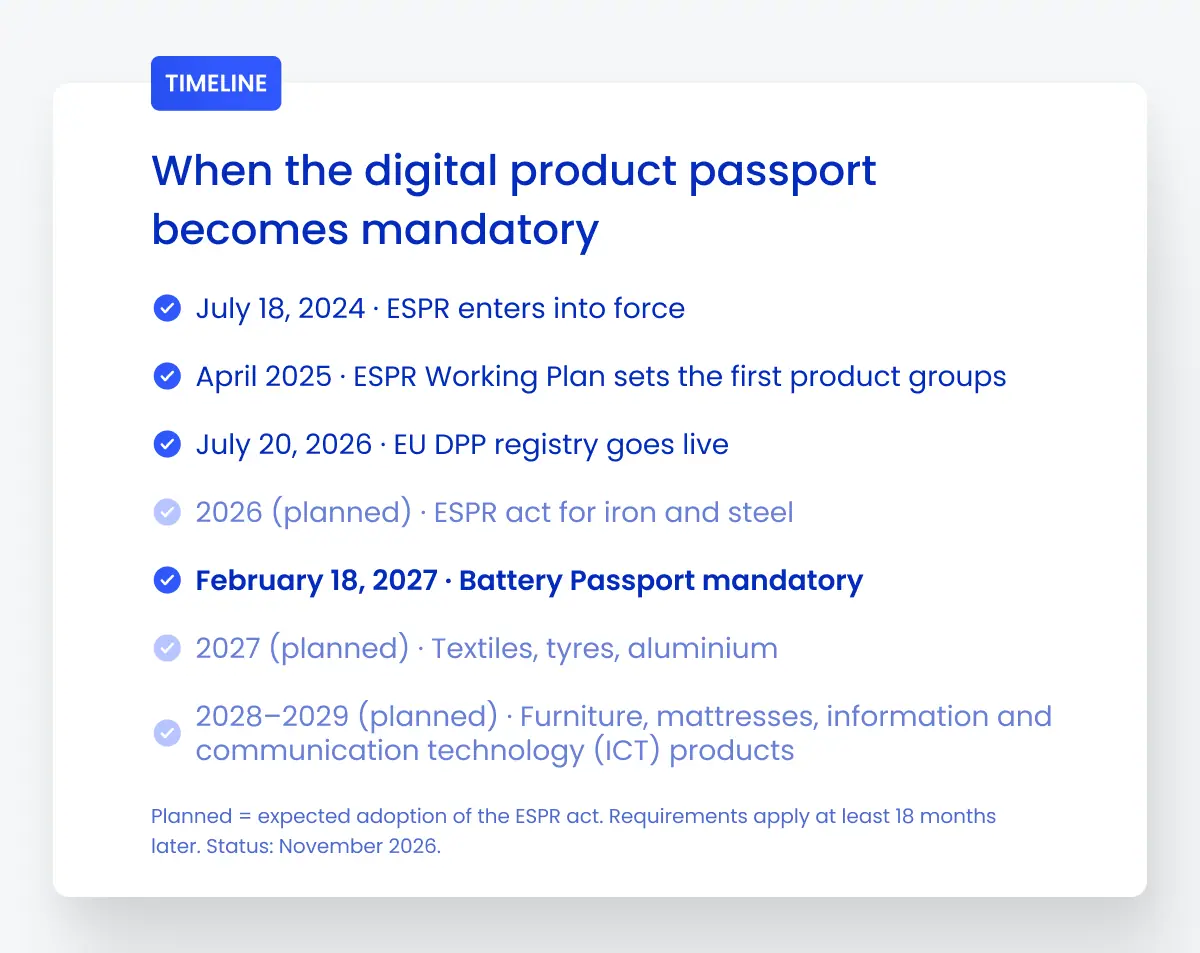
There is no single start date for the EU digital product passport. Each product group gets its own. The ESPR dates are planned adoption dates, not the dates companies must comply. Once an act is adopted, companies get at least 18 months before it applies.
Why do batteries come first?
Batteries have their own law. The Battery Regulation, Regulation (EU) 2023/1542, was adopted in 2023, a year before the ESPR, and wrote the passport duty and its date straight into Article 77. The other product groups are waiting for ESPR acts that are still being prepared.
The two laws are linked. Article 78 of the ESPR added a new Article 77(10) to the Battery Regulation, requiring the economic operator to upload the battery's unique identifier to the DPP registry. That makes batteries the first product group to go through that system.
Battery Passport vs digital product passport: what's the difference?
The Battery Passport is a digital product passport for batteries. It uses the same EU infrastructure, but battery law sets the rules.
So there is no second passport for the same battery. A company needs one Battery Passport per battery. If the company also makes other products, such as steel housings or enclosures, those may need ESPR passports later, under different rules.

The two rows that matter most in practice are level and data over time. A passport for every single battery, carrying use data, and for EV, LMT and stationary storage batteries a state of health that changes while the battery is in use, is harder to run than a record per product model. That is why the battery work starts in purchasing and data teams, not with the QR code.
Digital product passport requirements: what does a DPP need?
The details depend on the product. The building blocks are the same:
- A unique identifier for the product. For batteries, the passport is per individual battery.
- A data carrier on the product, usually a QR code, that leads to the passport.
- Registration of the identifiers in the EU DPP registry, set up by Implementing Regulation (EU) 2026/1778.
- Data that stays available and current over the product's life, hosted by the economic operator or a service provider.
- Access by role. Some data is public, some only for people with a legitimate interest, some only for authorities. For batteries, a draft implementing act from October 2026 proposes who sees what. We covered it in Battery Passport Data: Where It Sits, What Must Work by 2027.
- Common standards for identifiers, data carriers, data exchange and storage, so passports work across the EU. Implementing Decision (EU) 2026/1736 lists six: EN 18216, EN 18219, EN 18220, EN 18221, EN 18222 and EN 18223.
The hardest part is rarely the QR code. It is the data behind it, much of which sits with suppliers. We described where teams get stuck in Battery Passport Implementation: Why Teams Get Stuck.
What happens to a battery's passport when it changes hands?
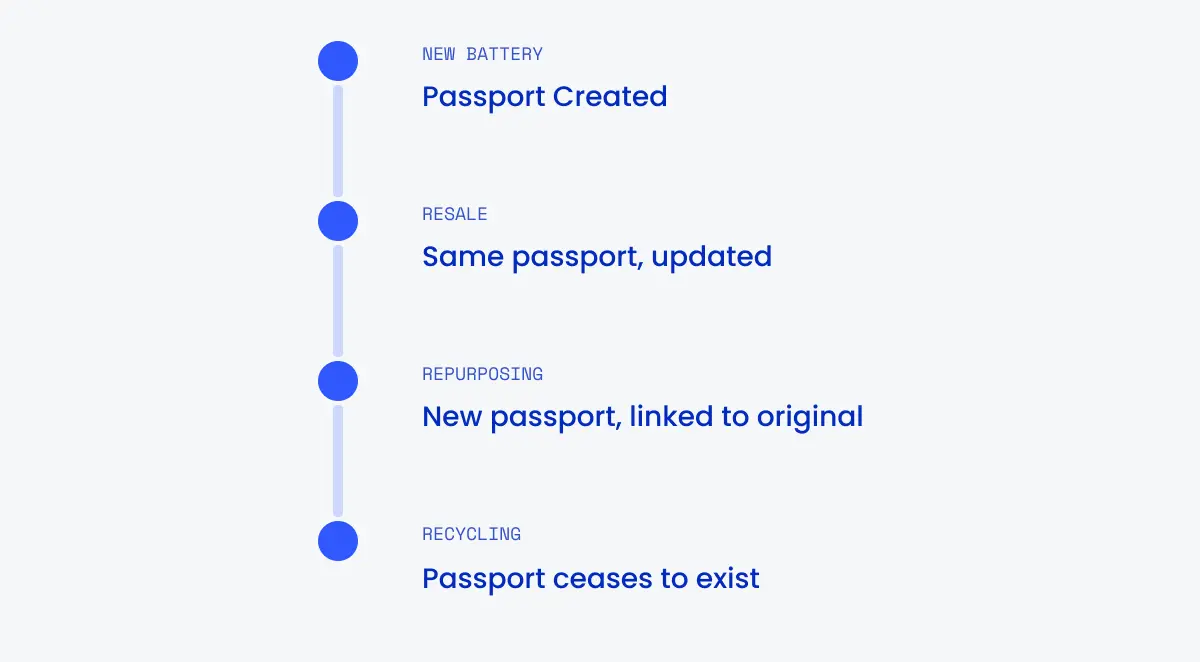
A passport is only useful if it still describes the battery in front of you. When a battery is resold, its existing passport is updated. When it is repurposed, for example an EV pack moving into stationary storage, it gets a new passport linked to the original, and the company placing it on the market again owes it. We covered who is responsible in each case in Battery Passport for BESS: Who Is Responsible in the EU?.
For a buyer, the passport is part of the evidence, not all of it. Condition data, such as SoH with method and date, still decides what a battery is worth. That is the daily work behind the Circunomics B2B Battery Marketplace, where batteries are assessed, traded and made regulatory-compliant across first and second life, and where we are building Battery Passport requirements into how batteries are documented and traded. How SoH values become comparable is covered in Battery State of Health (SoH): How to Check, Test & Price.
How to prepare for the digital product passport
- Battery manufacturers and importers should treat February 18, 2027 as fixed, name one passport owner and check supply contracts for which data suppliers deliver, in what format and by when.
- Companies that make batteries and other products can map which products fall under the Battery Regulation and which may later fall under ESPR acts, and build the identifier and data process once.
- BESS integrators and buyers should agree in writing which passport and condition data travels with each battery, and who updates it after the sale.
- IT and data teams can explore the EU DPP registry's testing environment, which needs its own EU Login account.
- Legal and procurement teams should start registry enrollment now. The EU DPP registry is already open for enrollment. Verified economic operator status requires a qualified electronic signature or an eIDAS high-assurance electronic identification, is checked by the Commission and expires after three years. That takes lead time before February 18, 2027.
FAQ
What is a digital product passport?
A digital product passport (DPP) is a digital record about a product, reached through a data carrier such as a QR code and linked to a unique identifier. It holds information on the product across its life, for example on composition, origin, repair or recycling. Product-specific rules decide what goes in it.
Is the digital product passport mandatory?
Yes, for products whose rules require it, once those rules apply. Batteries are the first: from February 18, 2027, EV, LMT and industrial batteries above 2 kWh placed on the EU market need a Battery Passport. Other products need a DPP only once an ESPR act for their product group applies.
When does the digital product passport become mandatory?
It depends on the product group. Batteries come first, on February 18, 2027. Other product groups follow under ESPR acts, each with a transition period of at least 18 months after adoption.
Is the Battery Passport a digital product passport?
Yes. It is a digital product passport for batteries, required by the Battery Regulation rather than the ESPR. It uses the same EU technical system, including the DPP registry, but its content, scope and February 18, 2027 start date come from battery law.
Do batteries need a Battery Passport and an ESPR passport?
No. The Battery Passport is the passport for batteries in scope. A company may need separate ESPR passports for other products it makes once the acts for those products apply. Those are separate products with separate rules.
Who is responsible for a digital product passport?
The economic operator that places the product on the EU market, usually the manufacturer or importer. It can host the passport data itself or use a DPP service provider. For a repurposed battery, the company that places it on the market again is responsible for the new passport.
What does a digital product passport require?
A unique identifier, a data carrier such as a QR code, registration of the identifier in the EU DPP registry, data that stays available and current over the product's life, access rules by role and common technical standards. The content itself is set per product group.
Which products are next after batteries?
The Commission's indicative timeline names iron and steel (2026), energy-related products (2026-2029), textiles, tires and aluminium (2027), furniture (2028), and mattresses and ICT products (2029). These are planned adoption dates, not application dates, and they can move; operators then get at least 18 months.
What is the EU DPP registry?
The EU database that stores at least the unique identifiers of products with a DPP. It went live on July 20, 2026, with a testing environment, and Implementing Regulation (EU) 2026/1778 sets out how it works. The passport data itself is hosted by companies or their service providers.
How should a company prepare for the digital product passport?
Find out which of your products fall under the Battery Regulation now and which may fall under ESPR acts later. Name one owner, check which data your suppliers deliver and in what format, and build the identifier and data process once so it can serve both.
What happens to a Battery Passport in second life?
A resold battery keeps its passport, which is updated. A repurposed battery gets a new passport linked to the original, owed by the company that places it on the market again. After recycling, the passport ceases to exist.
Is this legal advice?
No. This post gives the regulatory status as of November 2026. Check EUR-Lex and the Commission's DPP and Battery Passport pages before you act.
Not sure where your Battery Passport data sits?
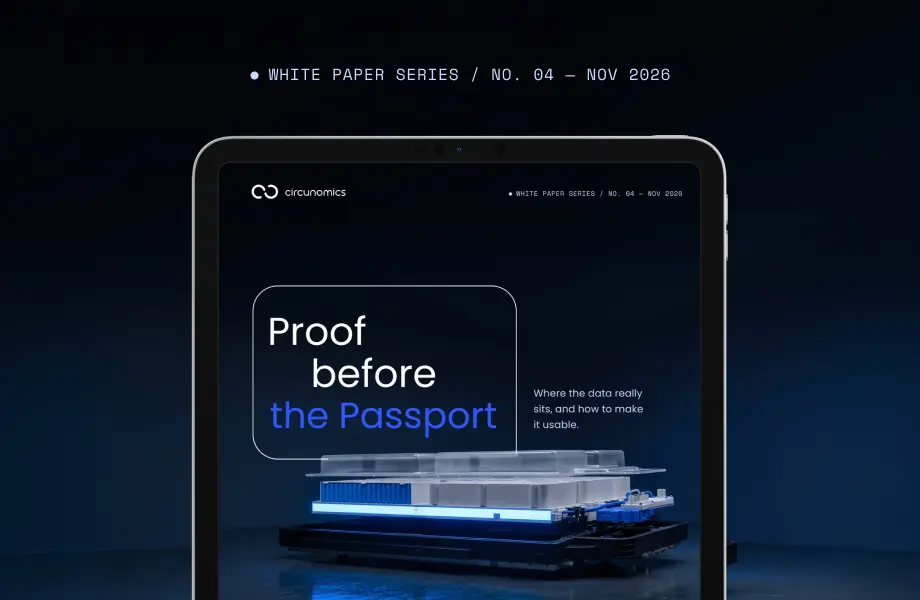
Our white paper Proof Before the Passport, written with our technology partner Spherity, maps where passport data sits, what has to work on day one and how to test it before February 18, 2027.
Julian Kosgalwis leads our Battery Passport work with battery manufacturers. Book 20 minutes with him, or download the paper.
This post is general information, not legal advice. Regulatory status as of November 2026.