Sometimes it’s purchasing, sometimes the head of engineering. Sometimes it’s the CEO, who tells him, “We need help with this.” When Julian Kosgalwis asks a company who’s in charge of its Battery Passport, he rarely hears the same answer twice.
When that answer is unclear, the project usually hasn’t really started yet. Most of the companies Julian speaks with know the passport becomes mandatory on February 18, 2027. Fewer have decided who owns Battery Passport implementation, where the data will come from, or what needs to happen between now and then.
Julian leads our Digital Battery Passport work at Circunomics, so he’s on these calls a lot. We asked him what slows teams down, and what you can do this week if your plan still fits on a single slide.
TL;DR
- The Battery Passport becomes mandatory on February 18, 2027 under Regulation (EU) 2023/1542 for electric vehicle (EV) batteries, light means of transport (LMT) batteries and industrial batteries above 2 kWh.
- Julian sees teams stall for five reasons: nobody owns the project, the data is missing or sits with suppliers, internal systems don’t connect, there’s no realistic plan to the deadline, and the build-or-buy question stays open.
- Most teams are at one of five readiness stages, from “nothing structured yet” to “passports live”. The right next step depends on the stage, not on company size.
- Some rules, such as who may read restricted passport data, are still being finalized by the European Commission. That is a reason to start with the parts that are settled, not a reason to wait.
- The fastest first move: answer the seven questions further down with the people who should own the answers.
What is a Battery Passport?
A Battery Passport is a digital record for an individual battery, opened by scanning the QR code on the battery. It holds data on the battery’s identity, materials, performance and durability, with carbon footprint and sourcing data following later.
The company that places the battery on the EU market creates and maintains it under Article 77 of Regulation (EU) 2023/1542.
From February 18, 2027, every battery placed on the EU market needs a QR code, but only EV, LMT and industrial batteries above 2 kWh need a full passport behind it. The QR code is the access point, and the passport is the data set it links to.
A typical first call
Julian hears a version of the same story in many of his first calls with battery manufacturers. The team knows the passport is coming and has put one person in one department in charge of it. So far, nothing has happened.
Naming someone is a good first step. But the passport touches more than one team. Engineering has the battery data, purchasing deals with the suppliers who hold the rest, and someone has to sign off on the budget. One person in quality or purchasing rarely has the reach to get all of them moving.
Julian sees this starting point more than any other, so that’s where we began the interview and worked forward from there.
Where are most companies with Battery Passport implementation?
Q: Julian, when you talk to original equipment manufacturers (OEMs) and pack suppliers today, how far along are they?
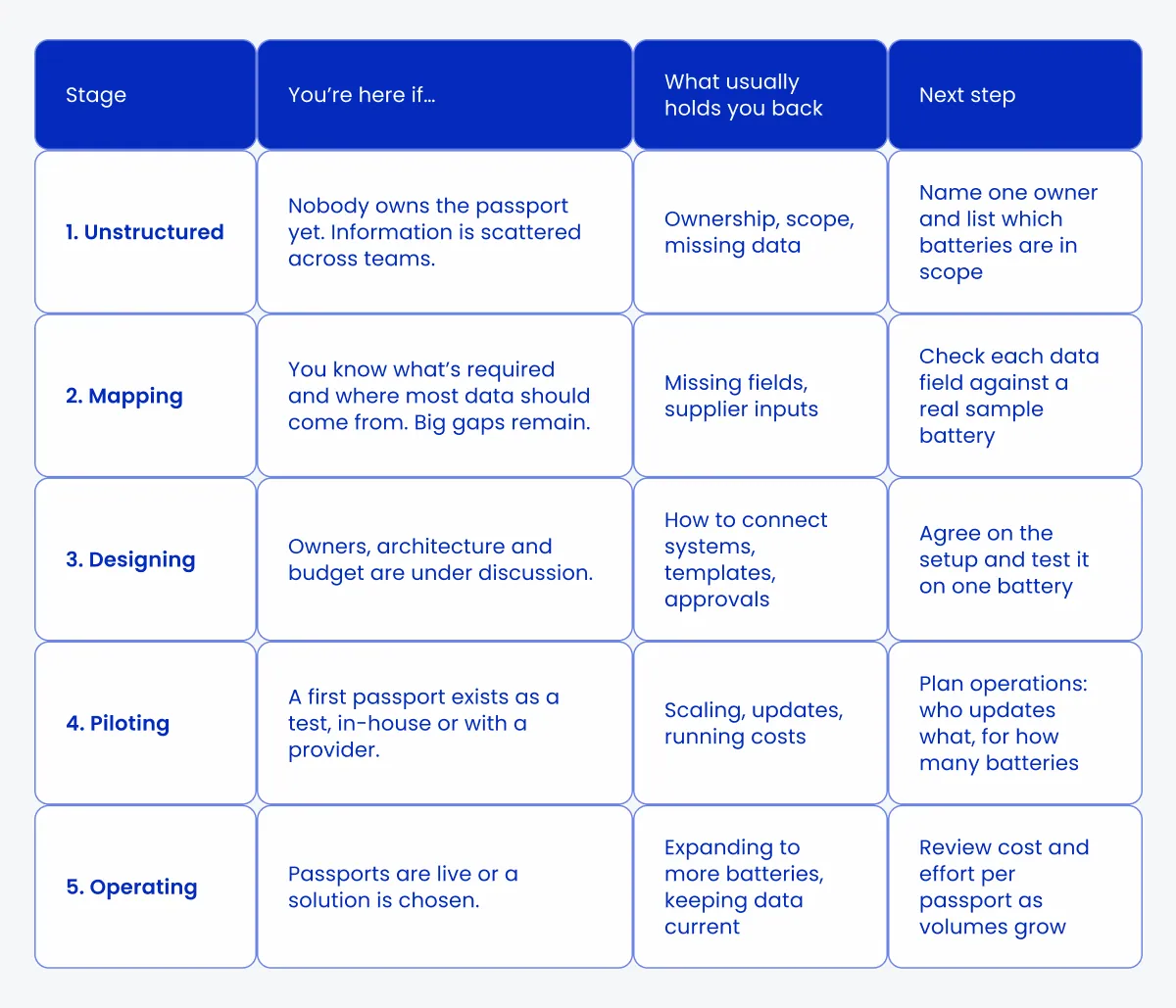
Most of the companies I talk to are at one of two points. Either nobody has clear ownership yet, and the information sits with different teams, or they’ve gone through the requirements, know roughly where each piece of data should come from, and are now finding the gaps. Those gaps are usually in what their suppliers can deliver. Fewer companies are already talking about system setup and budget, and only a few have a test passport running.
Q: Is there a way to tell where you stand?
We use five stages. They’re not a grade. A team at stage 1 can move quickly if the right people are in the room, and a team at stage 4 can still be stuck. The stage tells you what the next problem is.
Problem 1: Who owns the Battery Passport inside the company?
Q: You mentioned ownership earlier. Why is it the first thing to sort out?
Because everything else waits for it. Until someone owns the passport, nobody decides which batteries are in scope, nobody follows up with suppliers for data, and nobody asks for a budget. And the person who ends up with it is often whoever the regulation was forwarded to. They may not have the authority to make any of those calls.
Q: What should a team do about it?
Name one person who is accountable, even if they don’t hold the data themselves. That person then pulls in the others: the technical owner for the battery management system (BMS) and systems, purchasing for supplier data, and someone who controls budget and deadlines. Without that, every meeting starts from zero.
Our article on Battery Passports for trucks, buses and off-road machines explains who carries legal responsibility and how to split roles inside an OEM.
Problem 2: Where does Battery Passport data come from?
Q: Once someone owns it, what comes next?
The data. The European Commission’s guidance lists 71 data points and marks each one as mandatory, conditional, optional or not yet required for each battery category. When teams go through that list, they find fields nobody has, fields that exist in three versions, and fields that only the cell or pack supplier can provide.
Q: Why are suppliers such a big part of this?
Because the passport is yours, but a lot of the information isn’t. If you finish the battery and put it on the EU market, you answer for the passport. The materials, the chemistry and many of the manufacturing details still come from your cell or pack supplier. If the contract doesn’t say who sends which data, in what format and by when, you usually find out it’s missing when you need it.
Q: What helps?
Pick one real battery and try to fill in every required field for it. The empty ones are your gaps, and most of the time you’ll see straight away which supplier or team you need to ask. That tells you more than a list of requirements that nobody has tested against an actual product.
Our explainer on the 71 data points goes through the fields one by one. Carbon footprint, responsible sourcing and recycled content data are not required at the February 2027 start.
Problem 3: Why don’t ERP, PLM and BMS systems connect to the passport?
Q: Most OEMs already run enterprise resource planning (ERP) and product lifecycle management (PLM) systems. Isn’t the data already there?
Partly. Product data sits in PLM, order and serial number data in ERP, live battery data in the BMS, and service history somewhere in aftersales. Each system was built for its own job. None of them was built to produce a passport.
Q: So, what’s the risk?
Manual work. You can create a handful of passports by copying data by hand. It doesn’t scale, and every update means doing it again. Once you issue passports for many batteries and variants, you need templates and interfaces that pull the data automatically and check it before it goes live.
Problem 4: Is there a realistic plan to February 2027?
Q: What do you see when teams look at the calendar?
A lot of them know the date but haven’t worked backward from it. Who signs off on the setup? When does procurement need to approve? Which team has time in December? If those questions don’t have answers, the deadline stays abstract until it’s close.
Q: What makes a plan credible?
A sponsor with a budget, a named project owner and milestones you can check. And something tangible early on. When people see a working passport for one of their own batteries, the discussion changes. Before that, it’s slides.
Problem 5: Should we build the Battery Passport ourselves or buy a solution?
Q: Many larger companies consider building it in-house. When does that make sense?
If you have the IT capacity, the data is well organized and you’re ready to run and update passports for the full life of your batteries, building can work. What teams often underestimate is the part after go-live: updates, access for different parties, new battery variants, changes in the rules. That’s ongoing work, not a one-off project.
Q: And when is an external solution the better fit?
When the gap is in structure and integration rather than in the data itself. Or when the internal team has other priorities before February. A fair comparison is what it costs to set up, what it costs per passport over the years, and how fast you get a validated passport live.
What’s still open in the Battery Passport rules?
Q: Is it risky to start while the Commission is still publishing guidance?
Some parts aren’t final. The rules on who may access restricted passport data were due by August 18, 2026. The Commission published a draft for feedback in October, but it hasn’t been adopted yet. The start date, the battery categories and the data guidance are already there, though. You can map your data, settle ownership and prepare your systems now. Waiting for every detail means starting too late.
Q: Could the deadline still move?
I wouldn’t plan on it. The proposals currently being discussed to simplify EU product rules don’t move the February 18, 2027 start date for the passport.
How to prepare team for the Battery Passport this month
Q: If a reader has 30 minutes this week, what should they do?
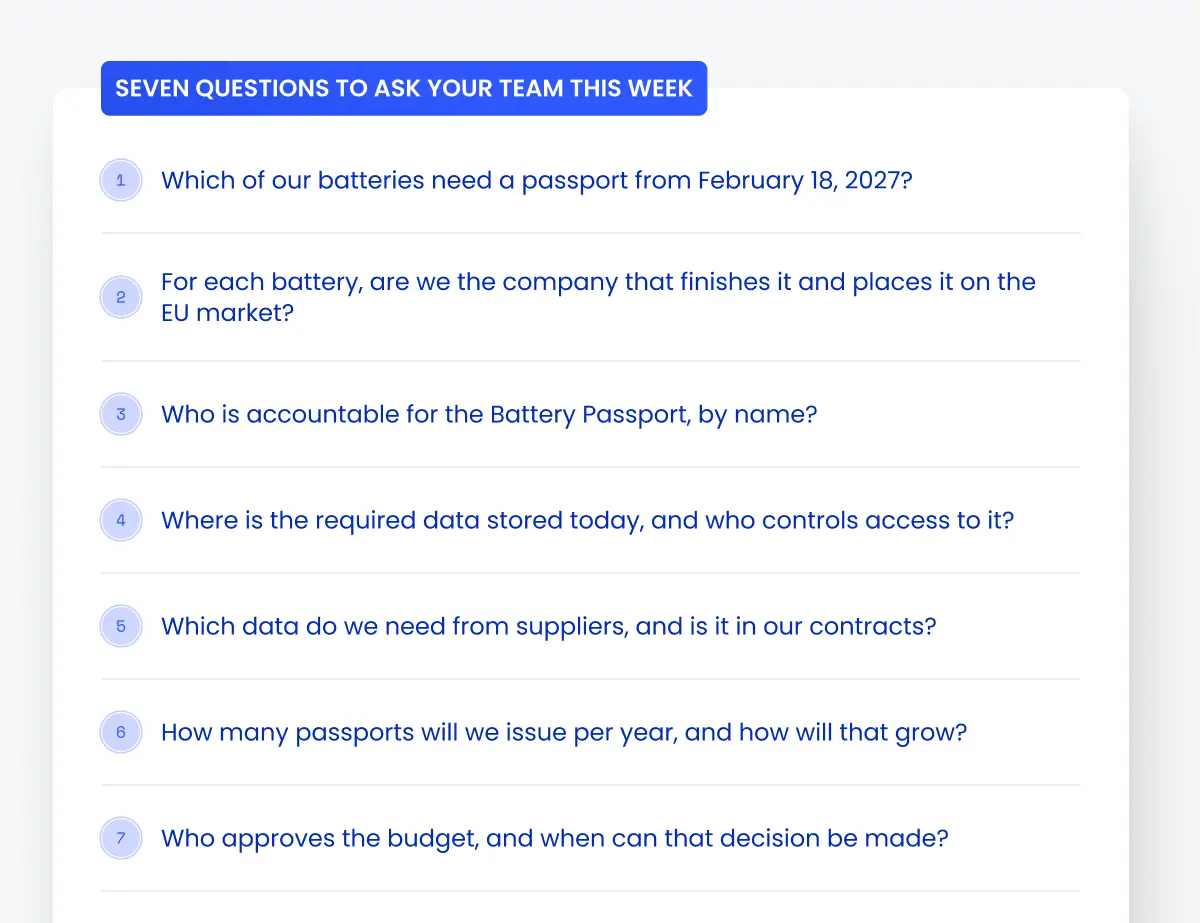
Answer seven questions with the people who should be involved. If you can’t answer them, you know where to start.
How Circunomics helps at each stage
Circunomics is the B2B Battery Marketplace where batteries are assessed, traded and made regulatory-compliant across first-life and second-life. Alongside the marketplace, we help battery manufacturers set up and run their Battery Passport, in steps that match where they’re starting from.
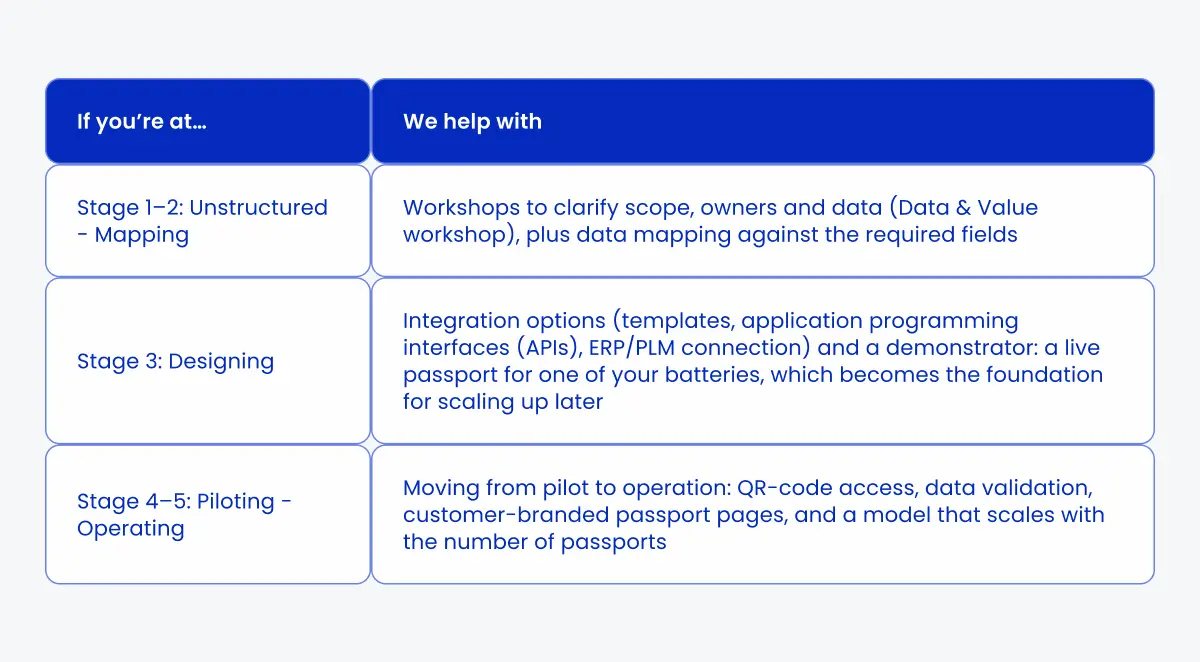
Our job is to get a team from where it is to a validated passport, without rebuilding what already works.
While the Battery Passport is primarily driven by regulatory requirements, I believe its long-term value goes well beyond compliance. It has the potential to become an important enabler of circularity by improving transparency, traceability, and data accessibility throughout a battery's lifecycle. This can support better decisions around maintenance, repair, reuse, repurposing, and ultimately recycling.
Interestingly, some of the customers I speak with already recognize this potential. Beyond the mandatory data points defined by regulation, we are discussing which additional information could be valuable to integrate from the start to unlock future circular business opportunities.
This becomes particularly relevant when a battery reaches the end of its first life. For example, when a pack is sold for second-life use, buyers need reliable information about its identity and condition, including State of Health (SoH), the testing method, and the date of assessment. On the Circunomics B2B Battery Marketplace, listings already provide specifications, SoH, inspection results, and photos, demonstrating how access to relevant battery data can support more transparent and informed transactions.
FAQ: EU Battery Passport implementation
What is a Battery Passport?
A Battery Passport is a digital record for an individual battery, accessed through a QR code on the battery. It holds data on identity, materials, performance and durability, and later carbon footprint and sourcing. It is required under Article 77 of Regulation (EU) 2023/1542.
What does “Battery Passport readiness” mean?
It describes how far a company is from issuing valid passports for its batteries. It covers ownership, data, systems, a plan to the deadline and a decision on how to run the passport. Circunomics uses five stages, from “unstructured” to “operating”, to identify the next step for each team.
When does the Battery Passport become mandatory?
From February 18, 2027, under Regulation (EU) 2023/1542. It applies to EV batteries, LMT batteries and industrial batteries above 2 kWh that are placed on the EU market or put into service from that date. Batteries placed on the market earlier do not need a passport retroactively.
Which batteries need a Battery Passport?
EV batteries, LMT batteries (such as e-bike and e-scooter batteries) and industrial batteries above 2 kWh. All other batteries placed on the EU market from February 18, 2027 still need a QR code, but it links to information such as the label details and the declaration of conformity instead of a full passport.
Who is responsible for the Battery Passport?
The economic operator that places the battery on the EU market. According to the European Commission’s FAQ, that is the company completing the finished, working battery, for traction batteries usually where the BMS is fitted. For batteries made outside the EU, it is normally the importer. Suppliers provide data but don’t hold the passport.
Who should own the Battery Passport inside a company?
There is no fixed department. Depending on the company, Julian sees it with quality, engineering, purchasing or the managing director. What matters is that one person is accountable and pulls in the technical owner, purchasing for supplier data, and whoever controls budget and deadlines.
Do we need all 71 data points on day one?
No. The European Commission’s guidance marks each data point as mandatory, conditional, optional or not yet required, depending on the battery category. Carbon footprint, responsible sourcing and recycled content data are not required at the February 2027 start. Check the column for your battery category.
Who can see the data in a Battery Passport?
It depends on the data. Some is public to anyone who scans the QR code, some is open only to people with a legitimate interest (such as repairers, second-life operators and recyclers), and some only to authorities and notified bodies. The Commission is still finalizing the detailed access rules.
Can we build the Battery Passport in-house?
Yes, if you have the IT capacity, organized data and the resources to run and update passports over the battery’s lifetime. Compare setup effort, cost per passport over several years and time to a validated passport against an external solution before deciding.
Can a provider create the passport for us?
Yes, under a written authorization. A provider can collect and structure the data, create and host the passport. Legal responsibility stays with the company that places the battery on the EU market, including responsibility for accurate data.
Do second-life batteries need a new Battery Passport?
Yes, if the battery is repurposed or remanufactured. It gets a new passport linked to the original one, and the company placing the second-life battery on the market becomes responsible for it. A simple repair doesn’t require a new passport.
Should we wait until all rules are final?
No. The start date, battery categories and data guidance are published. Some details, such as the access rights to restricted data, are still being finalized. Teams can settle ownership, map data and prepare systems now and adjust details later.
What is a Battery Passport demonstrator?
A live passport for one selected battery, built with the customer’s own data. It shows which data is available, how the passport looks and what still needs work, so internal stakeholders can review something concrete before the full rollout.
Not sure which stage your team is at?
Julian Kosgalwis works with commercial vehicle, off-road and other battery manufacturers on their Battery Passport setup. Tell him where you stand, and he’ll help you work out the next step.
Contact Julian Kosgalwis.
Our Battery Passport white paper with a step-by-step playbook is coming soon.
This article reflects the EU Battery Regulation and Commission guidance as published by October 2026. It is not legal advice.