The new EU Battery Regulation (EU) 2023/1542 classifies electric truck and bus batteries as EV batteries. Excavator, wheel loader and forklift batteries count as industrial batteries. If you build both, you’ll need two kinds of Battery Passport.
The Battery Passport (also called the digital battery passport or EU battery passport) becomes mandatory on February 18, 2027. For truck and bus traction batteries it applies regardless of capacity. For off-road machinery it applies to industrial batteries above 2 kWh.
Below we cover which category your batteries fall into, who creates the passport, and where the data has to come from.
TL;DR
- From February 18, 2027, the EU Battery Regulation requires a Battery Passport for batteries that reach the EU market or go into service.
- Buses (M2, M3), trucks (N2, N3), vans (N1) and trailers with traction batteries (O) use EV batteries. Every traction pack in these vehicles needs a passport, whatever its capacity.
- Excavators, wheel loaders, forklifts and other off-road machinery use industrial batteries. They need a passport above 2 kWh, with a different set of mandatory data. A manufacturer with both product lines therefore deals with two data sets.
- The passport belongs to the company that completes the battery and places it on the EU market. That can be the pack supplier, the vehicle original equipment manufacturer (OEM) or the importer. A finished battery normally includes the BMS.
- Non-EU manufacturers can’t register the passport in place of their EU entity or importer.
- Packs placed on the market before February 18, 2027 need no passport. A pack remanufactured or repurposed later needs a new passport linked to the old one, while a repair doesn’t trigger one.
What is a Battery Passport?
A Battery Passport is a digital record for an individual battery, required by Article 77 of the EU Battery Regulation. A QR code on the battery links to the passport. The passport holds data on the battery model, manufacturer, chemistry, materials, performance and durability. Carbon footprint, responsible sourcing and recycled content follow as their later deadlines apply.
Some fields are public. Others are open only to people with a legitimate interest, such as repairers, remanufacturers and recyclers, or to authorities.
From February 18, 2027 the passport applies to EV batteries, light means of transport (LMT) batteries and industrial batteries above 2 kWh. As the EU’s first mandatory product passport, the Battery Passport serves as the digital product passport (DPP) for batteries and sets the model for the DPPs planned for other product groups. Example: a bus pack and a loader pack from the same supplier
Take a hypothetical example. A mid-size European manufacturer builds a 12-meter electric city bus and an electric wheel loader. Both use lithium-ion cells from the same supplier in Asia. An EU pack supplier assembles them into packs with BMS and housing.
From February 18, 2027, the bus pack and the loader pack each need a Battery Passport. The bus pack is an EV battery and the loader pack is an industrial battery, so the mandatory data is different. Whether the OEM or the pack supplier creates the passport depends on who finishes each battery.
Quality, purchasing and engineering each hold part of the answer. Without a clear owner, the passport can fall between them.
Are truck, bus and off-road machine batteries EV or industrial batteries?
Traction batteries in trucks, buses, vans and trailers are EV batteries, and traction batteries in off-road machinery are industrial batteries. The Battery Regulation classifies batteries by their intended use, regardless of who buys them.
An electric vehicle battery is a battery “specifically designed to provide electric power for traction in hybrid or electric vehicles of categories M, N or O” (Article 3(1)(14)). Buses, trucks, vans and trailers fall under those categories. Hybrid traction packs count as well.
The Regulation defines an industrial battery as one designed for industrial use. The definition also covers “any other battery that weighs more than 5 kg” that isn’t an EV, light means of transport (LMT) or starting, lighting and ignition (SLI) battery (Article 3(1)(13)). Recital 15 of the Regulation names traction batteries in “off-road machinery” as industrial batteries.
12 V and 24 V starter batteries in trucks and buses are SLI batteries. They don’t need a Battery Passport.
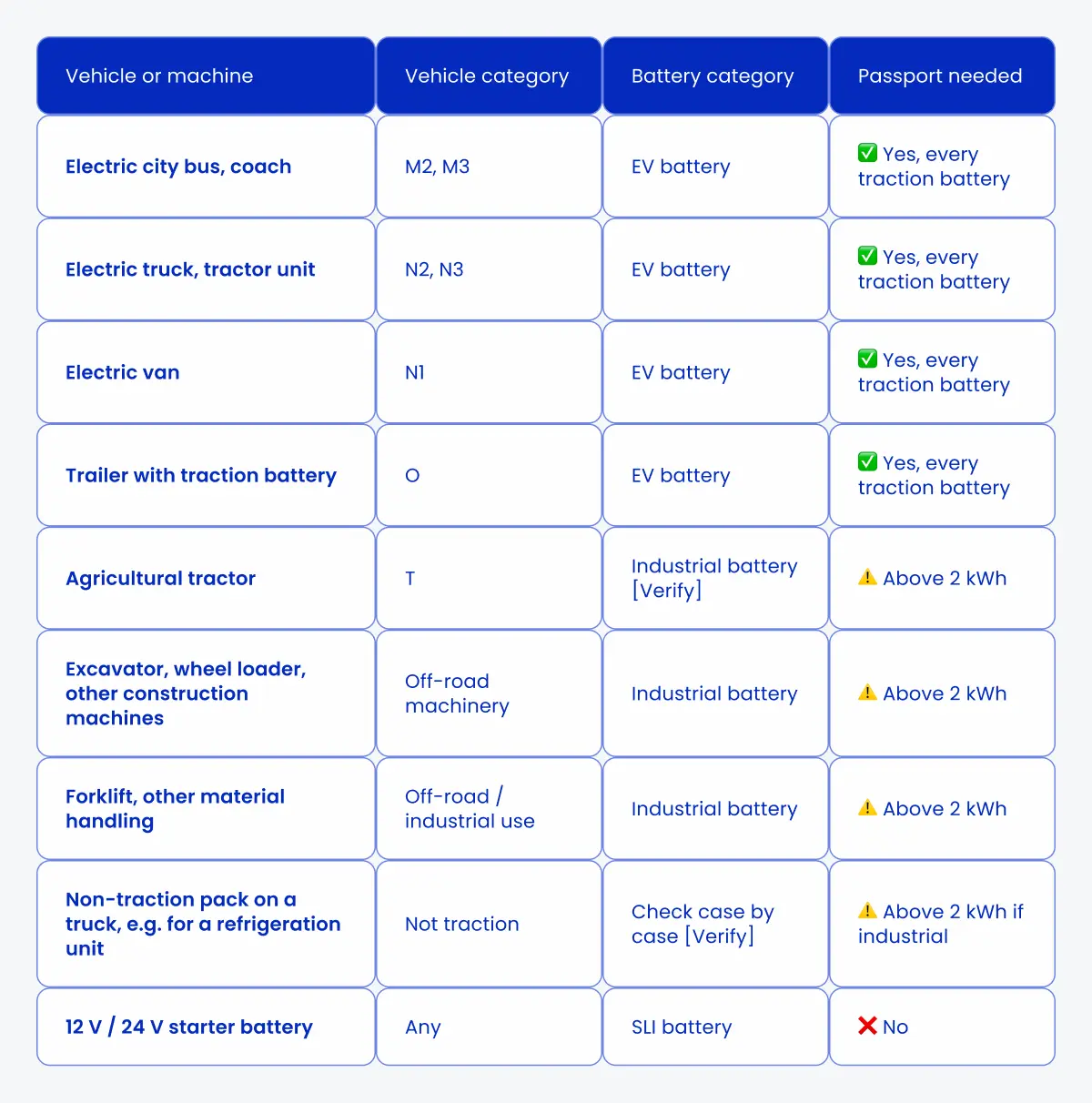
One OEM can fall under both regimes. A company that builds trucks and construction machinery needs EV battery passports for the trucks and industrial battery passports for the machines.
Who creates the Battery Passport: OEM, pack supplier or importer?
The economic operator that places the finished battery on the EU market or puts it into service creates the Battery Passport. In vehicles, that depends on who completes the battery.
The European Commission’s FAQ on the Digital Product Passport for batteries (1st edition, September 2026) covers three cases:
- The pack arrives finished and the OEM installs it. The battery manufacturer is responsible for the passport.
- The OEM completes the battery itself, for example by integrating modules with its own BMS and housing. The OEM becomes the battery manufacturer and creates the passport. The FAQ notes that a finished traction battery “would normally include the BMS”.
- An importer brings the vehicle into the EU with the finished battery already installed. The importer is responsible for the battery’s passport.
Non-EU manufacturers can’t register the passport in place of the EU operator. The FAQ says “the economic operator that places the battery on the EU market” has to do the registration. This matters for Chinese truck and bus makers entering Europe, since their EU entity or importer carries the obligation.
A service provider can do the operational work under a written authorization. The legal responsibility stays with the economic operator.
We covered the same logic for stationary storage in Battery Passport for BESS: Who Is Responsible in the EU?

Who owns the Battery Passport inside the OEM?
Inside an OEM, the Battery Passport needs one named, accountable owner, because the data and the risk spread across several teams. In conversations with commercial vehicle OEMs, we see the passport assigned to quality, regulatory affairs, purchasing, engineering, and at smaller companies the managing director.
Projects stall when four groups each assume another one owns the passport:
- The regulatory owner (compliance, homologation, quality) knows the obligation.
- The technical owner (battery systems, BMS, PLM/IT) knows where the data sits.
- Purchasing controls what pack and cell suppliers must deliver.
- A sponsor, often a managing director or VP, decides budget and deadlines.
Before choosing a tool, name one accountable owner. Before choosing a tool, name one accountable owner. Then define who supplies each data field and who keeps the passport current over the battery’s life.
What data does a truck or bus Battery Passport need, and where does it come from?
The Commission’s guidance on data points by category (version 2.0, August 15, 2026) lists 71 data points. For each battery category, it marks each one as mandatory, conditional, optional or not yet required. EV batteries and industrial batteries have different mandatory sets, and many industrial data points are conditional.
The guidance also says operators don’t need to fill in carbon footprint, responsible sourcing and recycled content data when the passport starts in February 2027. They follow with later deadlines and acts. Our 71 data points explainer goes through the fields.
For a truck or bus OEM, this data rarely comes from one system:

If your pack supplier delivers a finished battery, the supplier creates the passport. You still need access to it, because your customers and service teams will ask. If you complete the battery yourself, you depend on your suppliers’ data. Questions to settle in the supply contract:
- Who creates and registers the passport, and by what date before delivery?
- Which data fields does the supplier deliver, in what format (file, API), and how is quality checked?
- Who updates the passport after delivery, and who has access?
- How are part numbers and spare part sources documented for aftersales?
- What happens to the passport when someone remanufactures or repurposes a pack?
EU Battery Rules 2027: What Suppliers Must Know Now covers the supplier side.
Do replacement, remanufactured and repurposed packs need a Battery Passport?
A replacement pack first placed on the EU market after February 18, 2027 needs a Battery Passport, and so do remanufactured and repurposed packs, while a repair does not. The obligation applies to batteries placed on the market or put into service from February 18, 2027. Buses and trucks already on the road with their original packs don’t need a passport after the fact.
Replacement packs are different. A spare pack first placed on the EU market after the deadline falls under the obligation like any other new battery. Fleet operators should take this into account when they budget for mid-life pack replacement in buses or trucks.
The Commission’s FAQ separates three cases:
- Repair (for example, replacing a faulty module) doesn’t require a new passport.
- Remanufacturing means restoring the battery to at least 90% of its original rated capacity for the same use. It requires a new passport, linked to the previous one.
- Repurposing for a different use, such as a bus pack moving into stationary storage, also requires a new passport linked to the old one.
The FAQ also says that a battery needs a passport if someone remanufactures it after February 18, 2027, even if it reached the market before that date.
How does a Battery Passport help when you sell used truck and bus packs?
A Battery Passport gives a used pack a verifiable identity, which makes it easier to assess and price when it changes hands for a second life. It records what a battery is, where its materials come from and who made it.
Commercial vehicle packs are large and costly, and many leave their first vehicle with years of useful capacity left. When a fleet sells used packs, or an OEM sells surplus first-life stock, buyers want condition evidence: a battery SoH (State of Health) value with a test method and date, plus a clear identity for the battery. A passport combined with verified condition data gives them both and makes the pack easier to assess and price.
On the Circunomics B2B Battery Marketplace, listings show technical specifications, State of Health, inspection results and photos. Buyers can browse them without registering. Our State of Health guide explains how a battery health check works and how SoH affects price.
Battery Passport checklist: what to do before February 2027
Truck and bus OEMs
- List every battery type you will place on the EU market from February 18, 2027, and classify each one.
- For each type, decide whether you or the pack supplier completes the battery.
- Name one accountable owner and map the data owners behind each field.
- Add passport clauses to pack and cell supply contracts.
Pack suppliers
- Check which of your customers expect you to create the passport and which expect data delivery only.
- Prepare data for both EV and industrial customers if you supply both.
Non-EU OEMs entering the EU
- Clarify which EU entity places the battery on the market. That entity registers the passport.
- Plan supplier data collection before the first EU delivery.
Off-road machinery manufacturers
- Confirm that your traction packs are industrial batteries and check the 2 kWh threshold.
- Use the industrial column of the Commission guidance instead of the EV one.
Fleet operators
- Ask your OEM for passport access with each new vehicle delivered after February 18, 2027.
- Factor passports into replacement pack purchases and into any plans to sell or repurpose used packs.
FAQ: Battery Passport for trucks, buses and off-road machinery
What is a Battery Passport?
A Battery Passport is a digital record for an individual battery, required by Article 77 of the EU Battery Regulation (EU) 2023/1542. A QR code on the battery links to the passport, which holds data on the model, manufacturer, chemistry, materials, performance and durability. Anyone can see some of the data, while only people with a legitimate interest and authorities can see the rest.
When does the Battery Passport become mandatory?
On February 18, 2027, under Article 77 of the EU Battery Regulation. From that date, every EV battery, LMT battery and industrial battery above 2 kWh placed on the EU market or put into service needs a Battery Passport.
Do electric trucks and buses need a Battery Passport?
Yes. Traction batteries in buses (M2, M3), trucks (N2, N3), vans (N1) and trailers (O) are EV batteries under Regulation (EU) 2023/1542. Every EV battery placed on the EU market from February 18, 2027 needs a passport, with no minimum capacity. The 2 kWh threshold only applies to industrial batteries.
Are construction machine batteries EV batteries or industrial batteries?
Industrial batteries. The EV battery definition covers vehicle categories M, N and O, plus L-category vehicles with batteries over 25 kg. Traction batteries in off-road machinery, such as electric excavators and wheel loaders, are industrial batteries. They need a Battery Passport when their capacity exceeds 2 kWh.
Do forklift batteries need a Battery Passport?
Yes, if their capacity is above 2 kWh. The Regulation classifies forklift and other material-handling traction batteries as industrial batteries, and the passport obligation covers every chemistry, including lead-acid packs.
Do agricultural tractors fall under the EV or industrial rules?
Agricultural tractors are category T, which is not part of the EV battery definition. A tractor traction battery above 5 kg is therefore an industrial battery and needs a passport above 2 kWh.
Do 12 V and 24 V starter batteries in trucks need a Battery Passport?
No. Starter batteries are starting, lighting and ignition (SLI) batteries, which are outside the Battery Passport obligation.
Who creates the passport if a supplier delivers the finished battery?
The battery manufacturer. If a pack arrives as a finished battery and the vehicle OEM only installs it, the pack supplier is responsible, according to the Commission’s FAQ. If the OEM completes the battery, for example by adding its own BMS, the OEM becomes responsible.
Who is responsible for the Battery Passport of imported trucks and buses?
The importer, for the battery in the vehicle. A manufacturer outside the EU can do practical work under a written authorization. The economic operator that places the battery on the EU market must still register the passport.
What data does a truck or bus Battery Passport contain?
The Commission’s guidance lists 71 data points and marks each as mandatory, conditional, optional or not yet required per battery category. For EV batteries this covers identification, manufacturer, chemistry and materials, performance and durability, and spare part information. Operators don’t need to provide carbon footprint, responsible sourcing and recycled content data when the passport starts in February 2027.
Do vehicles delivered before February 2027 need a passport?
No. The obligation applies to batteries placed on the market or put into service from February 18, 2027. A pack from that earlier period needs a new passport if someone remanufactures or repurposes it afterwards.
Does a module swap trigger a new passport?
No. A repair, such as replacing a faulty module, does not require a new passport, according to the Commission’s FAQ. Remanufacturing (restoring at least 90% of rated capacity for the same use) and repurposing for a new use do, and the operator must link the new passport to the previous one.
Can a supplier or service provider create the passport for us?
Yes, under a written authorization. The provider can collect and structure the data, create the passport and host it. The economic operator that places the battery on the EU market keeps the legal responsibility, including for accurate data.
Planning the Battery Passport for trucks, buses or machines?
We help commercial vehicle and off-road OEMs work out which batteries are in scope, who owns the passport and where the data sits. Then we help them get a live passport.
Contact Julian Kosgalwis to compare where your team stands.
This article explains the regulation and Commission guidance as published by October 2026. It is not legal advice.