A Battery Passport is only as good as the data behind it, and for many companies a good part of that data sits with suppliers and partners. From February 18, 2027, every electric vehicle (EV) battery, light means of transport (LMT) battery and industrial battery above 2 kWh placed on the EU market needs a Digital Battery Passport under the EU Battery Regulation.
Our new white paper, Proof Before the Passport, written with contributions from our technology partner Spherity, shows where Battery Passport data sits, what has to work on day one, and how to test it before the deadline.
TL;DR
- Deadline: The Battery Passport is mandatory from February 18, 2027 for EV, LMT and industrial batteries above 2 kWh placed on the EU market. Nothing adopted or proposed in Brussels so far moves that date.
- Data: The company that owes the passport often depends on suppliers and partners for much of the data in it. Article 39 obliges suppliers of battery cells and modules to provide information, but sets no format and no deadline.
- Access: A draft implementing act from October 19, 2026 would set who may see which passport data. It would split access by role and limit what readers may do with the data.
- Trust: A genuine, unchanged record can still describe the wrong battery. The white paper keeps four checks apart: origin, integrity, accuracy and relevance.
- Second life: A resold battery keeps its passport. A repurposed battery gets a new one, linked to the original.
- Tools: The white paper adds a data map, a roadmap on a real calendar, 20 readiness questions and a handover checklist. Download it for free.
What is a Battery Passport?
A Battery Passport is a digital record for a single battery, required by Article 77 of the EU Battery Regulation (Regulation (EU) 2023/1542). It is reached through a QR code on the battery and linked to a unique identifier.
It holds information on the battery model and on that individual battery, such as composition, performance and durability, State of Health (SoH) over its life and, once those rules apply, carbon footprint and recycled content. Some of that data is public. Some is only for people with a legitimate interest, and some only for notified bodies, market surveillance authorities and the Commission.
The duty sits with the economic operator that places the battery on the EU market. From February 18, 2027 it covers:
- EV batteries
- LMT batteries, such as those in e-bikes and e-scooters
- Industrial batteries with a capacity above 2 kWh, including batteries in stationary storage
A battery changes hands
A 60 kWh pack from a delivery van is being assessed for stationary storage after four years of service. Its passport shows rated and current capacity, cycle count and a service history, with one module replacement two years ago that the record only calls "repair".
The record is genuine. Nobody has changed it. And the receiving team still can't tell whether the capacity values describe the pack as it is today. That gap between a passport that opens and a passport that answers is what the white paper is about.
Why is Battery Passport data the hard part?
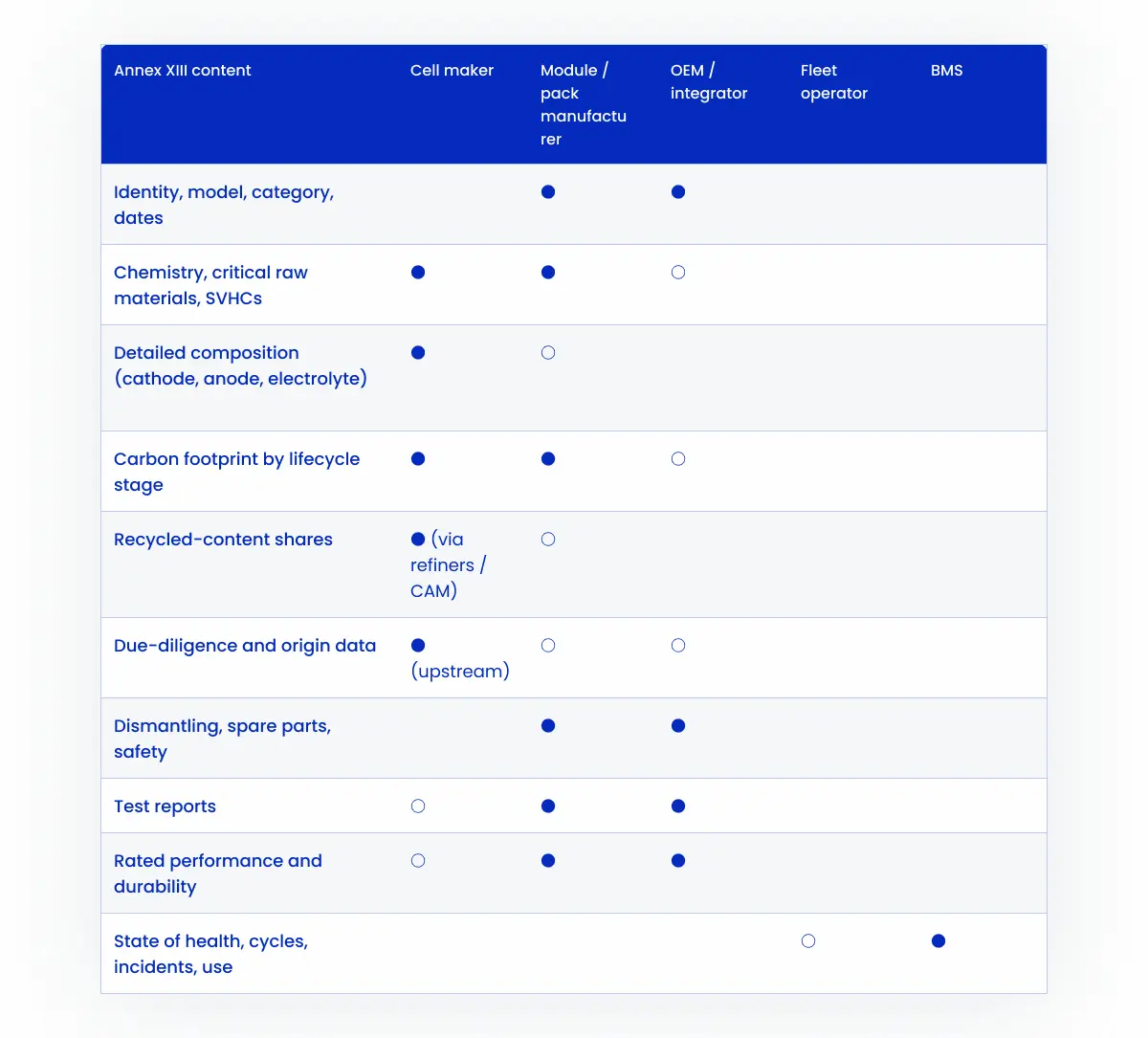
A passport draws on information from the cell maker, the pack manufacturer, the original equipment manufacturer (OEM) or integrator, the fleet operator and the battery management system (BMS). Detailed composition, carbon footprint and recycled content sit two or three steps upstream. State of Health (SoH) lives in the BMS and changes every day.
Article 39 of the Battery Regulation obliges suppliers of battery cells and modules to provide the necessary information free of charge, but it sets no format or deadline. Data from further upstream isn’t covered at all. In practice, the supply contract often decides what you get and when.
That makes Battery Passport requirements a purchasing question as much as an IT one. We covered the internal side, who owns the passport and why teams stall, in Battery Passport Implementation: Why Teams Get Stuck, and the full list of data points in EU Battery Passport: 71 Data Points Explained.
Who can access Battery Passport data? The draft act of October 19, 2026
Under the draft, access to Battery Passport data depends on your role: recyclers and repairers would get composition and dismantling data, the purchaser, or anyone acting on the purchaser's behalf, would get performance and SoH data, and safety information can be shared without restriction.
Until October, it was an open question who counts as having a "legitimate interest" in passport data. The European Commission's draft implementing act of October 19, 2026 now gives a first answer, and it splits access by role.
- Repairers, remanufacturers, repurposers, recyclers and waste treatment operators would get composition and dismantling information.
- The purchaser, and anyone acting on the purchaser's behalf, would get the individual performance and use data, including SoH.
- Safety information would carry no restriction. It may be shared and published, and treatment facilities for end-of-life vehicles and electronic waste could use it too.
The draft also sets limits on what readers may do with the data once they have it, including what they may use it for, how long they may keep it and whether they may pass it on. An access model that only handles who can read what may need another look.
One point is worth watching for anyone trading batteries. As drafted, a prospective buyer would only see SoH in the record if the seller shares it. Circunomics submitted feedback before the consultation closed on November 16, 2026, but the act is still a draft, and the white paper explains how to build your access model now so the final text becomes a configuration change.
Can you trust what a Battery Passport record says?
It depends on the question you ask. The white paper keeps four checks apart (origin, integrity, accuracy and relevance), because different people are responsible for them.

Spherity's contribution to the paper covers the first two, meaning how any reader can confirm who issued a passport and that its data hasn't been altered, without an account or a prior relationship. Circunomics covers the other two, which is the work we do every day when batteries are assessed and traded on our marketplace. How SoH values become comparable is covered in Battery State of Health (SoH): How to Check, Test & Price.
What happens to the Battery Passport when a battery is sold, repurposed or recycled?
A resale updates the existing record. A battery that is repurposed, for example an EV pack moved into stationary storage, gets a new passport linked to the original, and the company placing it on the market owes it. After recycling, the passport ceases to exist. For a battery energy storage system (BESS), we walked through who is responsible in each case in Battery Passport for BESS: Who Is Responsible in the EU?.
Before any battery deal, agree in writing which first-life data travels with the asset, who has checked it, and who owns the update duty afterwards. The white paper's appendix turns that into a checklist.
What's in the full white paper?
The post covers the main arguments. The paper gives you the tools to work with.
- A data map showing which part of the value chain usually holds each group of passport data, so you know who to ask
- A roadmap on a real calendar, from now to February 2027 and through the 2027 and 2028 follow-up dates
- 20 readiness questions and a test set your team can work through in one meeting
- A handover checklist for any battery transaction
- Spherity's perspective on making each part of the passport verifiable, and a section on how the two views meet
How to prepare for the Battery Passport this week
- Compliance: list every battery product, mark it in or out of scope, and write down why.
- Purchasing: check your 2027 supply contracts for which passport data your suppliers deliver, in what format and by when.
- Engineering and data: pick one battery and write down where each day-one data point comes from. Leave the gaps visible.
- IT and security: read the draft access act and check whether your access model covers purpose and retention, not only read rights.
- Management: name one person who owns the passport.
FAQ: Battery Passport data and the white paper
What is a Battery Passport?
A Battery Passport is a digital record for an individual battery, required by Article 77 of the EU Battery Regulation. It is accessed through a QR code on the battery and holds data such as composition, carbon footprint, recycled content, performance and State of Health. Access to each part of the data depends on who is asking.
When is the Battery Passport mandatory?
From February 18, 2027. Every EV battery, LMT battery and industrial battery above 2 kWh placed on the EU market from that date needs one.
Which batteries need a Battery Passport?
EV batteries, LMT batteries (for example e-bikes and e-scooters) and industrial batteries with a capacity above 2 kWh, which includes most batteries in stationary storage and BESS. Portable batteries and starter batteries are not covered by the passport duty.
Who is responsible for the Battery Passport?
The economic operator that places the battery on the EU market, usually the manufacturer or importer. For a repurposed or remanufactured battery, it is the company that places it on the market again. That company often depends on suppliers for much of the data, which is why supply contracts matter.
Does a battery placed on the market before February 18, 2027 need a passport?
The duty applies to batteries placed on the market from February 18, 2027. A battery that is repurposed or remanufactured after that date counts as placed on the market again and needs a new passport, linked to the original if one exists.
Who can see the data in a Battery Passport?
Some data is public, some is for persons with a legitimate interest, and some is only for notified bodies, market surveillance authorities and the European Commission. The draft implementing act of October 19, 2026 proposes access by role: recyclers and repairers get composition and dismantling data, purchasers and anyone acting on their behalf get performance and SoH data, and safety information can be shared without restriction. The act is still a draft.
Does the draft access act change the February 18, 2027 deadline?
No. The draft act only defines who may access which passport data and how they may use it. The obligation to have a passport for batteries placed on the EU market from February 18, 2027 is unchanged.
What's the difference between a verified and a usable passport record?
A verified record proves who issued the information and that nobody changed it. A usable record also has accurate values that describe this battery in its current state. A passport can be verified and still not support a decision, for example after an undocumented repair.
What happens to a Battery Passport in second life?
If a battery is only resold, the existing passport is updated. If it is repurposed, for example from an EV into stationary storage, it gets a new passport linked to the original. After recycling, the passport ceases to exist.
Who wrote the white paper?
Proof Before the Passport is No. 04 in the Circunomics White Paper Series, developed by our Marketing, Business Development, Product and Management teams. Spherity, our technology partner for battery passports, contributed a partner perspective, a technical section and an overview of its passport technology.
Is the white paper free?
Yes. You can download it free on our website after filling in a short form. We'll send the PDF to your inbox.
Who is the white paper for?
Compliance, engineering, data, purchasing and IT teams at battery manufacturers and OEMs, plus BESS developers, integrators and anyone who buys, sells or repurposes batteries in the EU.
Is this legal advice?
No. The white paper gives the regulatory status as of October 2026 and this post as of November 2026, with sources. Check the current status on EUR-Lex and the Commission's Battery Passport FAQ before you act.
Not sure where your Battery Passport data sits?
Julian Kosgalwis leads our Battery Passport work with commercial vehicle, off-road and industrial battery manufacturers. Book 20 minutes and bring the one data point your team is still chasing.
Contact Julian Kosgalwis · Download the White Paper
This post is general information, not legal advice. Regulatory status as of November 2026.